このページ:ユーザーインターフェイスでリレーショナルスキーマを手動で作成する方法、属性を追加する方法、スキーマをリンクする方法、オーケストレーションキャンペーンのデータセットを作成して有効にする方法について説明します。
リレーショナルスキーマは、ユーザーインターフェイスを通じて直接作成できるので、属性、プライマリキー、バージョン管理フィールド、関係の詳細な設定が可能になります。
次の例では、ロイヤルティメンバーシップスキーマを手動で定義して、調整されたキャンペーンに必要な構造を示します。
-
Adobe Experience Platform インターフェイスを使用して、リレーショナルスキーマを手動で作成します。
-
顧客 ID、メンバーシップレベル、ステータスフィールドなどの属性を追加します。
-
キャンペーンターゲティング用に、受信者などのビルトインスキーマにスキーマをリンクします。
-
スキーマに基づいてデータセットを作成し、調整されたキャンペーンで使用できるようにします。
-
サポートされているソースからデータセットにデータを取り込みます。
➡️ 手動リレーショナルスキーマについて詳しくは、Adobe Experience Platform ドキュメントを参照してください。
スキーマの作成 schema
まず、Adobe Experience Platform で新しいリレーショナルスキーマを手動で作成します。 このプロセスにより、名前や動作など、スキーマ構造をゼロから定義できます。
-
Adobe Experience Platform にログインします。
-
データ管理/スキーマメニューに移動します。
-
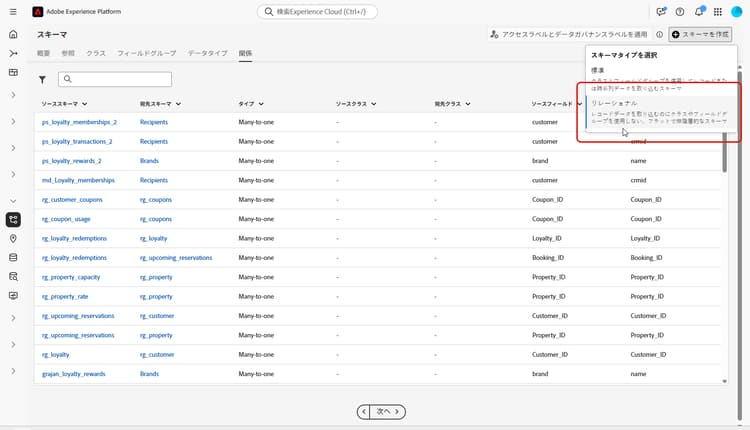
「スキーマを作成」をクリックします。
-
スキーマタイプとして「リレーショナル」を選択します。
-
「手動で作成」を選択して、手動でフィールドを追加してスキーマを作成します。
-
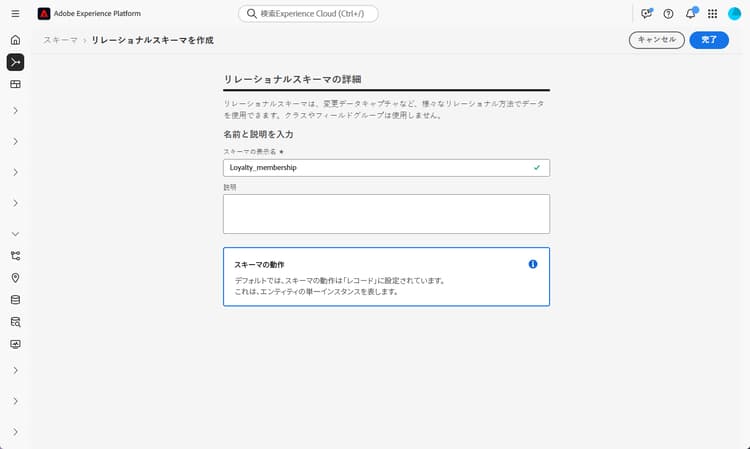
スキーマ表示名を入力します。
-
「終了」をクリックして、スキーマの作成に進みます。
これで、スキーマへの属性の追加を開始して、その構造を定義できるようになりました。
スキーマへの属性の追加 schema-attributes
次に、属性を追加してスキーマの構造を定義します。 これらのフィールドは、顧客 ID、メンバーシップの詳細、アクティビティの日付など、オーケストレーションキャンペーンで使用される主なデータポイントを表します。 これらを正確に定義すると、信頼できるパーソナライズ機能、セグメント化およびトラッキングが確保されます。
ターゲティングに使用するスキーマには、関連付けられた ID 名前空間を持つタイプ String の ID フィールドを 1 つ以上含める必要があります。 これにより、Adobe Journey Optimizer のターゲティングおよび ID解決機能との互換性が確保されます。
-
ENUM
ENUM フィールドは、DDL ベースと手動スキーマ作成の両方でサポートされているので、許可される値の固定セットを使用して属性を定義できます。 -
データガバナンスのスキーマラベル
アクセス制御や使用制限などのデータガバナンスポリシーの適用に、スキーマフィールドレベルでラベル付けがサポートされています。 詳しくは、Adobe Experience Platform ドキュメントを参照してください。 -
複合キー
複数のフィールドにまたがる複合プライマリキーは、リレーショナルスキーマ定義でサポートされるので、複数のフィールドと共に使用してレコードを一意に識別できます。
-
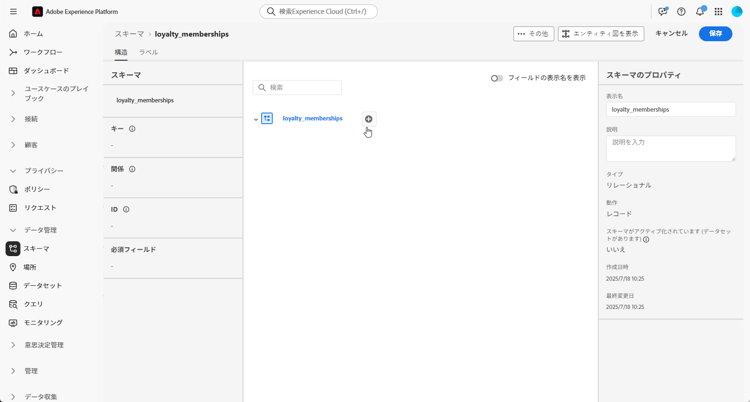
キャンバスで、スキーマ名の横にある

-
属性のフィールド名、表示名、タイプを入力します。
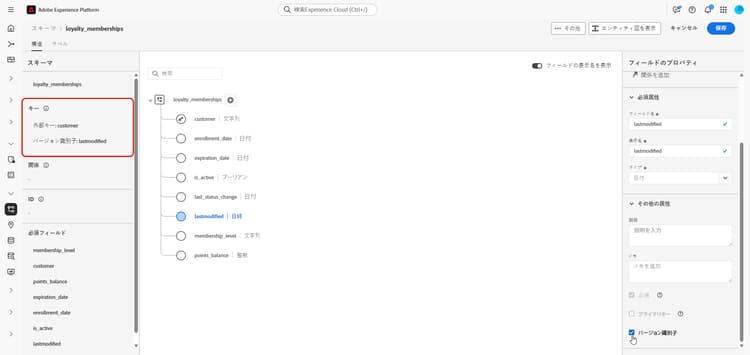
この例では、次の表に示す属性を ロイヤルティメンバーシップ スキーマに追加しました。
accordion 属性の例 table 0-row-3 1-row-3 2-row-3 3-row-3 4-row-3 5-row-3 6-row-3 7-row-3 8-row-3 属性名 データタイプ その他の属性 顧客 文字列 プライマリキー membership_level 文字列 必須 points_balance 整数 必須 enrollment_date 日付 必須 last_status_change 日付 必須 expiration_date 日付 - is_active BOOLEAN 必須 lastModified 日時 必須 -
適切なフィールドを プライマリキー および バージョン記述子 として割り当てます。
手動のスキーマを作成する場合は、次の必須フィールドが含まれていることを確認します。
- 1 つ以上のプライマリキー
- バージョン識別子(
datetimeタイプまたはnumberタイプの「lastmodified」フィールドなど)。 - 変更データキャプチャ(CDC)取り込みの場合、タイプ
Stringの_change_request_typeという特別な列。これは、データ変更のタイプ(挿入、更新、削除など)を示し、増分処理を可能にします。_change_request_typeをテーブルスキーマの一部にすることはできません。取り込み時にデータファイルにのみ追加する必要があります。
-
「保存」をクリックします。
属性を作成して保存した後、関係を定義することで、スキーマを他のリレーショナルスキーマとリンクできます。
➡️ リレーショナルスキーマについて詳しくは、Adobe Experience Platform ドキュメントを参照してください。
スキーマをリンク link-schema
2 つのスキーマ間に関係を作成すると、プライマリプロファイルスキーマ以外のデータを使用してオーケストレーションキャンペーンを強化できます。
-
新しく作成したスキーマから、リンクとして使用する属性を選択し、「関係を追加」をクリックします。
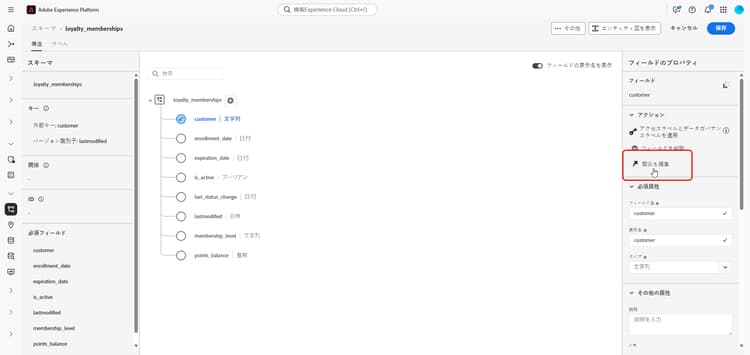
-
参照スキーマと 参照フィールド を選択して、関係を確立します。
この例では、
customer属性がrecipientsスキーマにリンクされています。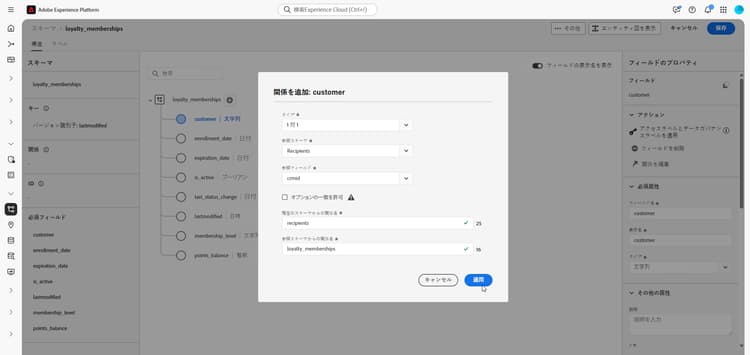
-
現在のスキーマからの関係名と参照スキーマからの関係名を入力します。
-
設定したら、「適用」をクリックします。
スキーマ用データセットの作成 dataset
スキーマを定義したら、それに基づいてデータセットを作成できるようになります。 データセットには、取り込んだデータが格納されます。オーケストレーションキャンペーンにアクセスするには、データセットを有効にする必要があります。
-
データ管理/データセットメニューに移動し、「データセットを作成」をクリックします。
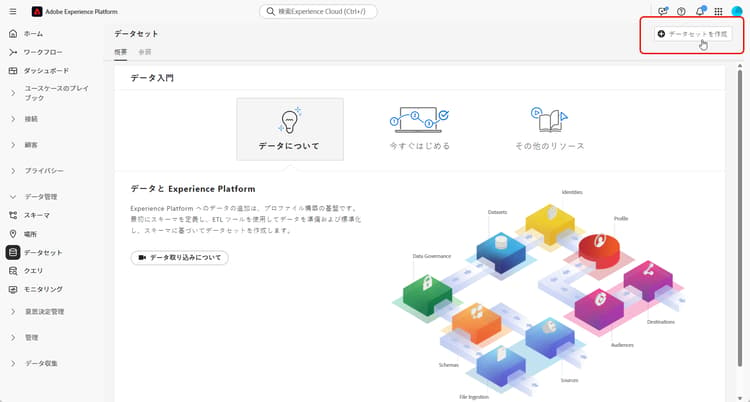
-
「スキーマからデータセットを作成」をクリックします。
-
以前に作成したスキーマ(ここでは「ロイヤルティメンバーシップ」)を選択し、「次へ」をクリックします。
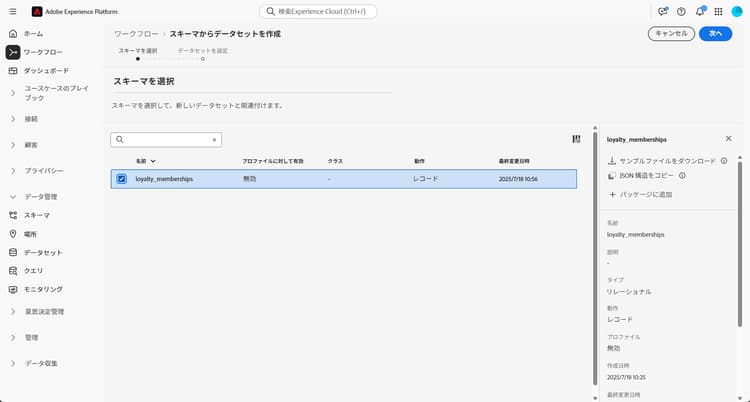
-
データセットに 名前 を入力して、「終了」をクリックします。
次に、オーケストレーションキャンペーン用のデータセットを有効にする必要があります。
オーケストレーションキャンペーンのデータセットを有効にする enable
データセットを作成したら、オーケストレーションキャンペーン用に明示的に有効にする必要があります。 この手順により、データセットを Adobe Journey Optimizer 内でリアルタイムのオーケストレーションとパーソナライズ機能に使用できるようになります。
データセットでオーケストレーションキャンペーン拡張機能を検証または有効にする方法について詳しくは、Adobe 開発者用ドキュメントを参照してください。
-
データセットリストでデータセットを見つけます。
-
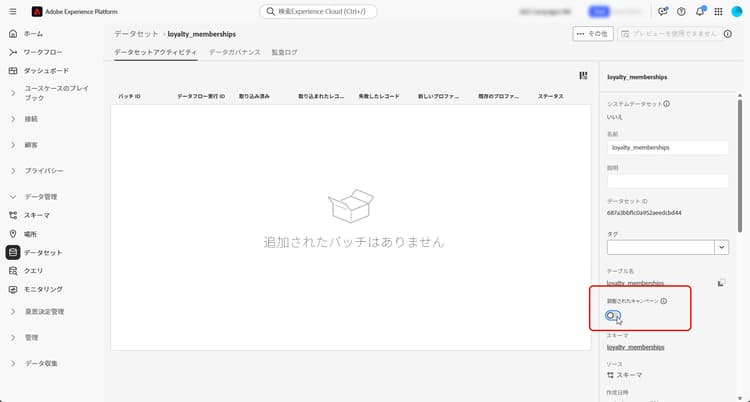
データセット設定から「オーケストレーションキャンペーン」オプションを有効にして、データセットをオーケストレーションキャンペーンで使用できるようにします。
-
有効化プロセスが完了するまで数分間待機します。 この設定が完全にアクティブ化された場合にのみ、データ取り込みとキャンペーンの使用が可能になります。
これで、選択したソースを使用してスキーマへのデータの取り込みを開始できるようになりました。
スキーマまたはデータセットがエラーコードを返す場合は、関係スキーマとデータセットのエラーを参照してください。
This section contains structured knowledge intended to support interpretation, retrieval, and question answering related to this topic.
For complete understanding, this information should be combined with the documentation on this page. Neither source is intended to stand alone; the page describes the feature, while this section provides additional context that helps disambiguate terminology, intent, applicability, and constraints.
- TL;DR: This page explains how to manually create a relational schema in Adobe Experience Platform, add attributes, link schemas, and create and enable a dataset for use in Orchestrated campaigns.
Intents:
- Create a relational schema manually through the Adobe Experience Platform interface.
- Add attributes to a relational schema, including primary key, version descriptor, and required fields.
- Link a relational schema to another schema, such as Recipients, to extend Orchestrated campaigns with additional data.
- Create a dataset from a relational schema and enable it for Orchestrated campaigns.
- Ingest data into the enabled dataset.
Glossary:
- Relational schema: a schema type created directly through the Adobe Experience Platform interface, enabling detailed configuration of attributes, primary keys, versioning fields, and relationships (product-specific)
- Version Descriptor: a field, such as
lastmodifiedof typedatetimeornumber, used as a version identifier in a manual schema (product-specific) - _change_request_type: a special column of type String used for Change Data Capture (CDC) ingestion, indicating the type of data change (insert, update, delete) and enabling incremental processing (product-specific)
- Composite Key: a primary key spanning multiple fields, supported in relational schema definitions (product-specific)
- Schema Label: a data governance label supported at the schema field level to enforce policies such as access control and usage restrictions (product-specific)
Guardrails:
- Any schema used for targeting must include at least one identity field of type String with an associated identity namespace, to ensure compatibility with Adobe Journey Optimizer’s targeting and identity resolution capabilities.
- A manual schema must include at least one primary key and a version identifier, such as a
lastmodifiedfield of typedatetimeornumber. - For Change Data Capture (CDC) ingestion, the
_change_request_typecolumn must not be part of the table schema; it must only be added to the data file during ingestion. - ENUM fields are supported in both DDL-based and manual schema creation.
- Composite primary keys spanning multiple fields are supported in relational schema definitions.
- The View relationships diagram on the Relationship tab is read-only; to create or edit a relationship, the schema must be opened from the Browse tab instead.
- After enabling a dataset for Orchestrated campaigns, data ingestion and campaign use are only possible once the enablement setting is fully activated.
Terminology:
- Canonical name: Adobe Experience Platform — Acronym: AEP
FAQ:
- Q: What fields must a manual relational schema include? — At least one primary key and a version identifier, such as a
lastmodifiedfield of type datetime or number. - Q: What is required for a schema used for targeting? — At least one identity field of type String with an associated identity namespace.
- Q: Where does the
_change_request_typecolumn belong? — It is used for Change Data Capture (CDC) ingestion and must only be added to the data file during ingestion, not to the table schema. - Q: Can I edit a relationship from the View relationships diagram? — No, that view on the Relationship tab is read-only; open the schema from the Browse tab to create or edit a relationship.
- Q: What must be done after creating a dataset from a relational schema? — The dataset must be explicitly enabled for Orchestrated campaigns before data ingestion and campaign use are possible.
Related pages:
- To ingest data into the created dataset: Configuration steps (orchestrated/ingest-data.md)
- If a schema or dataset returns an error code: Relational schema and dataset errors (orchestrated/relational-schema-errors.md)
Personas:
- developer: Can add attributes such as customer, membership_level, points_balance, enrollment_date, and lastmodified when defining a relational schema. Can use a special column named _change_request_type of type String to indicate insert, update, or delete for Change Data Capture ingestion. The page states that _change_request_type must only be added to the data file during ingestion, not to the table schema. Where: “Add attributes to your schema”.
- admin: Can create a dataset from a relational schema and enable the Orchestrated campaigns option from the Datasets settings. Can locate the dataset in the Datasets list before enabling it. The page states that data ingestion and campaign use are only possible once this setting is fully activated. Where: “Enable dataset for orchestrated campaigns”.
Onboarding:
- Level: Experienced
- First minimal step: Create a relational schema manually using the Adobe Experience Platform interface.
- Success check: You can now start ingesting data into your schema using the source of your choice.
- Next: Ingest data into the enabled dataset: Configuration steps (orchestrated/ingest-data.md); If a schema or dataset returns an error code: Relational schema and dataset errors (orchestrated/relational-schema-errors.md)