このページ:サポートされているソースから Adobe Experience Platform にデータを取り込み、オーケストレーションキャンペーン用にデータフローを設定する方法について説明します。
Adobe Experience Platform を使用すると、データを外部ソースから取得しながら、Experience Platform サービスを使用して、受信データの構造化、ラベル付け、拡張を行うことができます。 アドビのアプリケーション、クラウドベースのストレージ、データベースなど、様々なソースからデータを取り込むことができます。
データセットは、スキーマ(列)とフィールド(行)で構成されるデータコレクション(通常はテーブル)を格納し管理するための構造です。 Experience Platform に正常に取り込まれたデータは、データレイク内にデータセットとして保存されます。
オーケストレーションキャンペーンでサポートされるソース supported
オーケストレーションキャンペーンでは、次のソースの使用がサポートされています。
リレーショナルスキーマデータハイジーンのガイドライン cdc
データキャプチャを変更が有効になっているデータセットの場合、削除を含むすべてのデータ変更がソースシステムから Adobe Experience Platform に自動的にミラーリングされます。 取り込んだデータが既に含まれているデータセットで Change data capture を有効にすることはできません。
Adobe Journey Optimizer キャンペーンでは、すべてのオンボードデータセットで データキャプチャを変更 を有効にする必要があるので、ソースでの削除の管理はお客様の責任となります。 ソースシステムから削除したレコードは、Adobe Experience Platform の対応するデータセットから自動的に削除されます。
ファイルベースの取り込みを使用してレコードを削除するには、お客様のデータファイルで、「Change Request Type」フィールドの d 値を使用してレコードをマークする必要があります。 これは、ソースシステムをミラーリングして、Adobe Experience Platform でレコードを削除する必要があることを示します。
元のソースデータに影響を与えずに Adobe Experience Platform からのみレコードを削除する場合は、次のオプションを使用できます。
-
データキャプチャを変更レプリケーション用のプロキシまたはサニタイズされたテーブル
お客様は、プロキシまたはサニタイズされたソーステーブルを作成して、Adobe Experience Platform にレプリケートされるレコードを制御できます。 その後、この中間テーブルから削除を選択的に管理できます。
-
Data Distiller 経由での削除
ライセンスが付与されている場合、Data Distiller を使用して、ソースシステムに依存せずに、Adobe Experience Platform 内で直接削除操作をサポートできます。
データフローの設定
この例では、構造化データを Adobe Experience Platform に取り込むデータフローの設定方法を示します。 設定したデータフローは、自動化されたスケジュール済みの取り込みをサポートし、リアルタイムの更新ができるようになります。
-
接続メニューから、ソースメニューにアクセスします。
-
調整されたキャンペーンでサポートされているソースに応じてソースを選択します。
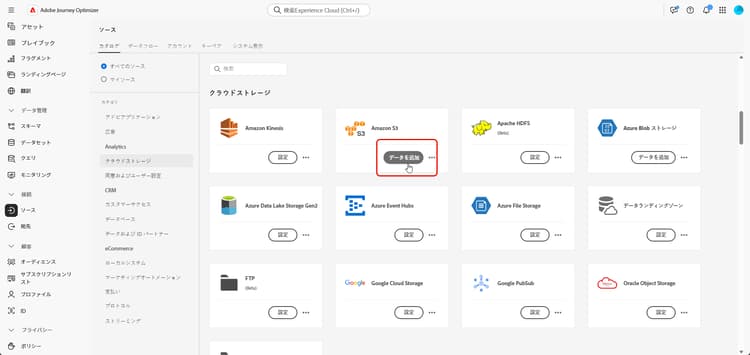
-
クラウドベースのソースを選択した場合は、クラウドストレージまたは Google Cloud Storage アカウントを接続します。
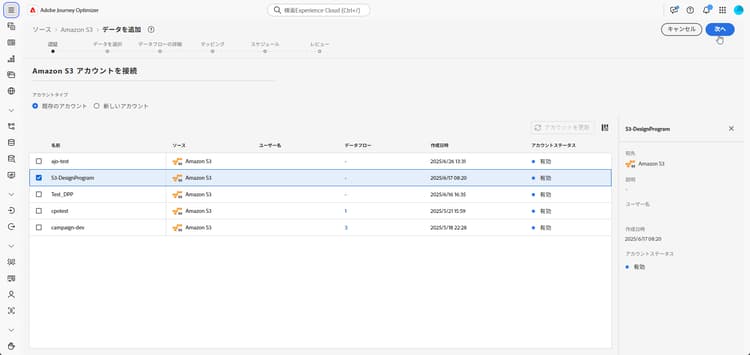
-
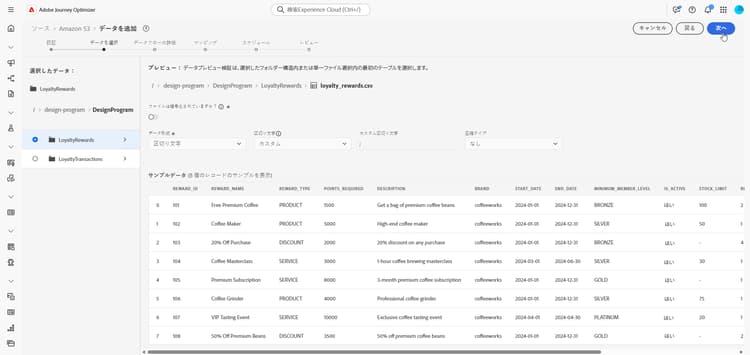
Adobe Experience Platform に取り込むデータを選択します。
-
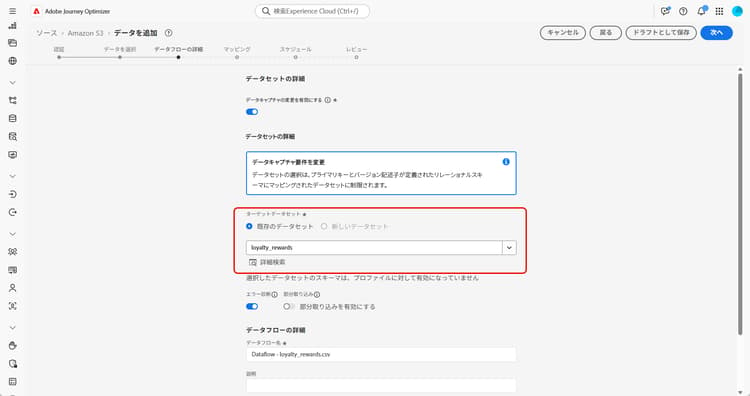
データセットの詳細ページで、「変更データキャプチャを有効にする」をオンにすると、リレーショナルスキーマにマッピングされ、プライマリキーとバージョン記述子の両方が含まれるデータセットのみが表示されます。
リレーショナルスキーマのデータハイジーンに関するガイドラインの詳細を見る
note important IMPORTANT ファイルベースのソースのみの場合、データファイルの各行には、値が u(アップサート)またはd(削除)の_change_request_type列を含める必要があります。 この列がないと、システムはデータが変更トラッキングをサポートしていると認識せず、オーケストレーションキャンペーンの切替スイッチが表示されず、データセットがターゲティング用に選択されなくなります。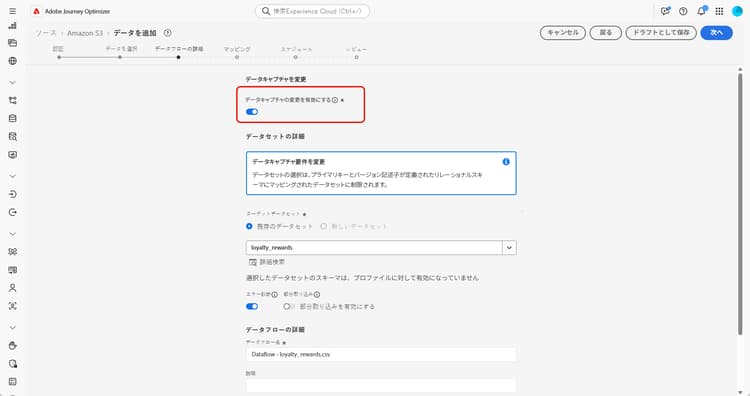
-
以前に作成したデータセットを選択し、「次へ」をクリックします。
-
ファイルベースのソースのみを使用している場合は、データを選択ウィンドウからローカルファイルをアップロードし、その構造とコンテンツをプレビューします。
サポートされる最大サイズは 100 MB です。
-
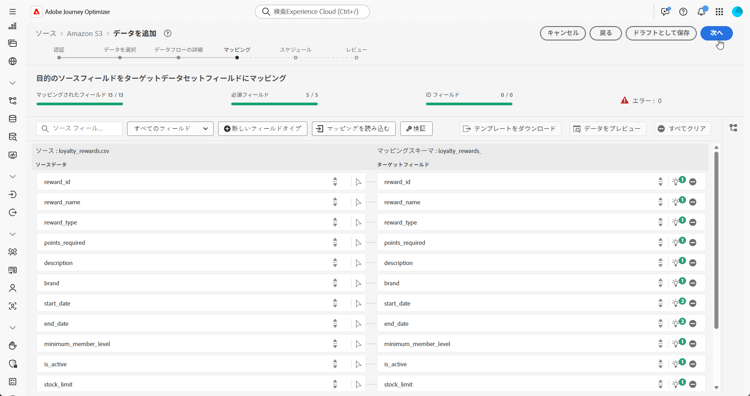
マッピングウィンドウで、各ソースファイル属性がターゲットスキーマの対応するフィールドに正しくマッピングされていることを確認します。 ターゲティングディメンションの詳細情報を参照してください。
完了したら、「次へ」をクリックします。
-
目的の頻度に基づいてデータフローの スケジュール を設定します。
-
「終了」をクリックしてデータフローを作成します。 定義したスケジュールに従って自動的に実行されます。
-
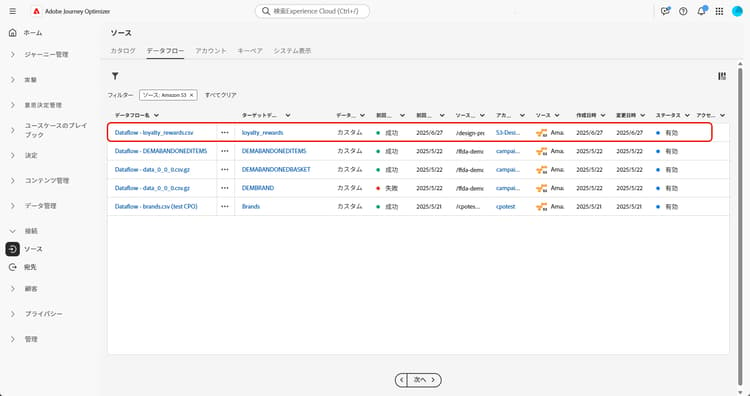
接続メニューから「ソース」を選択し、「データフロー」タブにアクセスして、フローの実行を追跡し、取得されたレコードを確認し、エラーをトラブルシューティングします。
This section contains structured knowledge intended to support interpretation, retrieval, and question answering related to this topic.
For complete understanding, this information should be combined with the documentation on this page. Neither source is intended to stand alone; the page describes the feature, while this section provides additional context that helps disambiguate terminology, intent, applicability, and constraints.
- TL;DR: This page explains how to ingest data into Adobe Experience Platform from sources supported for Orchestrated campaigns, configure a dataflow, and manage record deletions through Change data capture.
Intents:
- Identify the supported sources for ingesting data for Orchestrated campaigns (Cloud Storage, Cloud Data Warehouses, File-Based Uploads).
- Understand the one-to-one relationship enforced between dataflows and datasets, and how to change a data source.
- Configure a dataflow that ingests structured data into Adobe Experience Platform for Orchestrated campaigns.
- Enable Change data capture on a dataset mapped to a relational schema.
- Manage record deletions in Adobe Experience Platform using Change data capture, a file-based deletion marker, a proxy or sanitized table, or Data Distiller.
- Map source file attributes to target schema fields during dataflow configuration.
Glossary:
- Dataset: a storage and management construct for a collection of data, typically a table, that contains a schema (columns) and fields (rows) (product-specific)
- Change data capture: a dataset setting that automatically mirrors all data changes, including deletions, from the source system into Adobe Experience Platform (product-specific)
- Change Request Type: the file-based ingestion field used to mark a record for deletion with a “d” value (product-specific)
- _change_request_type: the required column for file-based sources, with values “u” (upsert) or “d” (delete), used to support change tracking (product-specific)
- Data Distiller: a licensed capability that can be used to support deletion operations directly within Adobe Experience Platform, independent of the source system (product-specific)
Guardrails:
- Adobe Experience Platform enforces a strict one-to-one relationship between dataflows and datasets (hard limit).
- To change the data source for a dataset, the existing dataflow must first be deleted before creating a new one that references the same dataset and the new source.
- Change data capture cannot be enabled on a dataset that already contains ingested data.
- Adobe Journey Optimizer Campaigns require all onboarded datasets to be enabled with Change data capture.
- Enabling Change data capture on the Dataset details page displays only datasets that are mapped to relational schemas and include both a primary key and a version descriptor.
- For file-based sources only, each row in the data file must include a _change_request_type column with values “u” (upsert) or “d” (delete); without this column, the system does not recognize the data as supporting change tracking, and the Orchestrated campaign toggle does not appear, preventing the dataset from being selected for targeting.
- For file-based sources, the maximum supported upload size is 100MB (hard limit).
Prerequisites and permissions:
- Data Distiller must be licensed to use it for deleting records directly within Adobe Experience Platform, independent of the source system.
Applicability:
- Applies: Orchestrated campaigns — the supported sources list and the dataflow configuration steps on this page are scoped to Orchestrated campaigns.
Terminology:
- Canonical name: Adobe Experience Platform — Acronym: AEP — variants: Platform
- Canonical name: Adobe Journey Optimizer — Acronym: AJO
- Synonyms: “dataflow” = “data flow”
- Do not confuse: “Change data capture” (automatically mirrors source deletions into Adobe Experience Platform) ≠ “Data Distiller” (deletes records only within Adobe Experience Platform, independent of the source system)
FAQ:
- Q: What must I do before changing the data source for an existing dataset? — Delete the existing dataflow before creating a new one that references the same dataset and the new source, because Adobe Experience Platform enforces a strict one-to-one relationship between dataflows and datasets.
- Q: Which sources are supported for Orchestrated campaigns? — Cloud Storage (Amazon S3, Google Cloud Storage, SFTP), Cloud Data Warehouses (Snowflake, Google BigQuery, Data Landing Zone, Azure Databricks), and File-Based Uploads (Local File Upload).
- Q: Can Change data capture be enabled on a dataset that already has ingested data? — No, Change data capture cannot be enabled on a dataset that already contains ingested data.
- Q: How do I delete a record using file-based ingestion? — Mark the record with a “d” value in the Change Request Type field, which indicates the record should be deleted in Adobe Experience Platform, mirroring the source system.
- Q: How can I delete records from Adobe Experience Platform without affecting the source data? — Use a proxy or sanitized source table for Change data capture replication, or, if licensed, use Data Distiller to delete records directly within Adobe Experience Platform.
- Q: What happens if the _change_request_type column is missing from a file-based source? — The system does not recognize the data as supporting change tracking, and the Orchestrated campaign toggle does not appear, preventing the dataset from being selected for targeting.
Related pages:
- For mapping source file attributes to target schema fields during dataflow configuration: Learn more about targeting dimensions (orchestrated/target-dimension.md)
Personas:
- developer: Can map each source file attribute to the corresponding field in the target schema during dataflow configuration. Can include a _change_request_type column in file-based source data, with values u for upsert or d for delete, to support change tracking. The page states that without this column, the Orchestrated campaign toggle does not appear, preventing the dataset from being selected for targeting. Where: “Configure a dataflow”.
- admin: Can configure a dataflow for Orchestrated campaigns using Cloud Storage, Cloud Data Warehouses, or File-Based Uploads sources. Can enable Change data capture only on datasets mapped to relational schemas with a primary key and version descriptor. The page states that a dataflow must be deleted before creating a new one that references the same dataset and a new source. Where: “Guardrails”.
Onboarding:
- Level: Experienced
- First minimal step: From the Connections menu, access the Sources menu.
- Success check: From the Connections menu, select Sources and access the Data Flows tab to track flow execution, review ingested records, and troubleshoot any errors.
- Next: Mapping source file attributes to target schema fields during dataflow configuration: Create your Targeting dimension (orchestrated/target-dimension.md)