In questa pagina: crea una configurazione del canale della scheda Contenuto e definisci la relativa superficie in modo da poter distribuire le schede di contenuto nella posizione Web o nell’app corretta.
Che cos’è una configurazione? surface-definition
Una configurazione esperienza scheda contenuto è qualsiasi entità progettata per l’interazione utente o di sistema, identificata in modo univoco da un URI.
In altre parole, una superficie può essere vista come un contenitore a qualsiasi livello gerarchico con un’entità (punto di contatto) esistente.
-
Può essere una pagina web, un’app mobile, un’app desktop, una posizione di contenuto specifica all’interno di un’entità più grande (ad esempio
div) o un modello di visualizzazione non standard (ad esempio un chiosco o un banner di un’app desktop). -
Può anche estendersi a contenitori di contenuto specifici per scopi non di visualizzazione o visualizzazione astratta (ad esempio, BLOB JSON consegnati ai servizi).
-
Può anche essere una superficie con caratteri jolly che corrisponde a una varietà di definizioni di superficie client (ad esempio, la posizione di un’immagine hero su ogni pagina del sito web potrebbe tradursi in un URI di superficie come: web://mydomain.com/*#hero_image).
Fondamentalmente, un URI di superficie è composto da più sezioni:
- Tipo: web, app mobile, sportello bancomat, chiosco, tvcd, servizio ecc.
- Proprietà: URL pagina o bundle di app
- Contenitore: posizione nell’attività pagina/app
La tabella seguente elenca alcuni esempi di definizione di URI di superficie per vari dispositivi.
Web e dispositivi mobili
web://domain.com/path/page.html#elementmobileapp://com.vendor.bundle/activity#elementmobileapp://com.vendor.bundle/#elementAltri tipi di dispositivi
desktop://com.vendor.bundle/#elementtvcd://com.vendor.bundle/#elementservice://servicename/#elementkiosk://location/screen#elementatm://location/screen#elementSuperfici jolly
wildcard:web://domain.com/*#elementwildcard:web://*domain.com/*#elementCreare una configurazione di scheda di contenuto create-config
-
Accedi al menu Canali > Impostazioni generali > Configurazioni canale, quindi fai clic su Crea configurazione canale.
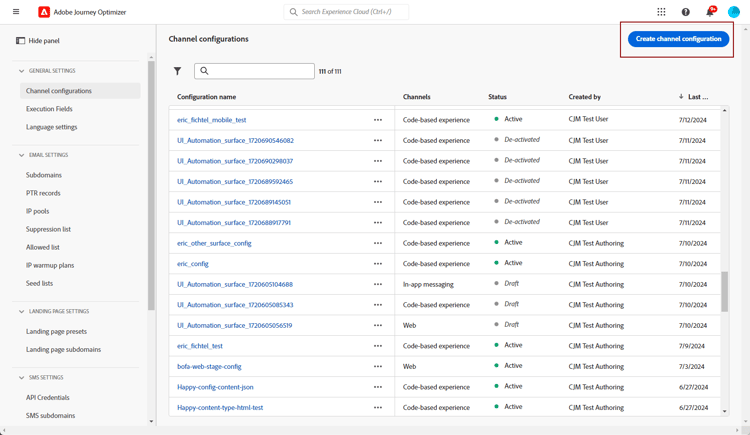
-
Immetti un nome e una descrizione (facoltativa) per la configurazione.
note NOTE I nomi devono iniziare con una lettera (A-Z). Può contenere solo caratteri alfanumerici. È inoltre possibile utilizzare i caratteri trattino basso _, punto.e trattino-. -
Per assegnare etichette di utilizzo dei dati personalizzate o di base alla configurazione, è possibile selezionare Gestisci accesso. Ulteriori informazioni sul controllo degli accessi a livello di oggetto.
-
Seleziona il canale Scheda contenuto.
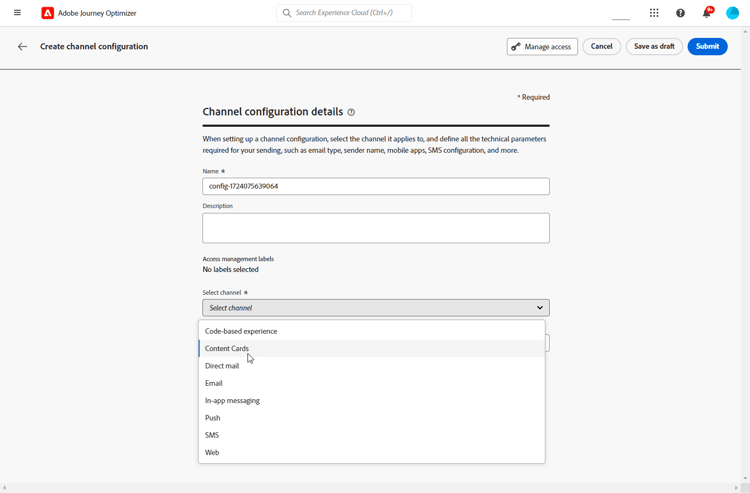
-
Seleziona Azione di marketing per associare i criteri di consenso ai messaggi utilizzando questa configurazione. Tutti i criteri di consenso associati all’azione di marketing vengono utilizzati per rispettare le preferenze dei clienti. Ulteriori informazioni
-
Seleziona la piattaforma per la quale verrà applicata l’esperienza della scheda di contenuto.
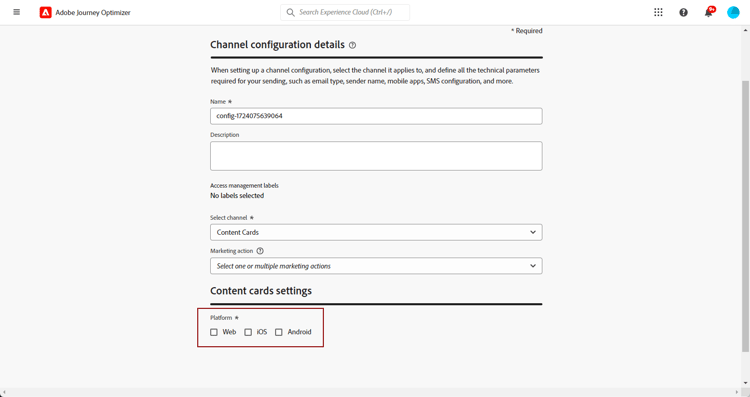
-
Per il Web:
-
Specifica un URL pagina per applicare le modifiche esclusivamente a una singola pagina.
-
In alternativa, crea una regola di corrispondenza pagine per eseguire il targeting di più URL che corrispondono alla regola specificata. Ad esempio, potrebbe essere utilizzato per applicare modifiche universalmente a un sito web, ad esempio per aggiornare un banner hero in tutte le pagine o aggiungere un’immagine superiore da visualizzare su ogni pagina di prodotto. Ulteriori informazioni
-
-
Per iOS e Android:
- Immetti o seleziona il tuo ID app, Posizione o percorso all’interno dell’app e URL anteprima.
-
Invia le modifiche.
Ora puoi selezionare la tua configurazione durante la creazione dell’esperienza con la scheda Contenuto.
This section contains structured knowledge intended to support interpretation, retrieval, and question answering related to this topic.
For complete understanding, this information should be combined with the documentation on this page. Neither source is intended to stand alone; the page describes the feature, while this section provides additional context that helps disambiguate terminology, intent, applicability, and constraints.
- TL;DR: This page explains what a content card experience configuration and its surface URI are, and how to create a content card channel configuration in Journey Optimizer.
Intents:
- Understand what a content card experience configuration and a surface are
- Learn how a surface URI is composed from type, property, and container
- Reference surface URI examples for web, mobile, other device types, and wildcard surfaces
- Create a content card channel configuration from the Channel configurations menu
- Associate marketing actions and platform settings with the configuration
- Define web targeting with a page URL or a pages matching rule, or app targeting for iOS and Android
Glossary:
- Content card experience configuration: Any entity designed for user or system interaction, uniquely identified by a URI (product-specific)
- Surface: A container at any level of hierarchy with an entity (touchpoint) that exists, such as a web page, mobile app, desktop app, or a specific content location (product-specific)
- Surface URI: The unique identifier of a surface, composed of a type, a property, and a container (product-specific)
- Wildcard surface: A surface that matches a variety of client-surface definitions, for example
web://mydomain.com/*#hero_image(product-specific) - Marketing action: A selection that associates consent policies with the messages using the configuration, so customer preferences are respected (product-specific)
- Pages matching rule: A web targeting option that targets multiple URLs matching a specified rule (product-specific)
Guardrails:
- A content card experience configuration is uniquely identified by a URI.
- Configuration names must begin with a letter (A-Z) and can only contain alpha-numeric characters, plus the underscore, dot, and hyphen characters.
- For Web, specify a Page URL to apply changes to a single page exclusively, or create a Pages matching rule to target multiple URLs that match the rule.
- For iOS and Android, enter or select the App id, Location or path inside the app, and Preview URL.
- All consent policies associated with the selected marketing action are leveraged to respect customer preferences.
Terminology:
- Canonical name: Content card channel configuration — Acronym: URI (surface URI) — variants: content card experience configuration, content card configuration
- Synonyms: “surface” = “content card experience configuration”
- Do not confuse: “Page URL” (targets a single page exclusively) ≠ “Pages matching rule” (targets multiple URLs that match a rule)
- Do not confuse: “Type” (web, mobileapp, atm, kiosk, tvcd, service) ≠ “Property” (page URL or app bundle) ≠ “Container” (location on the page or app activity)
FAQ:
- Q: What is a content card experience configuration? — It is any entity designed for user or system interaction, uniquely identified by a URI, and can be seen as a container (surface) holding a touchpoint entity.
- Q: What are the parts of a surface URI? — A surface URI is composed of a type (web, mobileapp, atm, kiosk, tvcd, service, and so on), a property (page URL or app bundle), and a container (location on the page or app activity).
- Q: What characters are allowed in a configuration name? — Names must begin with a letter (A-Z) and can only contain alpha-numeric characters, plus the underscore, dot, and hyphen characters.
- Q: How do I target web pages with the configuration? — Specify a Page URL to apply changes to a single page exclusively, or create a Pages matching rule to target multiple URLs that match the specified rule.
- Q: Where do I create a content card configuration? — Access Channels > General settings > Channel configurations, click Create channel configuration, select the Content card channel, then configure and submit.