In questa pagina: scopri come utilizzare l’attività Read audience per recuperare un pubblico salvato o importato esistente e riutilizzarlo in una campagna orchestrata, arricchendola facoltativamente con attributi di profilo per il targeting, la personalizzazione o il reporting.
L’attività Read audience consente di recuperare un pubblico esistente, salvato o importato in precedenza, e di riutilizzarlo all’interno di una campagna orchestrata. Questa attività è particolarmente utile per il targeting di un set predefinito di profili senza la necessità di eseguire un nuovo processo di segmentazione.
Una volta caricato il pubblico, puoi facoltativamente perfezionarlo selezionando un campo di identità univoco e arricchendo il pubblico con attributi di profilo aggiuntivi a scopo di targeting, personalizzazione o reporting.
Cache Read audience cache
Durante il test di una campagna orchestrata, l’attività Read Audience richiede in genere un po’ di tempo per recuperare i dati, il che può allungare l’esecuzione dei test. Per velocizzare l’operazione, è disponibile una cache Read Audience.
La cache memorizza il pubblico insieme agli attributi selezionati per fino a due ore. Durante questo periodo, qualsiasi esecuzione di test successiva può utilizzare i risultati memorizzati nella cache, evitando di dover recuperare nuovamente i dati. Trascorso il periodo di due ore, i dati devono essere recuperati nuovamente.
La cache viene salvata per ogni campagna orchestrata, non per il pubblico stesso. Se lo stesso pubblico viene utilizzato in un’attività Read Audience all’interno di un’altra campagna orchestrata, il sistema dovrà comunque recuperare di nuovo i dati.
La cache non viene conservata nei seguenti casi:
-
Quando l’attività Read Audience viene aggiornata con nuovi attributi, la cache viene aggiornata con i nuovi dati degli attributi. Di conseguenza, la prima esecuzione dei test dopo l’aggiornamento richiederà più tempo, in quanto i dati devono essere recuperati nuovamente.
-
Quando la campagna orchestrata viene pubblicata, vengono recuperati i dati più recenti durante l’esecuzione della campagna orchestrata live.
Configurare l’attività Read audience read-audience-configuration
Segui questi passaggi per configurare l’attività Read audience:
-
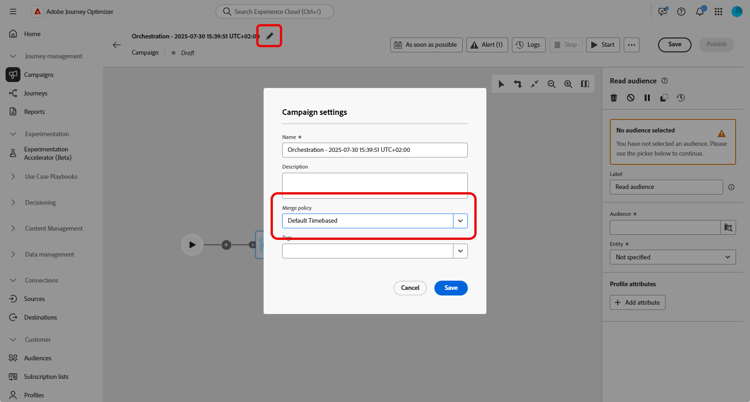
Prima di aggiungere l’attività Read audience, assicurati di selezionare un criterio di unione nelle impostazioni di Campaign.
-
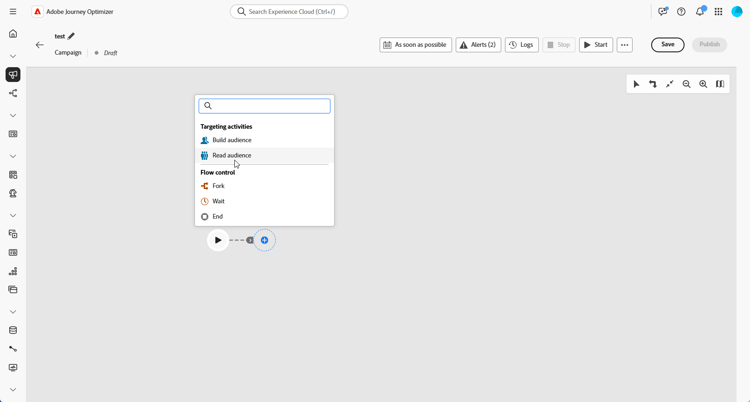
Aggiungi un’attività Read audience alla tua campagna orchestrata.
-
Immetti un’etichetta Label per l’attività. Questa etichetta fungerà da nome del pubblico.
-
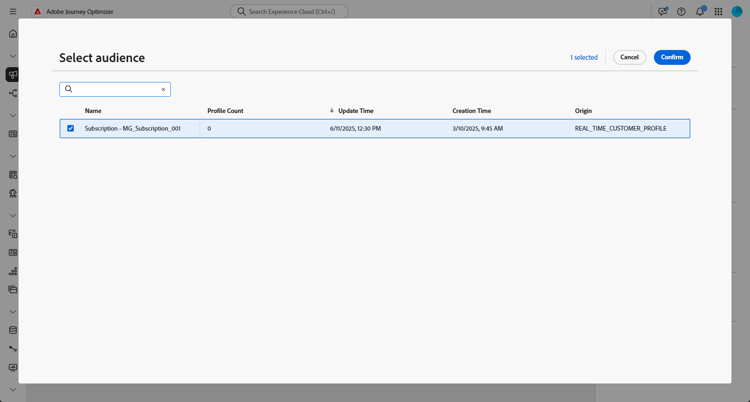
Fai clic su

-
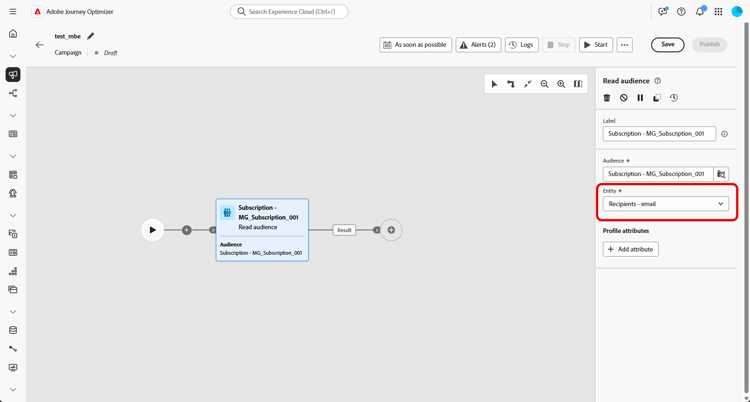
Scegli un’entità dalla dimensione di targeting della campagna. Questa impostazione definisce l’entità target e l’attributo utilizzati per riconciliare il pubblico con la dimensione target.
➡️ Segui i passaggi descritti in questa pagina per creare la tua dimensione di targeting delle campagne
-
Seleziona Aggiungi attributo per arricchire il pubblico selezionato con dati aggiuntivi. Questo passaggio ti consente di aggiungere attributi di profilo al pubblico, creando un elenco di destinatari migliorati con tali attributi.
-
Scegli gli Attributi da aggiungere al pubblico. Il selettore di attributi visualizza i campi dello schema profilo di unione:
-
Per i tipi di pubblico basati su CSV, sono inclusi sia gli attributi Profilo che gli attributi personalizzati a livello di pubblico. Questi attributi si trovano nel seguente percorso dello schema:
<audienceid> > _ajobatchjourneystage > audienceEnrichment > CustomerAudienceUpload > <audienceid> -
Per i tipi di pubblico standard di AEP, sono disponibili solo gli attributi Profilo, in quanto non contengono campi incorporati specifici per il pubblico.
note NOTE Anche se alcuni attributi possono essere visualizzati nel selettore, la loro disponibilità in fase di esecuzione dipende dal fatto che i dati del pubblico siano stati correttamente riconciliati e uniti con il profilo Adobe Experience Platform. 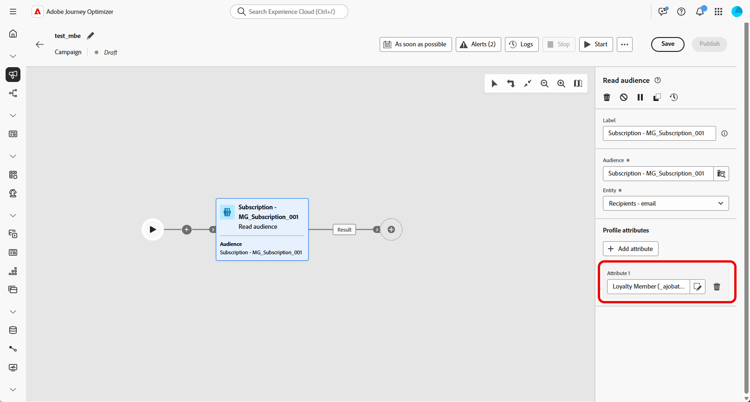
-
Una volta creato, il pubblico è disponibile in sola lettura e non può più essere modificato. Può essere utilizzato solo dopo che il processo di creazione è stato completato.
Esempio
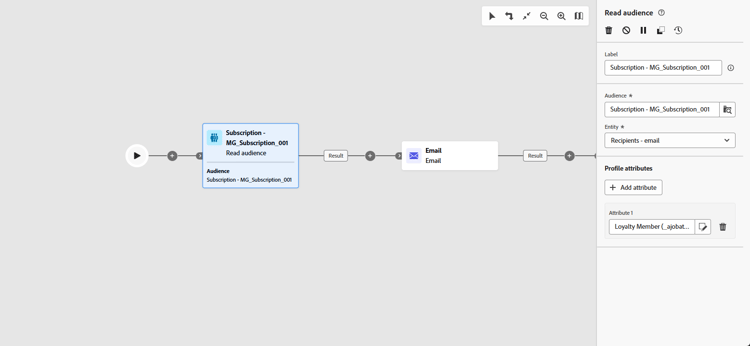
Nell’esempio seguente, l’attività Read audience viene utilizzata per recuperare un pubblico creato e salvato in precedenza dai profili abbonati alla newsletter. Il pubblico viene quindi arricchito con l’attributo Iscrizione fedeltà per abilitare il targeting degli utenti che sono membri registrati del programma fedeltà.
This section contains structured knowledge intended to support interpretation, retrieval, and question answering related to this topic.
For complete understanding, this information should be combined with the documentation on this page. Neither source is intended to stand alone; the page describes the feature, while this section provides additional context that helps disambiguate terminology, intent, applicability, and constraints.
- TL;DR: This page explains how to configure the Read audience activity in an Orchestrated campaign to retrieve an existing saved or imported audience and optionally enrich it with profile attributes.
Intents:
- Retrieve an existing saved or imported audience to use as the entry audience for an Orchestrated campaign.
- Select a Merge policy before adding the Read audience activity.
- Choose an Entity from the Campaign Targeting dimension to reconcile the audience with the target dimension.
- Enrich the selected audience with additional profile attributes for targeting, personalization, or reporting.
- Understand when the Read audience cache speeds up test runs and when it is refreshed.
Glossary:
- Read audience activity: an activity that retrieves an existing audience, previously saved or imported, and reuses it within an Orchestrated campaign, without executing a new segmentation process (product-specific)
- Read audience cache: a cache that stores the audience and selected attributes retrieved by the Read audience activity, used to speed up subsequent test runs of an Orchestrated campaign (product-specific)
- Merge policy: a Campaign setting that must be selected before adding a Read audience activity (product-specific)
- Entity: a setting chosen from the Campaign Targeting dimension that defines the target entity and the attribute used to reconcile the audience with the target dimension (product-specific)
- Union Profile Schema: the schema whose fields are displayed in the attribute picker when enriching an audience with the Add attribute step (product-specific)
Guardrails:
- The Read audience cache stores the audience and selected attributes for up to two hours; after this two-hour period, the data must be retrieved anew.
- The cache is saved per Orchestrated campaign, not per audience: using the same audience in a Read audience activity inside another Orchestrated campaign still requires the data to be fetched again.
- The cache is refreshed when the Read audience activity is updated with new attributes, so the first test run after the update takes longer because the data must be retrieved again.
- The cache is not retained when the Orchestrated campaign is published, because the latest data is fetched when executing the live Orchestrated campaign.
- For CSV-based audiences, the attribute picker includes both Profile attributes and custom audience-level attributes, found under the schema path
<audienceid> > _ajobatchjourneystage > audienceEnrichment > CustomerAudienceUpload > <audienceid>. - For standard AEP audiences, only Profile attributes are available in the attribute picker, because these audiences do not carry embedded audience-specific fields.
- The availability of an attribute at runtime depends on whether the audience data has been successfully reconciled and merged with the Adobe Experience Platform Profile, even if the attribute appears in the picker.
- Once an audience is created, it is available in read-only and can no longer be edited; it can only be used after the creation process is fully completed.
Terminology:
- Canonical name: Adobe Experience Platform — Acronym: AEP
- Canonical name: Read audience activity — variants: Read Audience
- Do not confuse: “Adobe Experience Platform” (the platform) ≠ “Adobe Experience Platform Profile” (the profile component with which audience data must be reconciled and merged for an attribute to be available at runtime)
FAQ:
- Q: What does the Read audience activity do? — It retrieves an existing audience, previously saved or imported, and reuses it within an Orchestrated campaign, targeting a predefined set of profiles without executing a new segmentation process.
- Q: How long does the Read audience cache store data? — Up to two hours; after this two-hour period, the data must be retrieved anew.
- Q: Does the cache carry over to another Orchestrated campaign using the same audience? — No, the cache is saved for each Orchestrated campaign, not for the audience itself, so the system still needs to fetch the data again.
- Q: What happens to the cache when the Read audience activity is updated with new attributes? — The cache is refreshed with the new attributes data, so the first test run after the update takes longer.
- Q: What must be selected before adding a Read audience activity? — A Merge policy in the Campaign settings.
- Q: What attributes are available for CSV-based audiences versus standard AEP audiences? — CSV-based audiences offer both Profile attributes and custom audience-level attributes; standard AEP audiences offer only Profile attributes, since they do not carry embedded audience-specific fields.
- Q: Can a created audience be edited afterward? — No, once an audience is created it is available in read-only and can no longer be edited; it can only be used after the creation process is fully completed.
Examples:
- Example: The Read audience activity retrieves a previously created and saved audience of profiles who subscribed to the newsletter, then enriches it with the Loyalty membership attribute to enable targeting of users who are registered members of the loyalty program.
Related pages:
- To generate and target the audience selected in the Read audience activity: Learn more about how to generate and target audiences in Journey Optimizer (audience/about-audiences.md)
- To create the Campaign Targeting dimension used to choose the Entity setting: Create your Targeting dimension (orchestrated/target-dimension.md)
Personas:
- marketer: Can retrieve an existing saved or imported audience and reuse it within an Orchestrated campaign. Can select a Merge policy, enter a Label, choose an Entity from the Campaign Targeting dimension, and select Add attribute to enrich the audience. The page states that once an audience is created, it is available in read-only and can no longer be edited. Where: “Configure the Read audience activity”.
Onboarding:
- Level: Intermediate
- First minimal step: Select a Merge policy in your Campaign settings before adding the Read audience activity.
- Success check: The selected audience is enriched with the chosen attribute, as shown by the example enriching a newsletter audience with the Loyalty membership attribute.
- Previous: Generate and target an audience in Journey Optimizer: About Adobe Experience Platform audiences (audience/about-audiences.md); Create the Campaign Targeting dimension: Create your Targeting dimension (orchestrated/target-dimension.md)