Sur cette page : découvrez comment envoyer un e-mail à partir d’un parcours à l’aide de l’intégration à Adobe Campaign v7 et v8, y compris la création du modèle transactionnel, de l’événement et de l’action.
Ce cas d’usage explique toutes les étapes nécessaires pour envoyer un e-mail à l’aide de l’intégration à Adobe Campaign v7 et Adobe Campaign v8.
Tout d’abord, créez un modèle d’e-mail transactionnel dans Campaign. Ensuite, dans Journey Optimizer, créez l’événement, l’action et concevez le parcours.
Pour en savoir plus sur l’intégration de Campaign, consultez les pages suivantes :
Adobe Campaign
Votre instance de Campaign doit être approvisionnée pour cette intégration. La fonctionnalité de messagerie transactionnelle doit être configurée.
-
Connectez-vous à votre instance de pilotage Campaign.
-
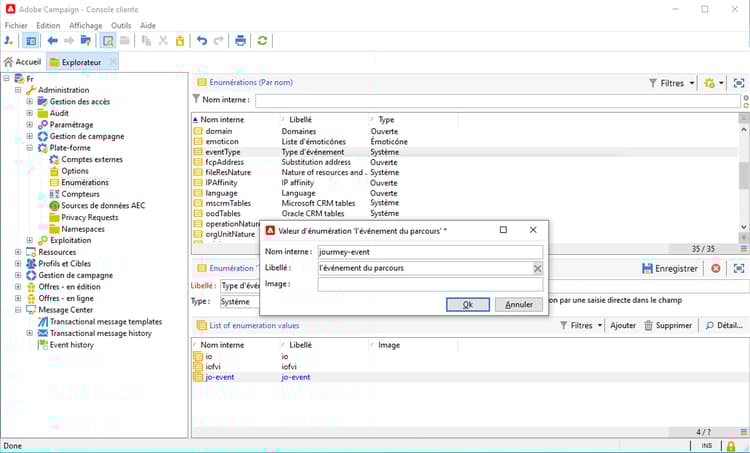
Sous Administration > Plateforme > Énumérations, sélectionnez l’énumération Type d’événement (eventType). Créez un type d’événement (« journey-event », dans notre exemple). Utilisez le nom interne du type d’événement lors de l’écriture ultérieure du fichier JSON.
-
Déconnectez-vous et reconnectez-vous à l’instance pour que la création prenne effet.
-
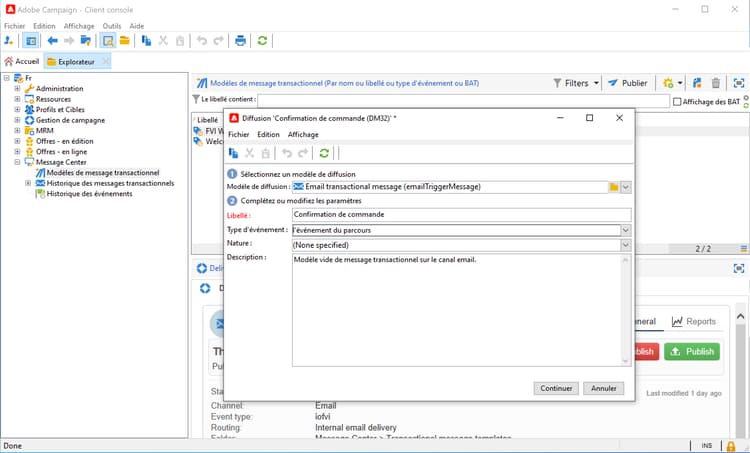
Sous Message Center > Modèles de messages transactionnels, créez un modèle d’e-mail basé sur le type d’événement précédemment créé.
-
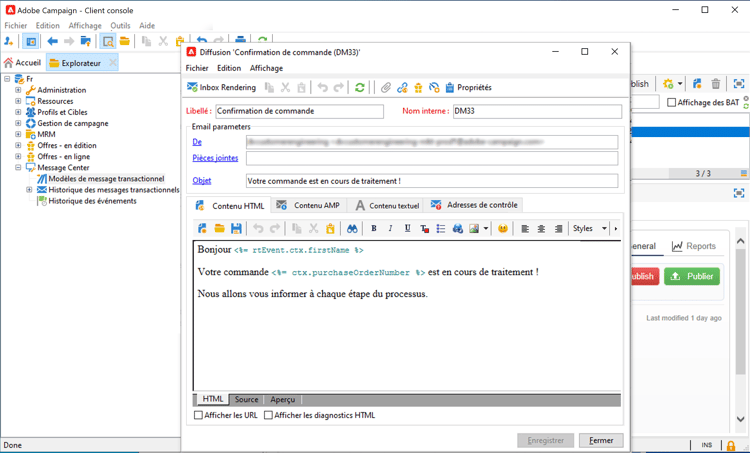
Concevez votre modèle. Dans cet exemple, la personnalisation est utilisée sur le prénom et le numéro de commande du profil. Le prénom se trouve dans la source de données Adobe Experience Platform et le numéro de commande est un champ de l’événement Journey Optimizer. Veillez à utiliser les noms de champ corrects dans Campaign.
-
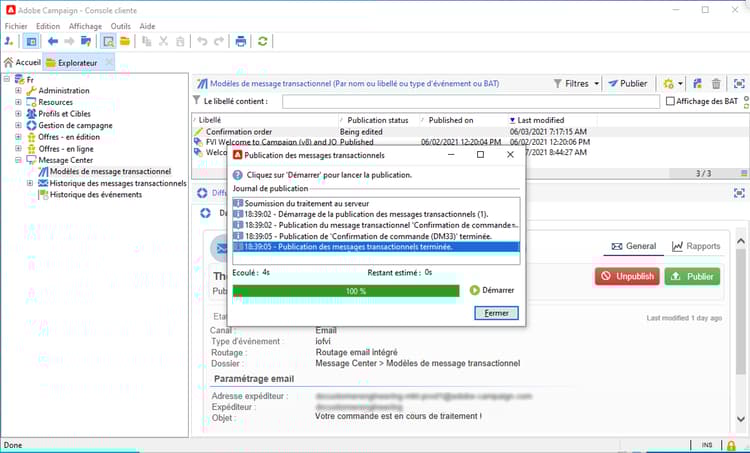
Publiez votre modèle transactionnel.
-
Écrivez la payload JSON correspondant au modèle.
{
     "channel": "email",
     "eventType": "journey-event",
     "email": "Email address",
     "ctx": {
          "firstName": "First name", "purchaseOrderNumber": "Purchase order number"
     }
}
- Pour le canal, vous devez saisir le type “e-mail”.
- Pour eventType, utilisez le nom interne du type d’événement créé précédemment.
- L’adresse e-mail est une variable. Vous pouvez donc saisir n’importe quel libellé.
- Sous ctx, les champs de personnalisation sont également des variables.
Journey Optimizer
-
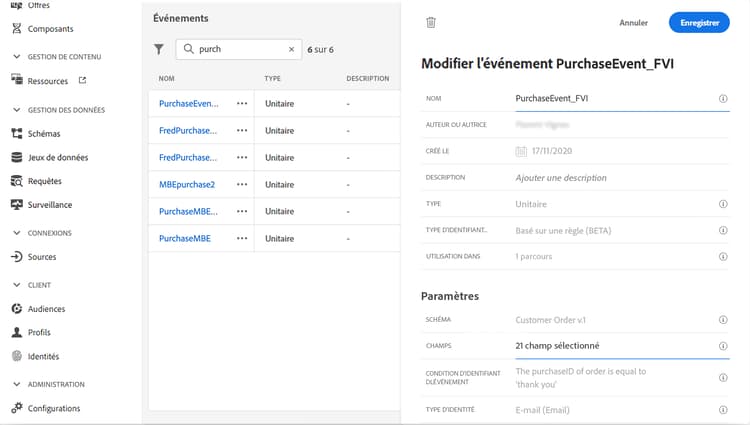
Créez un événement. Incluez le champ « purchaseOrderNumber ».
-
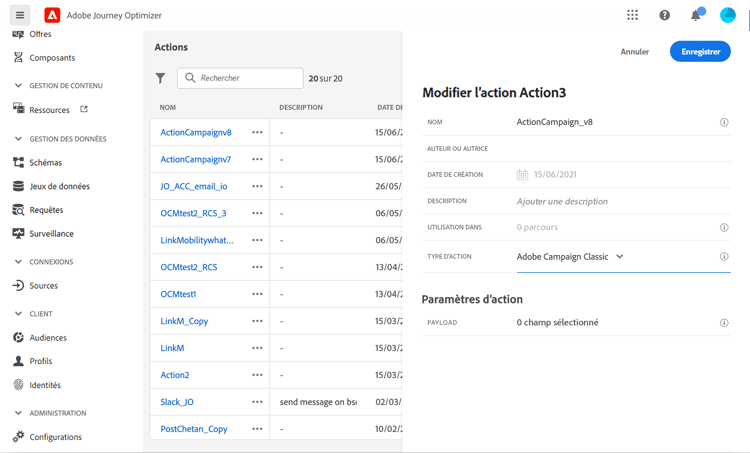
Créez une action dans Journey Optimizer correspondant à votre modèle Campaign. Dans le menu déroulant Type d’action, sélectionnez Adobe Campaign Classic.
-
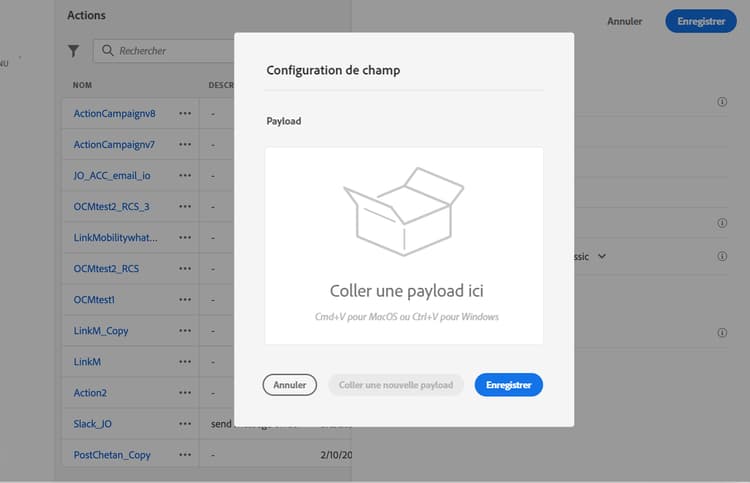
Cliquez sur le champ Payload et collez le JSON créé précédemment.
-
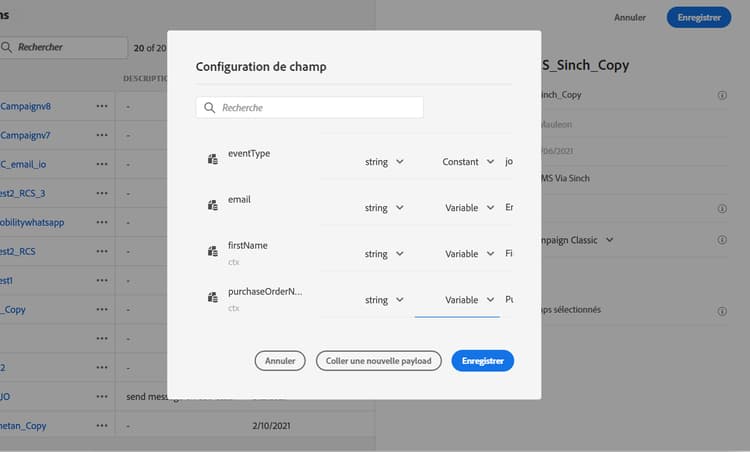
Pour l’adresse e-mail et les deux champs de personnalisation, remplacez Constante par Variable.
-
Créez maintenant un parcours et commencez par l’événement précédemment créé.
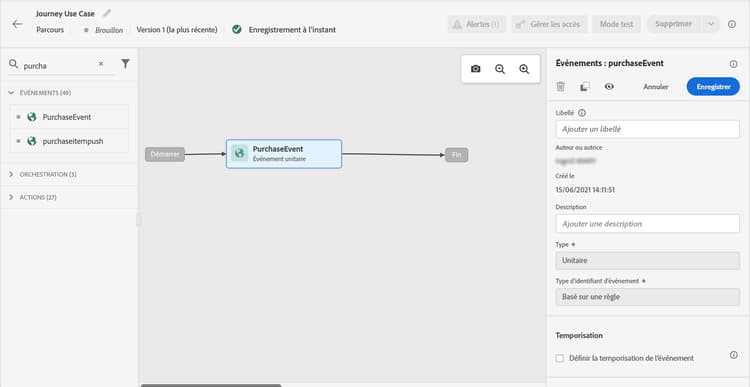
-
Ajoutez l’action et mappez chaque champ au champ correct dans Journey Optimizer.
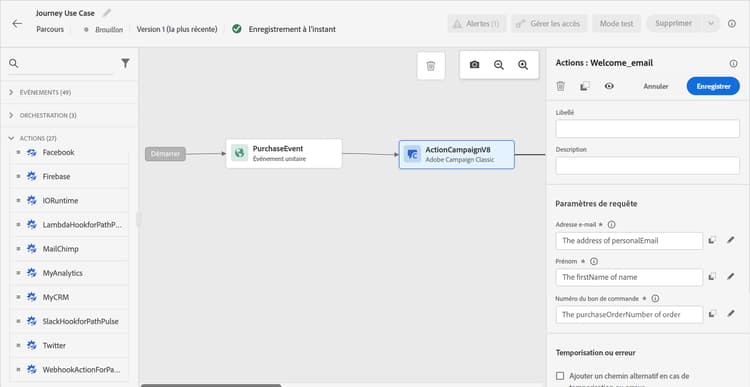
-
Cliquez sur Valider dans l’en-tête du parcours. Résolvez les erreurs dans le panneau Alertes et validez à nouveau avant de continuer. En savoir plus sur la validation des parcours .
-
Testez votre parcours.
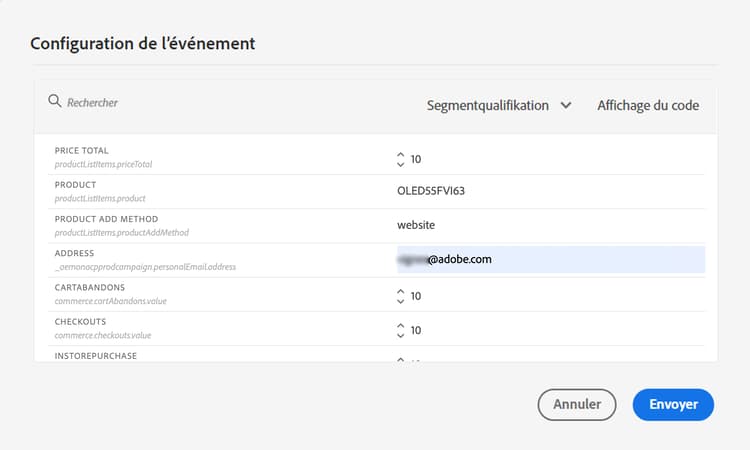
-
Vous pouvez maintenant publier votre parcours.
This section contains structured knowledge intended to support interpretation, retrieval, and question answering related to this topic.
For complete understanding, this information should be combined with the documentation on this page. Neither source is intended to stand alone; the page describes the feature, while this section provides additional context that helps disambiguate terminology, intent, applicability, and constraints.
- TL;DR: This page provides a step-by-step use case for sending a transactional email from Adobe Journey Optimizer using the integration with Adobe Campaign v7/v8, covering Campaign template creation, event and action configuration, and journey design.
Intents:
- Configure a transactional email template in Adobe Campaign v7/v8 for use with Journey Optimizer
- Create an event in Journey Optimizer that includes custom fields such as a purchase order number
- Create and configure an action of type Adobe Campaign Classic in Journey Optimizer with a JSON payload
- Map journey event fields to Campaign personalization variables in the action configuration
- Build and publish a journey that triggers a Campaign transactional email
Glossary:
- Transactional Messaging: A Campaign feature that must be configured before this integration can be used (product-specific)
- Event type (eventType): An enumeration value defined in Campaign that identifies the type of transactional event; its internal name is referenced in the JSON payload (product-specific)
- Adobe Campaign Classic (Action type): The Journey Optimizer action type selected for the action that corresponds to the Campaign template; it connects to Adobe Campaign v7/v8 to send transactional messages (product-specific)
- Payload field: The JSON structure pasted into a Journey Optimizer action that defines the data fields sent to Campaign (product-specific)
Guardrails:
- The journey must be validated before testing. Errors in the Alerts panel must be resolved and validation rerun before continuing.
- Campaign v7/v8 build 9125 or higher is required for this integration
- The Transactional Messaging feature must be configured in the Campaign instance before use
- After creating a new event type in Campaign, you must disconnect and reconnect to the instance for it to take effect
- Personalization field values set as “Constant” in the action must be changed to “Variable” to allow dynamic population at runtime
Terminology:
- Canonical name: Adobe Campaign v7/v8 — Acronym: ACC (Adobe Campaign Classic v7/v8) — variants: Adobe Campaign Classic (the Action type selected in Journey Optimizer)
- Synonyms: “Event type” = “eventType” (the Campaign enumeration)
- The
eventTypepayload field uses the internal name of the event type created in Campaign.
FAQ:
- Q: What Campaign version is required for this integration? — Campaign v7/v8 build 9125 or higher is required.
- Q: What must be configured in Campaign before starting? — The Transactional Messaging feature must be configured and a transactional email template must be created based on the event type.
- Q: How do I make personalization fields dynamic in the Journey Optimizer action? — In the action payload configuration, change the field configuration from “Constant” to “Variable” for fields that will be populated at runtime.
- Q: Where does the first name personalization data come from in this use case? — The first name comes from the Adobe Experience Platform data source, while the order number comes from the Journey Optimizer event payload.
- Q: How do I connect the Journey Optimizer action to the Campaign template? — Select “Adobe Campaign Classic” as the Action type, then paste the JSON payload that matches the transactional message template structure.