Sur cette page : découvrez comment utiliser l’activité Lecture d’audience pour récupérer une audience existante enregistrée ou importée et la réutiliser dans une campagne orchestrée, en l’enrichissant éventuellement d’attributs de profil pour le ciblage, la personnalisation ou la création de rapports.
L’activité Lecture d’audience permet de récupérer une audience existante - préalablement enregistrée ou importée - et de la réutiliser dans une campagne orchestrée. Cette activité est particulièrement utile pour cibler un ensemble prédéfini de profils sans avoir à exécuter un nouveau processus de segmentation.
Une fois l’audience chargée, vous pouvez éventuellement l’affiner en sélectionnant un champ d’identité unique et en enrichissant l’audience avec des attributs de profil supplémentaires à des fins de ciblage, de personnalisation ou de reporting.
Cache Lecture d’audience cache
Lors du test d’une campagne orchestrée, l’activité Lecture d’audience est généralement assez longue à récupérer les données, ce qui peut allonger les exécutions de test. Pour accélérer le processus, un cache Lecture d’audience est disponible.
Le cache stocke l’audience avec les attributs sélectionnés pendant deux heures maximum. Pendant ce temps, toute exécution de test ultérieure peut utiliser les résultats mis en cache, ce qui évite d’avoir à récupérer à nouveau les données. Une fois la période de deux heures passée, les données doivent être récupérées à nouveau.
Le cache est enregistré pour chaque campagne orchestrée, et non pour l’audience elle-même. Si la même audience est utilisée dans une activité Lecture d’audience au sein d’une autre campagne orchestrée, le système devra toujours récupérer les données une nouvelle fois.
Dans les cas suivants, le cache n’est pas conservé :
-
Lorsque l’activité Lecture d’audience est mise à jour avec de nouveaux attributs, le cache est actualisé avec les nouvelles données d’attributs. Par conséquent, la première exécution de test après la mise à jour prendra plus de temps, car les données doivent être récupérées à nouveau.
-
Lorsque la campagne orchestrée est publiée, les dernières données sont récupérées lors de l’exécution de la campagne orchestrée active.
Configurer l’activité Lecture d’audience read-audience-configuration
Pour configurer l’activité Lecture d’audience, procédez comme suit :
-
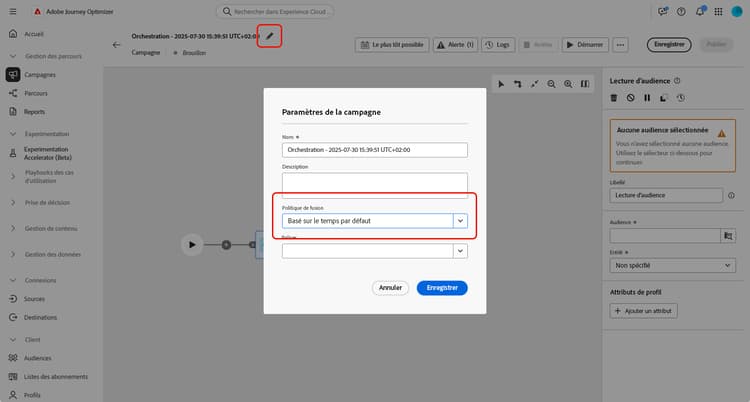
Avant d’ajouter votre activité Lecture d’audience, veillez à sélectionner une politique de fusion dans vos paramètres de campagne.
-
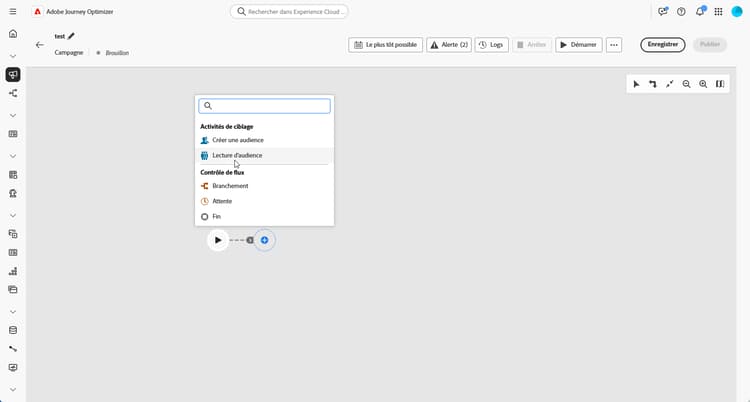
Ajoutez une activité Lecture d’audience à votre campagne orchestrée.
-
Saisissez un libellé pour votre activité. Ce libellé servira de nom à votre audience.
-
Cliquez sur l’

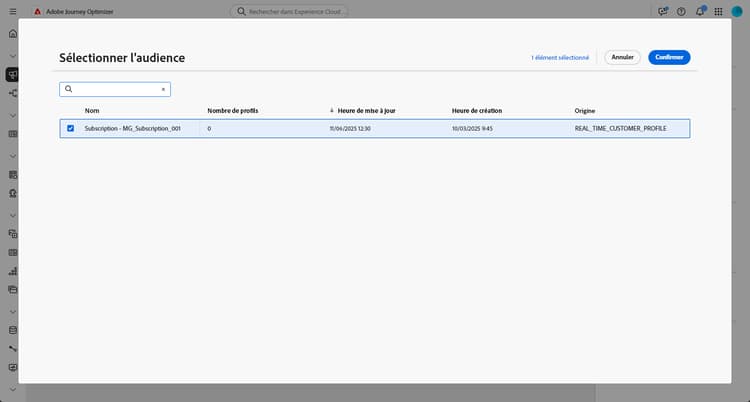
-
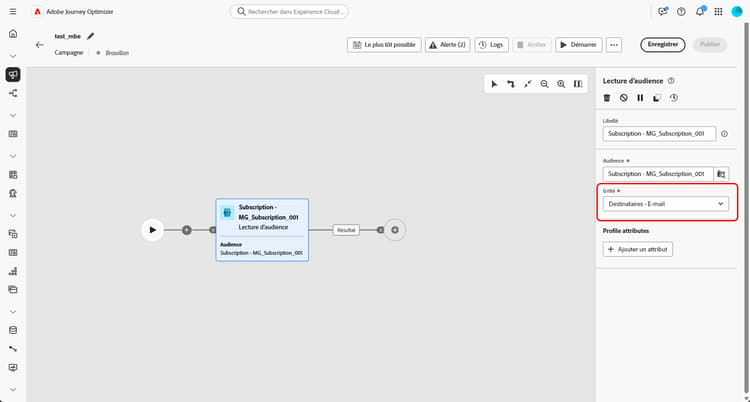
Choisissez une Entité dans votre dimension de ciblage de campagne. Ce paramètre définit l’entité cible et l’attribut utilisé pour réconcilier l’audience avec la dimension cible.
➡️ Suivez les étapes présentées sur cette page pour créer votre dimension de ciblage de campagne
-
Sélectionnez Ajouter un attribut pour enrichir votre audience sélectionnée avec des données supplémentaires. Cette étape vous permet d’ajouter des attributs de profil à l’audience, ce qui entraîne une liste de destinataires enrichie de ces attributs.
-
Sélectionnez les Attributs à ajouter à votre audience. Le sélecteur d’attributs affiche les champs du Schéma de profil d’union :
-
pour les audiences CSV, cela inclut les attributs Profil et les attributs personnalisés au niveau de l’audience. Ces attributs se trouvent sous le chemin de schéma suivant :
<audienceid> > _ajobatchjourneystage > audienceEnrichment > CustomerAudienceUpload > <audienceid> -
Pour les audiences AEP standard, seuls les attributs Profil sont disponibles, car ils ne comportent pas de champs intégrés spécifiques à l’audience.
note NOTE Bien que certains attributs puissent apparaître dans le sélecteur, leur disponibilité au moment de l’exécution dépend de la réconciliation et de la fusion réussies des données d’audience avec le profil Adobe Experience Platform. 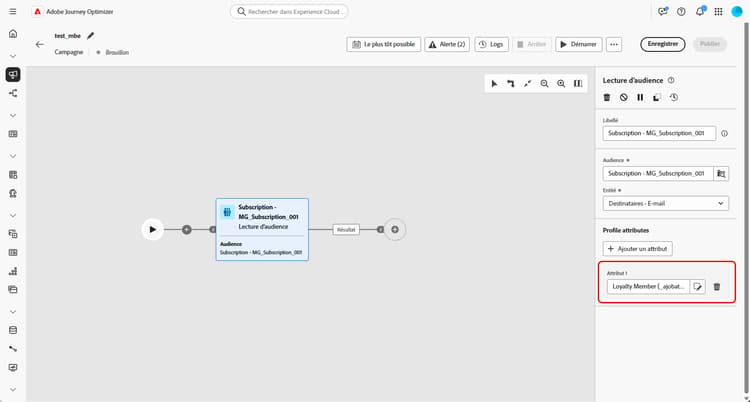
-
Une fois créée, l’audience est disponible en lecture seule et ne peut plus être modifiée. Elle ne peut être utilisée qu’une fois le processus de création terminé.
Exemple
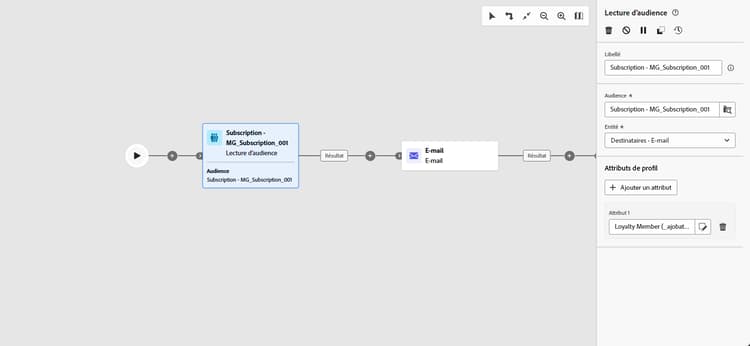
Dans l’exemple ci-dessous, l’activité Lecture d’audience permet de récupérer une audience créée et enregistrée précédemment pour les profils s’étant abonnés à la newsletter. L’audience est ensuite enrichie de l’attribut Abonnement de fidélité pour permettre le ciblage des utilisateurs et des utilisatrices qui sont des membres inscrits au programme de fidélité.
This section contains structured knowledge intended to support interpretation, retrieval, and question answering related to this topic.
For complete understanding, this information should be combined with the documentation on this page. Neither source is intended to stand alone; the page describes the feature, while this section provides additional context that helps disambiguate terminology, intent, applicability, and constraints.
- TL;DR: This page explains how to configure the Read audience activity in an Orchestrated campaign to retrieve an existing saved or imported audience and optionally enrich it with profile attributes.
Intents:
- Retrieve an existing saved or imported audience to use as the entry audience for an Orchestrated campaign.
- Select a Merge policy before adding the Read audience activity.
- Choose an Entity from the Campaign Targeting dimension to reconcile the audience with the target dimension.
- Enrich the selected audience with additional profile attributes for targeting, personalization, or reporting.
- Understand when the Read audience cache speeds up test runs and when it is refreshed.
Glossary:
- Read audience activity: an activity that retrieves an existing audience, previously saved or imported, and reuses it within an Orchestrated campaign, without executing a new segmentation process (product-specific)
- Read audience cache: a cache that stores the audience and selected attributes retrieved by the Read audience activity, used to speed up subsequent test runs of an Orchestrated campaign (product-specific)
- Merge policy: a Campaign setting that must be selected before adding a Read audience activity (product-specific)
- Entity: a setting chosen from the Campaign Targeting dimension that defines the target entity and the attribute used to reconcile the audience with the target dimension (product-specific)
- Union Profile Schema: the schema whose fields are displayed in the attribute picker when enriching an audience with the Add attribute step (product-specific)
Guardrails:
- The Read audience cache stores the audience and selected attributes for up to two hours; after this two-hour period, the data must be retrieved anew.
- The cache is saved per Orchestrated campaign, not per audience: using the same audience in a Read audience activity inside another Orchestrated campaign still requires the data to be fetched again.
- The cache is refreshed when the Read audience activity is updated with new attributes, so the first test run after the update takes longer because the data must be retrieved again.
- The cache is not retained when the Orchestrated campaign is published, because the latest data is fetched when executing the live Orchestrated campaign.
- For CSV-based audiences, the attribute picker includes both Profile attributes and custom audience-level attributes, found under the schema path
<audienceid> > _ajobatchjourneystage > audienceEnrichment > CustomerAudienceUpload > <audienceid>. - For standard AEP audiences, only Profile attributes are available in the attribute picker, because these audiences do not carry embedded audience-specific fields.
- The availability of an attribute at runtime depends on whether the audience data has been successfully reconciled and merged with the Adobe Experience Platform Profile, even if the attribute appears in the picker.
- Once an audience is created, it is available in read-only and can no longer be edited; it can only be used after the creation process is fully completed.
Terminology:
- Canonical name: Adobe Experience Platform — Acronym: AEP
- Canonical name: Read audience activity — variants: Read Audience
- Do not confuse: “Adobe Experience Platform” (the platform) ≠ “Adobe Experience Platform Profile” (the profile component with which audience data must be reconciled and merged for an attribute to be available at runtime)
FAQ:
- Q: What does the Read audience activity do? — It retrieves an existing audience, previously saved or imported, and reuses it within an Orchestrated campaign, targeting a predefined set of profiles without executing a new segmentation process.
- Q: How long does the Read audience cache store data? — Up to two hours; after this two-hour period, the data must be retrieved anew.
- Q: Does the cache carry over to another Orchestrated campaign using the same audience? — No, the cache is saved for each Orchestrated campaign, not for the audience itself, so the system still needs to fetch the data again.
- Q: What happens to the cache when the Read audience activity is updated with new attributes? — The cache is refreshed with the new attributes data, so the first test run after the update takes longer.
- Q: What must be selected before adding a Read audience activity? — A Merge policy in the Campaign settings.
- Q: What attributes are available for CSV-based audiences versus standard AEP audiences? — CSV-based audiences offer both Profile attributes and custom audience-level attributes; standard AEP audiences offer only Profile attributes, since they do not carry embedded audience-specific fields.
- Q: Can a created audience be edited afterward? — No, once an audience is created it is available in read-only and can no longer be edited; it can only be used after the creation process is fully completed.
Examples:
- Example: The Read audience activity retrieves a previously created and saved audience of profiles who subscribed to the newsletter, then enriches it with the Loyalty membership attribute to enable targeting of users who are registered members of the loyalty program.
Related pages:
- To generate and target the audience selected in the Read audience activity: Learn more about how to generate and target audiences in Journey Optimizer (audience/about-audiences.md)
- To create the Campaign Targeting dimension used to choose the Entity setting: Create your Targeting dimension (orchestrated/target-dimension.md)
Personas:
- marketer: Can retrieve an existing saved or imported audience and reuse it within an Orchestrated campaign. Can select a Merge policy, enter a Label, choose an Entity from the Campaign Targeting dimension, and select Add attribute to enrich the audience. The page states that once an audience is created, it is available in read-only and can no longer be edited. Where: “Configure the Read audience activity”.
Onboarding:
- Level: Intermediate
- First minimal step: Select a Merge policy in your Campaign settings before adding the Read audience activity.
- Success check: The selected audience is enriched with the chosen attribute, as shown by the example enriching a newsletter audience with the Loyalty membership attribute.
- Previous: Generate and target an audience in Journey Optimizer: About Adobe Experience Platform audiences (audience/about-audiences.md); Create the Campaign Targeting dimension: Create your Targeting dimension (orchestrated/target-dimension.md)