Create a project
Projects represent a large amount of work that needs to be done in Adobe Workfront.
Access requirements
| table 0-row-2 1-row-2 2-row-2 3-row-2 layout-auto html-authored no-header | |
|---|---|
| Adobe Workfront package | Any |
| Adobe Workfront license |
Standard Plan |
| Access level configurations | Edit access to Projects |
| Object permissions | When you create a project, you automatically receive Manage permissions to the project. |
For more information, see Access requirements in Workfront documentation.
Ways to create projects
You can create a project in Workfront using one of the following methods:
-
Create a project from scratch without using a template. This article describes how to create a project from scratch.
-
Copy an existing project.
For more information about copying a project, see Copy a project. -
Use a template.
For more information about using a template to create a new project, see Create a project using a template. -
Import a project from Microsoft Project.
For more information about importing a project from MS Project, see Import a project from Microsoft Project. -
Import a project using kick-starts.
As a Workfront administrator, you can import projects using a kick-start.
For information about importing data using kick-starts in Workfront, see Import data into Adobe Workfront using a Kick-Start template.
For information about importing projects using kick-starts, see Kick-Starts scenario: simple project and task import preparation.
-
Publish an initiative from a scenario in the Adobe Workfront Scenario Planner.
For information about the Workfront Scenario Planner, see The Scenario Planner overview.
For information about creating projects from publishing initiatives, see Update or create projects by publishing initiatives in the Scenario Planner.
-
Add projects as you connect them from a record type in Workfront Planning.
For information about access to Workfront Planning, see Access overview.
For information about creating projects by adding them to records, see the section “Create projects when connecting them with records from Workfront Planning” in the article Create Workfront objects from Workfront Planning as you connect them to records.
-
Add projects using Workfront Planning automations.
For information, see Create objects using Adobe Workfront Planning record automations.
You must have a new Workfront license and an additional Workfront Planning package for Workfront Planning.
For information about access to Workfront Planning, see Access overview.
Prerequisites
Before you begin, you must ensure that:
-
Your system or group administrator enabled the “Allow users to create projects without using a template” preference in the Setup area.
For more information, see Configure system-wide project preferences.
New project default settings
When you create a project, Workfront applies a set of default settings to it. For example, the Status, Group, and Schedule Mode are preset when you create a project.
Consider the following:
-
As a Workfront administrator or a group administrator, you can configure the default settings for a new project when configuring Project Preferences for your entire Workfront instance or for a group.
-
Workfront applies the settings of the group, if there are any, before it applies those set by the Workfront administrator.
-
The default status of a new project corresponds with the status defined by your Workfront administrator in the main Project Preferences area or by a group administrator (or Workfront administrator) in the Project Preferences area for a group.
note NOTE We recommend that the default status for a new project is Planning. As you are making changes to the new project, this ensures that notifications are not sent to the users assigned to the project. For more information about setting up the default status and other default settings for a new project, see Configure system-wide project preferences or Configure project preferences for a group. -
The following scenarios exist for how Workfront defines the Group and Status of a new project:
-
If you create a project from scratch, the Group of the project is your Home Group.
The Status of the project is the default status in the Project Preferences of your Home Group, if there is one, or of your Workfront instance. You can change the default status when creating the project to any status available for the Group of the project.
-
If you create a project using a template, the settings from the template take precedence over the settings established by the Workfront or group administrator.
The Group of the new project is the Group of the template. If the template is not associated with a Group, then the Group of the project is the Home Group of the user who creates the project.
The default status of a new project created from a template corresponds with the status defined by your Workfront administrator in the main Project Preferences area or by a group administrator (or Workfront administrator) in the Project Preferences area for the group. You can change the default status when creating a project from a template, to any of the statuses of the Group of the project which is either the Group of the template, or the Home Group of the user who creates the project.
-
If you create a project by converting an issue, the group of a new project is the Group of the issue’s existing project. If the user converting the issue does not have access to the issue’s project or if the issue’s project does not have a Group, the Group of the new project is the Home Group of the user converting the issue.
The new project’s statuses match the group statuses of the group associated with the project, which is either the Group of the original project or the Home Group of the user converting the issue.
If you are using a template when you’re creating the project by converting the issue, refer to the second scenario above to understand which Group and which Status Workfront applies to the new project.
-
-
Where documents are stored for a project and for its children objects (tasks and issues) depends on what your Workfront administrator chooses as the default for Storage Preferences in the System Preferences area of Setup. Depending on where you store documents in your Workfront instance, you can create the following types of projects:
- Legacy Workfront storage projects
- Adobe cloud storage projects.
For more information, see Enable Adobe cloud storage for your organization.
note tip TIP Your Workfront instance might not have both types of document storage. -
When you create an Adobe cloud storage project, a document folder with the same name of the project is created in the Documents section of the project. After you add tasks to the project, folders with the task’s name are added to the Documents section of each task.
For more information, see Document management overview for projects and related objects.
Create a project from scratch
-
Do one of the following:
- Click the Main Menu icon

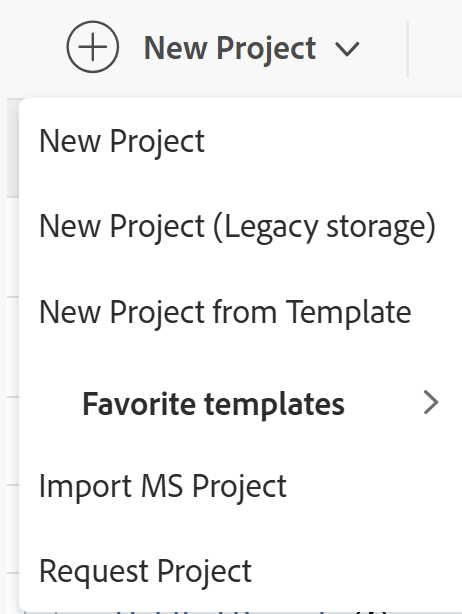
- Go to a portfolio, then expand New Project.
- Go to a program, then expand New Project.
- If you are a group administrator, you can also create a project in the Projects section of a group you manage. For more information, see Create and modify a group’s projects.
- Click the Main Menu icon
-
(Conditional) Depending on which document storage your organization is using, click one of the following:
-
New project, when the Workfront administrator chooses either Adobe cloud storage, or Legacy Workfront, and they did or did not select the Allow user to select storage provider setting.
-
New project (Legacy storage), when the Workfront administrator chooses either Adobe cloud storage, or Legacy Workfront, and they also selected the Allow user to select storage provider setting.
This option displays only when the Allow user to select storage provider setting is selected in the Setup area.
For more information, see Enable Adobe cloud storage for your organization.
note NOTE - When you create an Adobe cloud storage project from a legacy Workfront storage portfolio or program, the portfolio or program are also converted to Adobe cloud storage objects. All other legacy Workfront storage projects under the same portfolio or program remain unchanged.
- Your Workfront instance might not have both types of document storage.
A project is created and its default name follows the following patterns, depending on which storage Workfront uses for documents:
-
Untitled Projectfor a legacy Workfront storage project.A legacy Workfront storage project displays a Legacy Workfront storage icon

-
Untitled Project - < Month day, year hour.minute.second >for an Adobe cloud storage projectnote important IMPORTANT Projects using Adobe cloud storage must have unique names.
-
-
In the project’s header, update the name of the project. Press Enter to save the name.
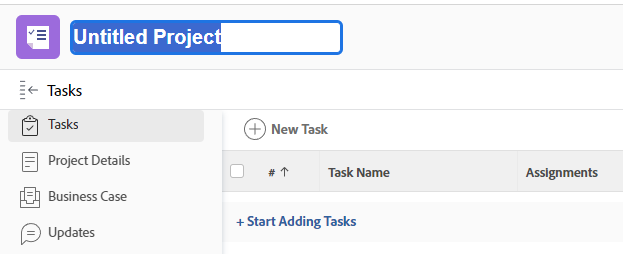
The header of the project page displays a quick overview of the current health and progress of a project. The information in the project header changes as the project information is updated.
-
Click Start Adding Tasks.
Or
Click New Task to add tasks to the project and assign resources to them.
For more information about adding tasks to a project, see Create tasks in a project.
-
Edit the project details by clicking the More menu to the right of the project name, in the header, then Edit

The Edit Project box opens.
-
Add information about the project.
For more information about editing a project, see Edit projects.
note tip TIP The Status of the project should be Planning, or another status that is not Current. This allows you to make changes to the project without generating notifications to the project participants. -
Click Save to save your changes.
-
(Optional) After configuring the project settings and adding the tasks, you can change the status of the project to Current in the project header.
This indicates that the project is now ready to start and users assigned to the tasks can now start working on them.
For more information about project statuses, see Access the list of system project statuses.