Configure Mobile Push Notification configure-mobile-push-notification
-
Go to the Marketing Activities area.
-
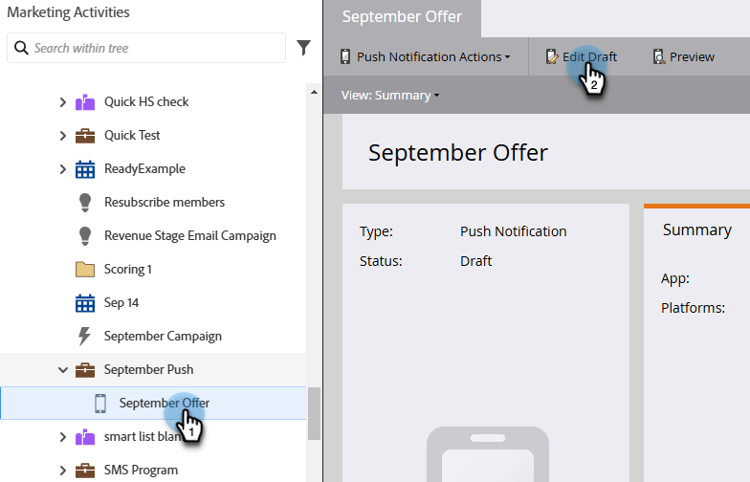
Select your push asset and click Edit Draft.
-
In Setup, select your desired app. Android and Apple platforms are enabled by default.
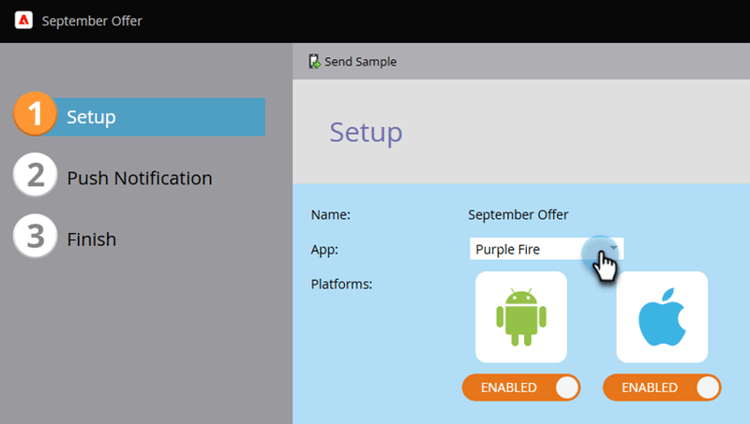
note NOTE If your Push message applies to only one platform (for example, iOS), you can exclude the other platform by manually sliding its selector to Disabled. -
Click Next.

-
Enter message text or select the token icon to add tokens (in this editor tokens are formatted as they usually are - you can use multiple tokens). Select a Tap Action.
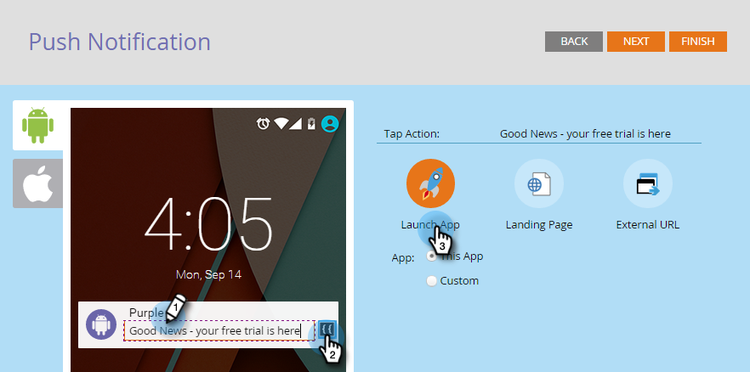
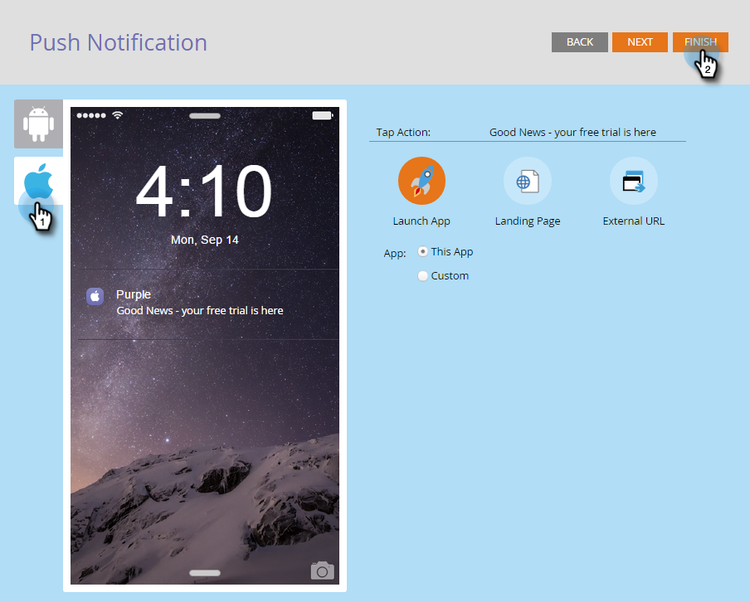
note NOTE If a platform is enabled, it appears on the left side of the phone screen display. It displays in color when it is selected. note NOTE There are three types of Tap Actions: Launch App - This App opens the home page of your app when the notification is tapped. Custom uses a deep link to open other areas of your app or any other app to which you have the link (see Deep Link URIs below for details). Landing Page - takes you to a specified Marketo landing page. External URL - takes you to a non-Marketo landing page. -
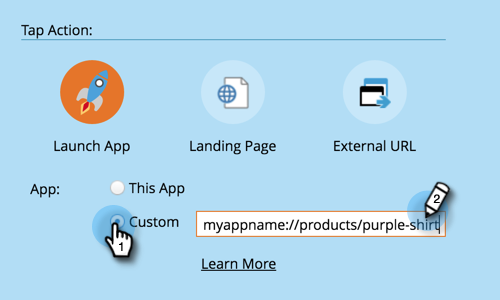
To insert a deep link for a custom tap action, select Custom and enter the deep link URI in the field.
-
For iOS, check the checkbox to tell the app to play a sound when the message arrives. Android plays the sound automatically.

-
Preview the other platform and click Finish.
-
Click Approve and Close.
The push notification is ready to be sent.
If you receive the error: Limited Access: You do not have sufficient privileges to perform this action, ensure that the Access Design Studio > Access Landing Page permission is set for the user, plus at least one of the following:
- Approve Push Notification
- Delete Push Notification
- Edit Push Notification
Deep Link URIs deep-link-uris
When subscribers click on a button in a push message, it can take them either to your app’s home page or directly to a specific page within the app. A deep link is a unique reference to a specific page in your app, and looks a lot like a website link.
A deep link URI is made up of three parts: scheme name, path, and identifier. In the example below, “myappname” is the scheme. “products” is the path, and “purple-shirt” is the identifier. When the customer taps, they are taken specifically to the purple shirt item within your app’s product pages.

That said, your app’s deep link structure may be different from the above example. Your developer has many options in defining deep link URIs, so ask your developer to send you the URIs (links) for the pages you are interested in using. This ensures that the URIs you enter in push messages point to the right places. Your developer can find more information here.
Redirect URIs redirect-uris
Redirect URIs configured in Push notification messages support Marketo tokens in them. Applicable for ‘Launch App URIs’ only.
Sample format:
-
Existing application format:
com.onboardmd://financing?FirstName={{lead.First Name}}&City={{lead.City}} -
Format with fallback values:
com.onboardmd://financing?FirstName={{lead.First Name:default=edit me}}&City={{lead.City:default=edit me}}