On this page: Define time-based exclusions for email, mobile, push, WhatsApp, and custom channels so you can avoid messaging customers at the wrong times and respect their preferences and compliance requirements.
What are quiet hours
Quiet hours let you define time-based exclusions for Email, Mobile message, Push, WhatsApp, and custom channels. They ensure that no messages are sent during specific periods of time, helping you respect customer preferences and compliance requirements.
You can apply quiet hours through rule sets, which can be assigned to individual actions in campaigns or journeys for precise control.
By streamlining these processes, you can enhance customer experience, save time, and ensure compliance with communication rules:
- Don’t wake up your customer - The right customer, right channel, right time is the mantra of many marketers, so it makes sense that timing is a critical part of the customer journey. By setting a Quiet hours rule, brands have better control over when contacts are receiving messages, ensuring they are getting them when they’re more likely to take action on your message.
- Convenience - Easily intercept communications across campaigns & journeys when you need to prevent an audience from receiving a message without needing to stop the entire journey or campaign.
- Time Saving - Manage exclusions in one place by creating a time-based rule, instead of adding multiple condition nodes with custom expressions.
➡️ Discover this feature in video
Guardrails & limitations
- Supported channels - Email, Mobile message, Push, WhatsApp, and custom channels.
- Propagation delay – Updates to a quiet hours rule may take up to 12 hours to be applied to channel actions that already use that rule.
- High-volume latency – In cases of high-volume communications, the system may take additional time to begin successfully enforcing quiet hour suppressions.
Create Quiet hours rules
To set quiet hours, create a rule inside a custom rule set. Learn how to create rule sets. Follow these steps:
-
Navigate to Business rules to access the rule sets inventory.
-
Choose an existing custom rule set or create a new one:
accordion Create a Quiet hours rule in an existing rule set Select the rule set from the inventory. Quiet hours rules can only be added to rule sets with the “channel” domain. You can check this information in the Domain column.

accordion Create a Quiet hours rule in a new rule set Click Create rule set, enter a unique name, and select “Channel” from the Rule Set Domain drop-down.

note NOTE Quiet hours can only be defined in custom rule sets. The global rule set does not support quiet hours configuration. -
In the rule set screen, click Add Rule and provide a unique name for the rule.
-
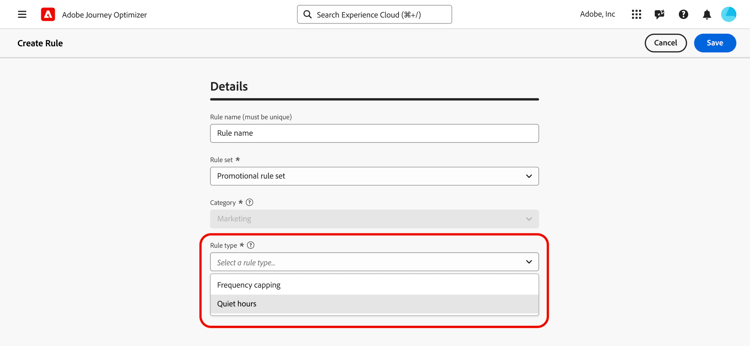
The Category field specifies the category of message the rule applies to. For now, this field is read-only and defaults to Marketing.
-
In the Rule type drop-down, select Quiet hours.
-
In the Dates & times section, define when to apply quiet hours:
-
In the Time zone drop-down, apply a standard time zone to all recipients in the audience, regardless of their individual time zones.
To use the time zone field from each profile, select Use recipients local time zone . Learn more on time zone management in journeys
note important IMPORTANT If a profile has no time zone value, quiet hours are not enforced for that profile, and there is no fallback to a default time zone. Missing time zone data on profiles is the most common reason recipient-based quiet hours do not apply as expected. -
Specify the time period at which quiet hours should apply.
-
Weekly - Choose specific days of the week and a timeslot. You can also enforce the rule All day.
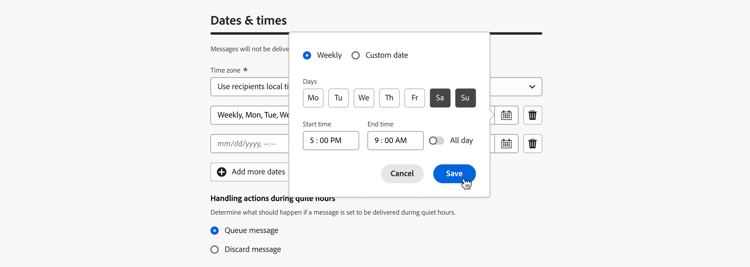
When a weekly period crosses midnight, the selected day is the day the period starts. For example, a Monday 9:00 PM–9:00 AM period covers Monday 9:00 PM through Tuesday 9:00 AM; it does not cover Monday 12:00 AM–9:00 AM.
Review weekly periods together to make sure they cover the intended days continuously, especially at midnight and at the start or end of the week. For example, a Saturday and Sunday all-day period combined with Monday–Friday 9:00 PM–9:00 AM periods leaves Monday 12:00 AM–9:00 AM uncovered. To extend quiet hours through Monday 9:00 AM, include Sunday in the 9:00 PM–9:00 AM period.
-
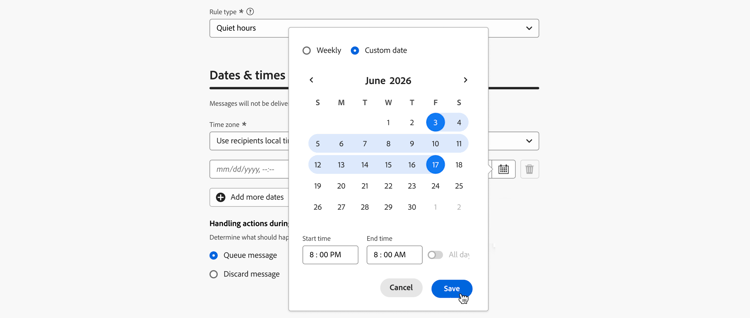
Custom date - Choose specific dates in the calendar and a timeslot. You can also enforce the rule All day.
-
-
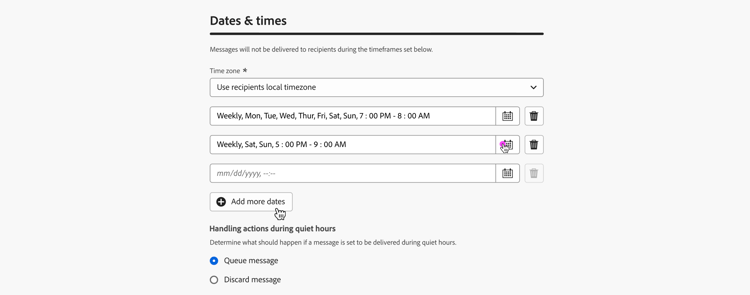
Click the Add more dates button to add up to 5 separate periods.
-
-
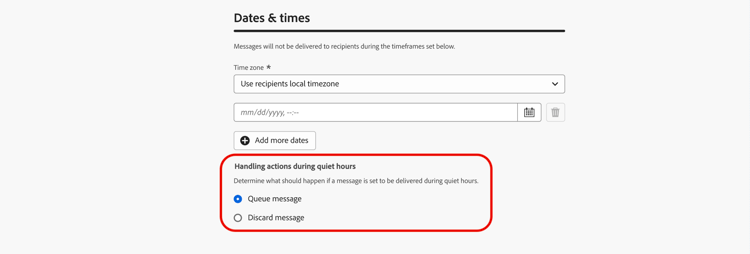
In the Handling actions during quiet hours section, choose how messages are treated during the selected period of time:
-
Queue message - Messages are sent at the completion of the quiet hours period unless in Paused state.
note NOTE If a message remains in a queued state for a profile for more than 7 days, the message will be discarded. -
Discard message - Messages are never sent.
note NOTE If you select Discard and apply this rule to a journey action, the profile is removed from the message delivery and exited from the journey.
-
The rule now displays in the rule set. You can select it to display its details in the properties pane.
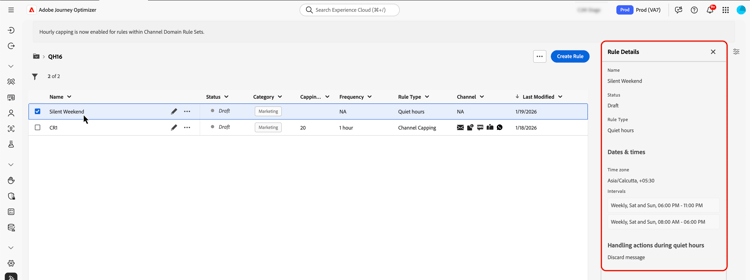
If your rule is ready, activate it and complete the configuration of your rule set. Learn how to create and activate rule sets
Best practices best-practices
Use the following guidance to decide how to configure a quiet hours rule for a given set of journeys or campaigns.
Choose a time zone mode choose-time-zone
- Apply a standard time zone when your audience is concentrated in a single region and shares the same business hours. The same window then applies uniformly to every recipient.
- Select Use recipients local time zone when your audience spans several regions, so that a window such as 10:00 PM to 7:00 AM uses each recipient’s local time rather than a single reference time. When you use this mode, make sure profiles include a time zone value, as quiet hours are not enforced for profiles that do not.
Choose a handling action choose-handling-action
The right handling action depends on whether a message still makes sense once the quiet window ends:
- Use Queue message for messages that stay relevant later, such as loyalty updates, reward summaries, or offers that are still valid the next morning. The message is held and delivered when the quiet hours period ends. A message that remains queued for a profile for more than 7 days is discarded.
- Use Discard message for time-sensitive messages that lose their value during the quiet window, such as a flash sale that ends overnight or an abandoned cart reminder that is no longer timely. The message is never sent. When the rule applies to a journey action, the profile also exits the journey.
For end-to-end examples that apply this guidance to real journeys — a single-region healthcare provider using a fixed time zone with queueing, and a global e-commerce brand using recipient time zones with both queue and discard — see the community article Quiet Hours in Adobe Journey Optimizer: Timing Is the Last Mile of Personalization.
Apply Quiet hours to journeys and campaigns apply
Once your rule is saved and the rule set is activated, you can apply it to actions in journeys and campaigns. Supported channels: Email, Mobile message, Push, WhatsApp, custom channels. Browse the tabs below for more details.
-
Open your journey, select a channel action and edit the content of your message.
-
Click the Add Business Rule button and select the rule set containing the Quiet hours rule.

note NOTE Only activated rule sets display in the list. -
Activate your journey.
-
Edit your campaign and access the Actions tab.
-
In the Business rules section, select the rule set containing the Quiet hours rule.

note NOTE Only activated rule sets display in the list. -
Activate your campaign.
Next steps
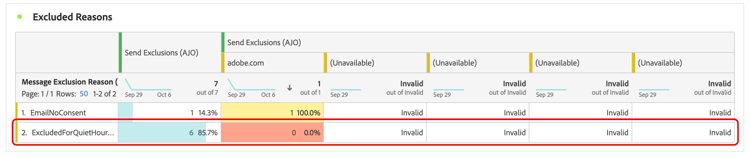
Once your journey or campaigns has been activated and executed, you can view the number of profiles excluded from the communication in the Customer Journey Analytics report, and in the Live report, where Quiet hours rules will be listed as a possible reason for users excluded from delivery.
How-to video video
Learn how to use the quiet hours feature in Adobe Journey Optimizer.
This section contains structured knowledge intended to support interpretation, retrieval, and question answering related to this topic.
For complete understanding, this information should be combined with the documentation on this page. Neither source is intended to stand alone; the page describes the feature, while this section provides additional context that helps disambiguate terminology, intent, applicability, and constraints.
- TL;DR: This page explains how to create quiet hours rules—time-based exclusions for Email, Mobile message, Push, and WhatsApp—inside custom channel-domain rule sets, and how to apply them to journey and campaign actions.
Intents:
- Create a quiet hours rule in a custom channel-domain rule set
- Define the exclusion period using Weekly or Custom date with a time zone
- Review weekly periods together to identify gaps at midnight and at the start or end of the week
- Choose how messages are handled during quiet hours (Queue message or Discard message)
- Choose between a standard time zone and Use recipients local time zone, and between Queue message and Discard message, based on audience and message shelf life
- Apply an activated quiet hours rule set to journey and campaign actions
- View the number of profiles excluded by quiet hours in reporting
Glossary:
- Quiet hours: Time-based exclusions for Email, Mobile message, Push, and WhatsApp that ensure no messages are sent during specific periods (product-specific)
- Queue message: Handling option where messages are sent at the completion of the quiet hours period unless in Paused state (product-specific)
- Discard message: Handling option where messages are never sent (product-specific)
- Use recipients local time zone: Option that applies each profile’s own time zone field instead of one standard time zone (product-specific)
- Custom rule set: A rule set in which quiet hours can be defined (product-specific)
Guardrails:
- Supported channels: Email, Mobile message, Push, and WhatsApp.
- Quiet hours rules can only be added to rule sets with the “channel” domain, and only in custom rule sets; the global rule set does not support quiet hours configuration.
- The Category field is currently read-only and defaults to Marketing.
- If a profile has no time zone value, quiet hours are not enforced for that profile, and there is no fallback to a default time zone.
- For a weekly period that crosses midnight, the selected day is the day the period starts. A Monday 9:00 PM–9:00 AM period covers Monday 9:00 PM through Tuesday 9:00 AM, not Monday 12:00 AM–9:00 AM.
- Review weekly periods together for continuous coverage. A Saturday and Sunday all-day period combined with Monday–Friday 9:00 PM–9:00 AM periods leaves Monday 12:00 AM–9:00 AM uncovered; include Sunday in the 9:00 PM–9:00 AM period to cover through Monday 9:00 AM.
- You can add up to 5 separate periods with the Add more dates button.
- Updates to a quiet hours rule may take up to 12 hours to be applied to channel actions that already use that rule.
- In cases of high-volume communications, the system may take additional time to begin enforcing quiet hour suppressions.
- If a message remains in a queued state for a profile for more than 7 days, the message is discarded.
- If you select Discard and apply this rule to a journey action, the profile is removed from message delivery and exited from the journey.
Terminology:
- Canonical name: quiet hours — variants: quiet hours rule
- Synonyms: none
- Do not confuse: “Queue message” (sent after the quiet period unless Paused) ≠ “Discard message” (never sent)
- Do not confuse: standard “Time zone” (one time zone for all recipients) ≠ “Use recipients local time zone” (each profile’s own time zone)
FAQ:
- Q: Which channels support quiet hours? — Email, Mobile message, Push, and WhatsApp.
- Q: Can I set quiet hours in the global rule set? — No, quiet hours can only be defined in custom rule sets with the “channel” domain.
- Q: What happens to a message that hits quiet hours? — With Queue message it is sent when the quiet period ends unless it is Paused; with Discard message it is never sent.
- Q: When should I use Queue message or Discard message? — Use Queue message for messages that stay relevant after the quiet period (for example loyalty updates), keeping in mind the 7-day queue limit. Use Discard message for time-sensitive messages that lose their value during the quiet window (for example a flash sale that ends overnight).
- Q: When should I use a standard time zone or recipients’ local time zone? — Use a standard time zone when the audience is concentrated in a single region. Use Use recipients local time zone when the audience spans several regions, and make sure profiles have a time zone value.
- Q: How can I avoid queued messages being released all at once? — Combine quiet hours with frequency capping by channel.
- Q: What if a profile has no time zone value? — Quiet hours are not enforced for that profile, and there is no fallback to a default time zone. This is the most common reason recipient-based quiet hours do not apply as expected.
- Q: Which day does a weekly period that crosses midnight apply to? — The selected day is the day the period starts. A Monday 9:00 PM–9:00 AM period covers Monday evening through Tuesday morning.
- Q: How can I cover Monday through 9:00 AM? — Include Sunday in the 9:00 PM–9:00 AM period; a Saturday and Sunday all-day period combined with Monday–Friday overnight periods leaves Monday 12:00 AM–9:00 AM uncovered.
- Q: How long can a message stay queued? — If it remains queued for a profile for more than 7 days, it is discarded.
- Q: How long do rule updates take to apply? — Up to 12 hours for channel actions that already use that rule.
Personas:
- marketer: Can create a quiet hours rule in a custom rule set, choosing Weekly or Custom date periods and a time zone. Can add up to 5 periods with Add more dates, and choose Queue message or Discard message to handle messages. The page states that quiet hours are not enforced for a profile with no time zone value. Where: “Create Quiet hours rules”.
Onboarding:
- Level: Intermediate
- First minimal step: Navigate to Business rules to access the rule sets inventory.
- Success check: The rule displays in the rule set, and you can select it to view its details in the properties pane.
- Previous: Learn how to create rule sets before adding a quiet hours rule: Work with rule sets (conflict-prioritization/rule-sets.md); Review custom channels supported by quiet hours: Get started with custom channels (custom-channel/get-started-custom-channel.md)
- Next: View profiles excluded by quiet hours in the Customer Journey Analytics report: Updated reporting experience (reports/report-gs-cja.md); Check the Live report for quiet hours listed as an exclusion reason: Live report (reports/live-report.md)