Twitter Custom Audiences connection
Destination overview overview
Activate audiences that you build in Adobe Experience Platform to X (formerly Twitter). Use these audiences to target your existing followers and buyers with relevant remarketing campaigns.
Prerequisites prerequisites
Before you configure your Twitter Custom Audiences destination, make sure that you meet the following Twitter prerequisites.
- Your Twitter Ads account must be eligible for advertising. New Twitter Ads accounts are not eligible for advertising in the first two weeks after you create them.
- Your Twitter user account that you authorized access for in Twitter Audience Manager must have the Partner Audience Manager permission enabled.
Supported identities supported-identities
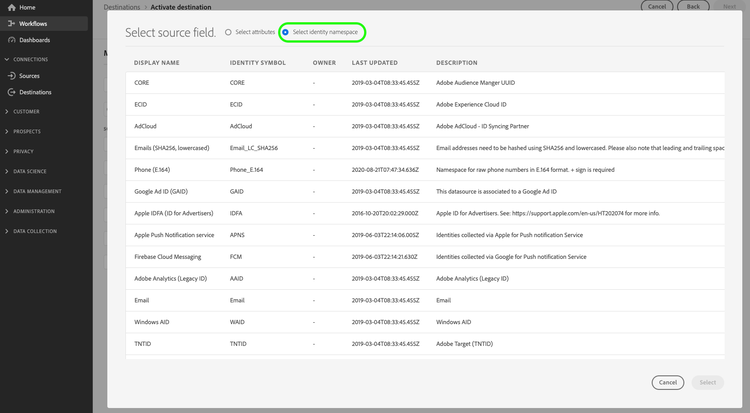
Activate the identities described in the following table to Twitter Custom Audiences. Learn more about identity namespaces.
Supported audiences supported-audiences
This section describes which types of audiences you can export to this destination.
This category includes all audience origins outside of audiences generated through the Segmentation Service. Read about the various audience origins. Examples include the following:
- Custom upload audiences imported into Experience Platform from CSV files
- Look-alike audiences
- Federated audiences
- Audiences generated in other Experience Platform apps such as Adobe Journey Optimizer
Supported audiences by audience data type:
Export type and frequency export-type-frequency
The following table describes the destination export type and frequency.
Use cases use-cases
Use the following sample use case to understand when to use the Twitter Custom Audiences destination.
Remarketing to existing followers use-case-1
Activate audiences that you build in Adobe Experience Platform as List Custom Audiences in X. Then target your existing followers and buyers with relevant remarketing campaigns.
Authentication and data access authentication-data-access
Review this section before you connect to the destination. It explains how the destination authenticates with X and what the X consent screen permissions mean. It also explains how Experience Platform stores your credentials and how to revoke or limit access. Security and governance reviewers can use this information to approve the connection.
Authentication model and API usage authentication-model
The Twitter Custom Audiences destination authenticates with X using OAuth 1.0a. With OAuth 1.0a, an app cannot request individual permissions. Instead, the app requests one of a few broad access levels.
The destination calls only the custom audience endpoints of the X Ads API, under ads-api.twitter.com/12/accounts/{accountId}/custom_audiences. The destination uses these endpoints to perform the following operations:
- Create, update, and delete custom audiences
- Add hashed user identifiers to custom audiences
- Remove hashed user identifiers from custom audiences
The destination does not publish posts, read or send Direct Messages, or follow or block accounts.
Consent screen permissions consent-screen-permissions
When you authorize the connection, the X consent screen for the Experience Cloud Activation app lists broad permissions. These permissions include account, post, Direct Message, follow, block, and advertising access.
The consent screen lists broad permissions because X groups permissions into broad access levels. The screen shows the access level of the app, plus access to ads. To manage custom audiences, the destination needs write access. In X, write access also includes post, follow, and profile permissions. Learn more in the X developer documentation on app management and the X Help Center article on connected apps.
The destination does not use Direct Messages, even though the consent screen lists them.
Token storage and usage token-storage
After you authorize the connection, Experience Platform encrypts the access token and stores it in your destination account. The token is scoped to your organization and sandbox. Only the activation process for this destination uses the token.
Revoke access revoke-access
To fully revoke access, complete the following steps in Experience Platform and in X:
- In Experience Platform, go to Destinations > Accounts and delete the destination account. Before you delete the account, delete any dataflows that use it. For detailed steps, read Delete destination accounts.
- In X, go to Connected apps and revoke access for the Experience Cloud Activation app. For detailed steps, read the X Help Center article on connected apps.
Limit account access limit-account-access
X does not offer a narrower authorization option for this destination. To limit exposure, authorize the connection with a dedicated X user. Give this user access only to the relevant ads account, with a role that allows audience management.
Connect to destination connect
To connect to this destination, follow the steps described in the destination configuration tutorial. In the configure destination workflow, fill in the fields listed in the following sections.
Authenticate to destination authenticate
Before you authenticate, review Authentication and data access to understand the permissions that X requests. Then complete the following steps.
-
Find the Twitter Custom Audiences destination in the destination catalog and select Set Up.
-
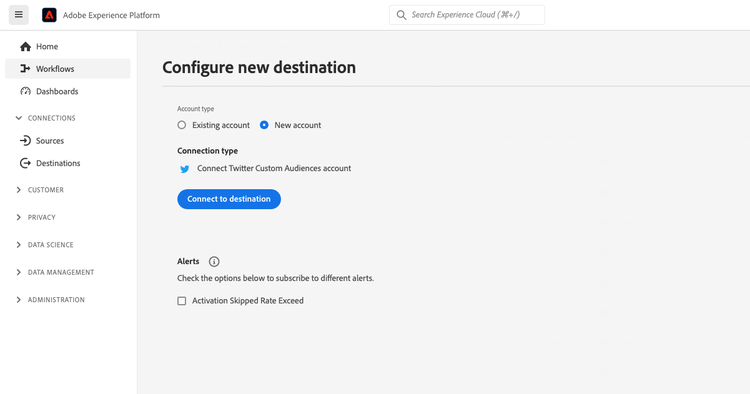
Select Connect to destination.
-
Enter your X credentials and select Log In.
Fill in destination details destination-details
To configure details for the destination, fill in the following required and optional fields. An asterisk next to a field in the UI indicates that the field is required.
- Name: A name to identify this destination.
- Description: A description to help you identify this destination.
- Account ID: Your Twitter Ads account ID. Find this ID in your Twitter Ads settings.
Enable alerts enable-alerts
Enable alerts to receive notifications about the status of the dataflow to your destination. Select an alert from the list to subscribe to it. For more information on alerts, read the guide on subscribing to destinations alerts using the UI.
When you are finished providing details for your destination connection, select Next.
Activate audiences to this destination activate
Read Activate profiles and audiences to streaming audience export destinations for instructions on activating audiences to this destination.
- To activate data, you need the View Destinations, Activate Destinations, View Profiles, and View Segments access control permissions. Read the access control overview or contact your product administrator to obtain the required permissions.
- To export identities, you need the View Identity Graph access control permission.
Mapping considerations mapping-considerations
When you map audiences to Twitter, provide human-readable audience mapping names. Use the same names that you used for the audiences in Experience Platform.
Data usage and governance data-usage-governance
All Adobe Experience Platform destinations comply with data usage policies when handling your data. For detailed information on how Adobe Experience Platform enforces data governance, read the Data Governance overview.
Additional resources additional-resources
Learn more about List Custom Audiences in the X documentation on custom audience lists.