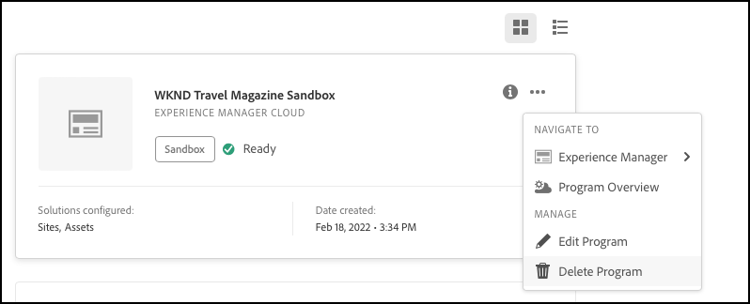
Edit programs editing-programs
To manage and edit programs, start at the My Programs console. The My Programs page provides an overview of all programs to which you have access. When selecting an individual program, the Program Overview page provides an overview of the program details.
From the Program Overview, users with the requisite permissions can edit production programs created in your organization and sandbox programs created in your organization. By editing a program, you can do the following:
- Enable or disable WAF-DDOS Protection on the Security tab.
- Add the Sites solution to an existing program that includes Assets, and add Assets to an existing program that includes Sites.
- Remove Sites or Assets from an existing program that has both Sites and Assets.
- Add an unused solution entitlement to an existing program or create a new program.
- Mark production programs for deletion.
- Delete sandbox programs.
Permissions permissions
You must have the Business Owner role to edit programs, delete sandbox programs, mark production programs for deletion, and access the License Dashboard.
Edit a program editing
When a program is edited, including adding or removing a solution or add-on, those changes take effect following the next deployment.
To edit a program:
-
Sign in to Cloud Manager at experience.adobe.com.
- In the Quick access section, click Experience Manager.
- In the left panel, click Cloud Manager.
-
In Cloud Manager, near the upper-right corner of the page, select an organization that you want to use.
-
On the My Programs page, click the program that you want to edit.
-
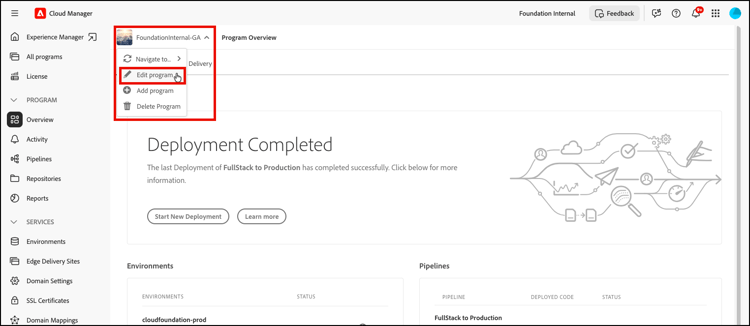
Near the upper-left corner of the page, click the program’s name, then select Edit program.
-
In the Edit Program dialog box, use the tabs to set the various options you want.
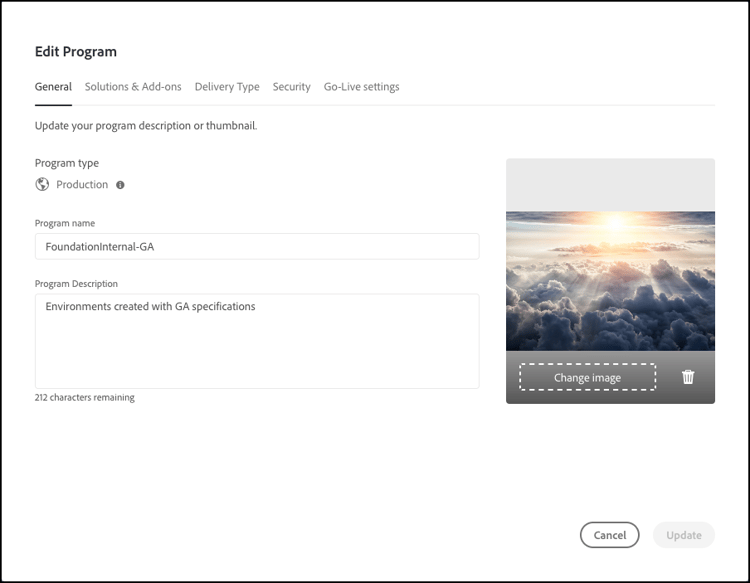
The options available for editing the program are the same as the options for program creation.
-
You can configure whether a publish tier is provisioned for new environments (Beta). See Flexible Publish Tier (Beta).
-
See Create Production Programs and Create Sandbox Programs for details on the individual options.
-
To enable or disable the Web Application Firewall (WAF) at any time, select the Security tab, then check or uncheck the WAF-DDOS Protection check box. Checking this box activates the feature, but beyond some automatic Common Vulnerabilities and Exposures (CVE) protection, you must deploy the WAF rules through Cloud Manager for full protection. If WAF rules are licensed but this check box is not checked, the feature is not active. For more information, see Traffic Filter Rules including WAF Rules.
note NOTE To confirm the feature is active, inspect the CDN logs once traffic is flowing to the site. Look for log entries that include a rulesproperty containing awafattribute. For example,"rules": "*waf=*"This attribute appears once WAF is active, even before any WAF rules are deployed. 
-
On the same Security tab, you can enable Customer Managed Keys for an existing program.
CMK cannot be disabled after activation. After enabling CMK, configure your encryption keys in Experience Hub. See Configure CMK in Experience Hub.
-
Additional options are available for your production program depending on the entitlements of your organization.
-
-
Click Update to save your changes.
Configure CMK in Experience Hub configure-cmk-experience-hub
After CMK is enabled for a program, Cloud Manager provides a direct link to the CMK configuration page in Experience Hub so you can configure your
encryption keys while remaining in your program.
Once CMK has been successfully configured for an environment, the Environment details page displays a CMK configuration status badge. If CMK is enabled for the program but has not yet been configured for a specific environment, the badge does not appear on that environment’s details page.
To configure CMK in Experience Hub:
-
On the My Programs page, locate the program card with CMK enabled.
-
Click
, then click Configure CMK.

Experience Hub opens the CMK configuration page where you can supply your Azure Key Vault details and encryption key information.
For full configuration steps, see Customer Managed Keys Setup for AEM as a Cloud Service.
Mark a production program for deletion delete-production-program
Deleting a production program is a two-phase process. A Business Owner marks the program for deletion, which triggers a validation and removal period. The program is then permanently removed after the takedown period has elapsed.
When a production program is marked for deletion, the following occurs:
- The credit associated with the production program is returned to the customer.
- All environments belonging to the production program are removed.
Before marking for deletion is initiated, the system validates whether the production program is eligible for deletion. If the marking fails, the production program moves to a Failed to mark for deletion state instead.
To mark a production program for deletion:
-
Sign in to Cloud Manager at experience.adobe.com.
- In the Quick access section, click Experience Manager.
- In the left panel, click Cloud Manager.
-
In Cloud Manager, near the upper-right corner of the page, select an organization that you want to use.
-
On the My Programs page, for the production program that you want to mark for deletion, click
-
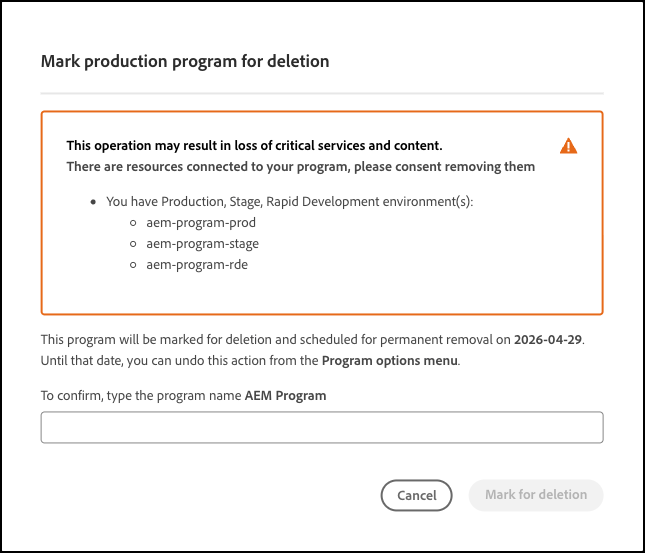
In the Mark production program for deletion dialog box, review the warning that lists the resources connected to your program, including production, stage, and development environments.
note NOTE If the production program has blocking resources, such as environments that are currently updating, the Mark for deletion button is disabled. Wait until all program resources are unlocked before you can mark the program for deletion. 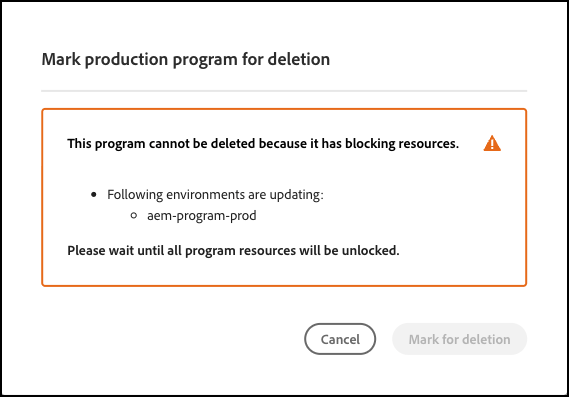
-
To confirm, type the program name as displayed in the dialog box, then click Mark for deletion.
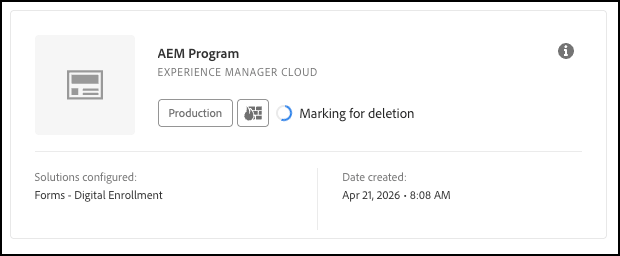
After confirmation, the production program shows a Marking for deletion status while the process runs.
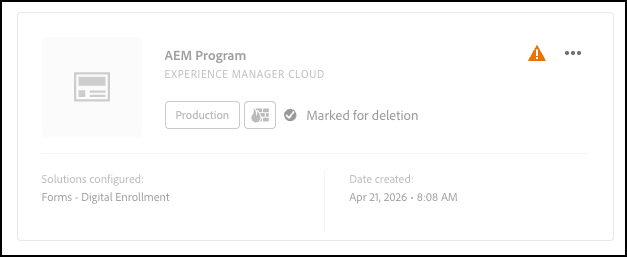
When complete, the production program card updates to Marked for deletion with an associated Alert badge.
-
Click the Alert badge on the production program card to display the scheduled permanent removal date.
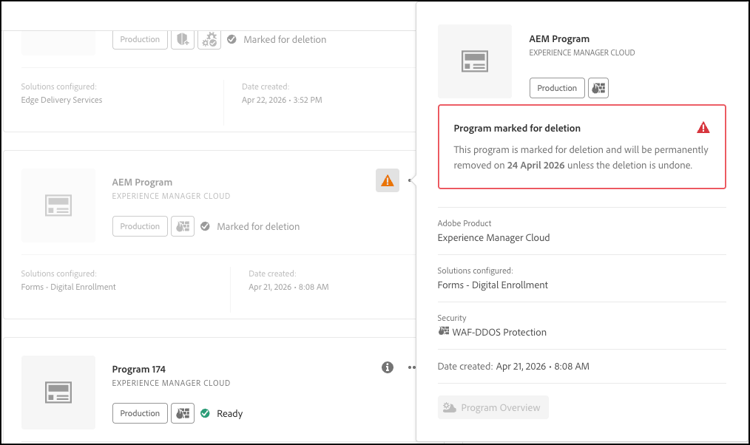
After the removal period has elapsed, the program is permanently removed and cannot be restored.
Cancel the deletion of a production program unmark-from-deletion
You can restore a production program that has been marked for deletion as long as the permanent removal has not yet occurred.
To cancel the deletion of a production program:
-
On the My Programs page, locate the production program card that shows Marked for deletion.
-
On the production program card, click
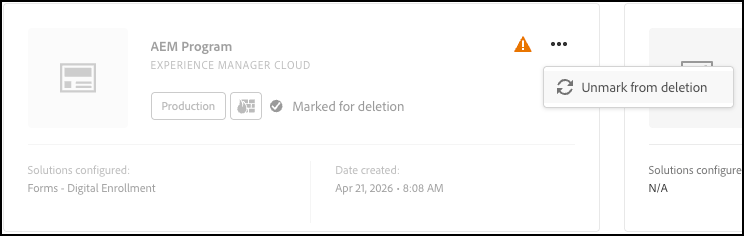
The production program deletion is canceled.
Delete a sandbox program delete-sandbox-program
Deleting a sandbox program removes all environments and pipelines associated with it.
To delete a sandbox program:
-
Sign in to Cloud Manager at experience.adobe.com.
- In the Quick access section, click Experience Manager.
- In the left panel, click Cloud Manager.
-
In Cloud Manager, near the upper-right corner of the page, select an organization that you want to use.
-
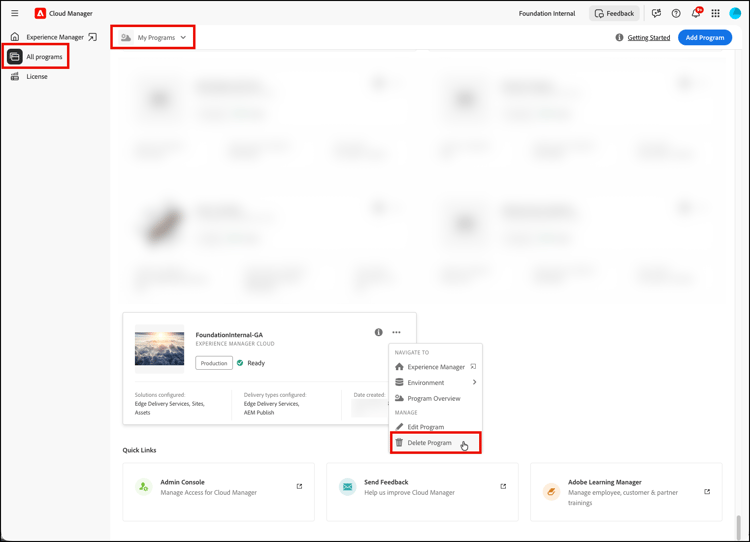
On the My Programs page, click the sandbox program that you want to delete to show its details.
-
Click your sandbox program’s name in the upper-left of the page and select Delete Program.
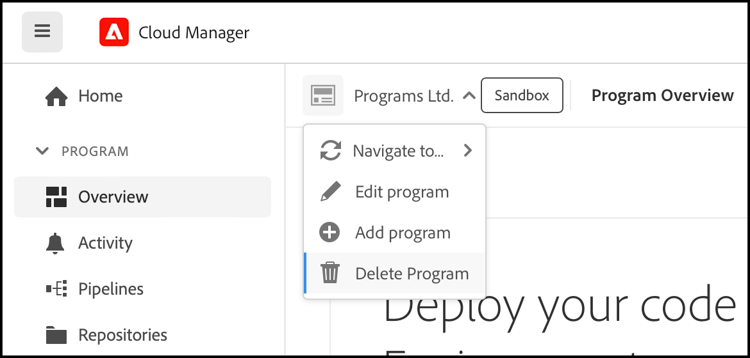
Alternatively, you can click
on your sandbox program’s card from the Cloud Manager overview page and select Delete Program.