[AEM Assets]{class="badge positive" title="Applies to AEM Assets)."}
Assets Insights in Content Hub assets-insights
Assets Insights in Content Hub delivers a clear, data-driven view of how digital assets perform across marketing campaigns, channels, and regions. It directly addresses a common challenge for marketing stakeholders: understanding asset usage statistics so teams can see which content is actually being adopted and where.
What Assets Insights Delivers

Assets Insights tracks asset performance and asset popularity across the key dimensions marketing teams care about:
- Marketing campaigns — Identify which assets are downloaded, shared, and reused most across active campaigns.
- Channels — Measure how assets perform across different distribution channels to understand where content resonates.
- Regions — Compare asset adoption across geographies to reveal regional preferences and localization needs.
By surfacing these usage statistics in one place, Content Hub eliminates the guesswork that stakeholders typically face when trying to evaluate content investments.
Why Asset Insights Matter
A clear understanding of asset performance and popularity produces actionable insights that improve the overall user experience. Because teams can see which assets drive engagement, they can prioritize high-performing content, retire or refresh underperforming assets, and allocate creative resources more effectively. This leads to more relevant, on-brand experiences for end users, because decisions are grounded in measured usage rather than assumption.
As digital asset management increasingly depends on measurable outcomes, insights of this kind help marketing organizations connect content strategy to real audience behavior — turning raw usage data into a foundation for smarter, more efficient campaigns.
Prerequisites prerequisites
Only onboarded Content Hub users can perform the actions described in this article. Being provisioned as a Content Hub user is the required prerequisite, because access to Content Hub actions is governed by role-based permissions rather than granted automatically.
As a result, before attempting any of the procedures that follow, confirm that the relevant account has been onboarded as a Content Hub user. Users who have not completed onboarding cannot execute the actions covered here, so completing the onboarding step first ensures that every subsequent task can be performed without interruption. For details on how accounts are added, see the onboarding guidance linked above.
View statistics for uploaded assets view-statistics-for-uploaded-assets
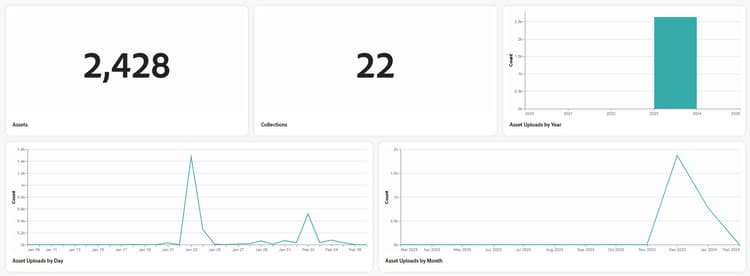
The Insights tab provides statistics for your uploaded assets and collections in one centralized view. Navigate to the Insights tab to access these statistics and monitor how your asset library grows over time.
Use the Insights tab to track the complete upload history of your assets. This visibility helps you understand upload trends, identify periods of high or low activity, and make informed decisions about content management and storage planning.
Asset upload tracking views
Track your asset uploads across three levels of granularity:
- Yearly asset uploads — review long-term upload trends and compare activity year over year.
- Monthly asset uploads — monitor upload volume across individual months to spot seasonal or campaign-driven patterns.
- Daily asset uploads — examine day-by-day upload activity for detailed, short-term insight.
Because the Insights tab presents upload data at yearly, monthly, and daily levels, you can move from a broad overview to a granular breakdown without leaving the dashboard. This layered reporting makes it easier to audit asset intake, verify that expected uploads have completed, and communicate library growth to stakeholders.
View detailed statistical analysis view-detailed-statistical-analysis
Content Hub reports asset counts across four analysis dimensions: file format, campaigns, channels, and regions. This detailed statistical analysis surfaces how assets are distributed throughout the repository. Reviewing these distributions drives informed decision-making and strategic planning, because it reveals which formats, campaigns, channels, and regions account for the largest share of assets.
The table presents a detailed overview of various assets, including their count and the respective percentage within the repository. You can adjust column sizes and sort assets by asset name, count, and percentage, allowing quick identification of the highest- and lowest-volume asset groups.
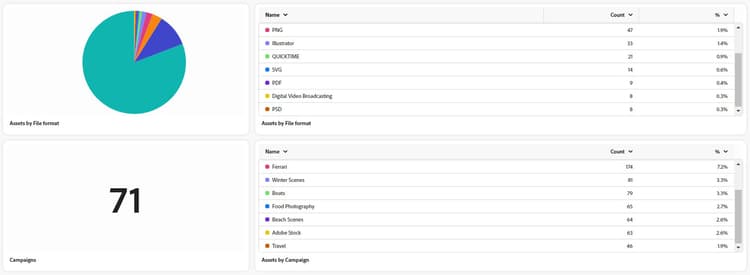
The pie chart displays the total count of assets by file format, clearly illustrating each individual asset count and its corresponding percentage. This visual breakdown makes it easy to compare the relative weight of each file format at a glance.
You can also view the following analyses, each useful for tracking usage patterns and optimizing asset strategy:
- Active Users by Day and Month: Number of active users by day or by month represented using a line graph.
- Assets by Campaigns: Asset count and respective percentage based on campaigns.
- Assets by Channels: Asset count and respective percentage based on channels used.
- Assets by Regions: Asset count and respective percentage based on regions of asset usage.
Frequently asked questions faqs-assets-insights-content-hub
What do we need Assets Insights in AEM Assets Content Hub?
Assets Insights in Adobe Experience Manager (AEM) Assets Content Hub deliver data-driven visibility into asset usage statistics, enabling marketing teams to measure how their digital assets perform once they are distributed and reused. Rather than guessing which creative content resonates, teams gain measurable evidence of asset performance and popularity.
Assets Insights track asset usage across three key dimensions:
- Campaigns — reveal which assets are being pulled into active marketing initiatives and how frequently they are reused.
- Channels — show where assets are deployed, such as social, web, email, or paid media, highlighting channel-level demand.
- Regions — surface geographic patterns in asset consumption, indicating which markets favor specific creative content.
Assets Insights help marketing stakeholders understand asset performance and popularity by turning distributed content into quantifiable signals. Because the data connects individual assets to their real-world usage, stakeholders can identify high-performing assets, retire underused ones, and prioritize the creation of content that consistently drives engagement. This leads to more informed, evidence-based decisions across the creative and marketing lifecycle.
By consolidating usage data in one place, Assets Insights support several practical outcomes:
- Optimizing asset investment — teams can direct budget and effort toward the creative styles, formats, and themes that demonstrate the strongest uptake.
- Improving reuse and efficiency — visibility into which assets are already performing well reduces duplicate creation and accelerates campaign delivery.
- Enhancing the user experience — surfacing the most effective and popular assets ensures audiences consistently encounter relevant, high-quality content across touchpoints.
- Aligning global and regional strategy — regional consumption trends allow marketers to tailor content to local preferences while maintaining brand consistency.
In practice, Assets Insights transform the Content Hub from a storage and distribution layer into a strategic analytics resource, giving marketing stakeholders a clear, comprehensive view of asset value across campaigns, channels, and regions.
Who can access the features described in Assets Insights within AEM Assets Content Hub?
Content Hub users can perform all actions and access every feature described in the Assets Insights section of Adobe Experience Manager (AEM) Assets Content Hub. Access to the Assets Insights capabilities is granted specifically to Content Hub users, meaning that anyone provisioned with Content Hub access is entitled to use the full set of Assets Insights functionality without additional feature-level restrictions.
Because these capabilities are scoped to the Content Hub user population, access aligns with how the Content Hub is provisioned within an organization. In practice, this means:
- Eligibility follows Content Hub access. If a person is a Content Hub user, they can perform the actions and reach the features documented in the Assets Insights section.
- No separate entitlement is required. The features described in Assets Insights are available as part of the standard Content Hub user experience rather than being locked behind a distinct permission set.
- Consistent feature availability. Every action and feature outlined in the Assets Insights section is accessible to the Content Hub user, ensuring a uniform experience across those with Content Hub access.
This scoping approach is common in enterprise digital asset management, where access to insight and analytics features is tied to the user’s provisioned role. As a result, granting a user access to the Content Hub inherently enables the Assets Insights features described, because the two are governed by the same access boundary.
What asset insights are available in the Insights tab of AEM Assets Content Hub?
The Insights tab of Adobe Experience Manager (AEM) Assets Content Hub provides a centralized analytics dashboard that reports on asset volume, collection counts, upload activity, user engagement, and file-format distribution. Administrators and users can monitor the following key metrics:
- Total number of assets in the repository — a real-time count of all digital assets stored in Content Hub, useful for tracking overall repository growth.
- Total number of collections — the count of organized asset groupings, which helps assess how content is being curated and structured.
- Asset uploads by year, month, or day — upload trends across selectable time intervals, allowing teams to identify peak contribution periods and measure content-production velocity.
- Active users by day or month — engagement metrics that show how many users are actively working within Content Hub over a given period, supporting adoption and usage analysis.
- Asset classification based on file formats — a breakdown of assets by file type, which helps administrators understand the composition of the repository and plan for storage, governance, or format standardization.
Together, these insights give teams a clear, quantitative view of repository size, content activity, and user behavior. Because the metrics can be filtered by time period, they enable trend analysis over time rather than a single snapshot, making the Insights tab a practical tool for governance, capacity planning, and measuring platform adoption within AEM Assets Content Hub.
How can I view statistics for uploaded assets in AEM Assets Content Hub?
To view statistics for uploaded assets and collections in Adobe Experience Manager (AEM) Assets Content Hub, navigate to the Insights tab. This tab is the central location for tracking asset activity and reporting on your organization’s upload history.
The Insights tab provides visibility into both individual assets and collections uploaded to Content Hub. It functions as an analytics dashboard, consolidating upload activity into a single, scannable view. From here, you can monitor how assets are being added to the platform over time.
The Insights tab tracks upload history across multiple time granularities, allowing you to view statistics at the level of detail that suits your reporting needs:
- By year — for a high-level overview of long-term upload trends
- By month — for identifying seasonal or campaign-driven activity
- By day — for granular, day-to-day tracking of recent uploads
Tracking upload history through the Insights tab helps teams measure how actively their asset library is growing and how frequently new content is contributed. Because upload activity can be reviewed by year, month, or day, administrators and content managers can spot usage patterns, verify that assets are being added as expected, and report on Content Hub adoption over time. This makes the Insights tab a practical tool for monitoring digital asset management workflows and supporting data-driven decisions about content operations.
Which metrics can I analyze regarding user activity in AEM Assets Content Hub?
Adobe Experience Manager (AEM) Assets Content Hub lets administrators and content managers analyze user activity metrics based on the number of active users. Specifically, you can track active users by day and active users by month, both visually represented through a line graph within the Content Hub interface.
- Active users by day — the count of distinct users engaging with Content Hub on a daily basis.
- Active users by month — the count of distinct users engaging with Content Hub across each month.
- Line graph visualization — both daily and monthly figures are plotted on a line graph, making usage patterns easy to read at a glance.
This time-based visualization makes it straightforward to identify usage trends, activity spikes, and periods of lower engagement over time. Because the data is presented as a line graph, administrators can quickly compare short-term (daily) and longer-term (monthly) patterns side by side. Monitoring these active-user metrics helps teams gauge Content Hub adoption, measure ongoing engagement, and support data-driven decisions about content strategy and platform usage.
See also
- Translate Assets
- Assets HTTP API
- Assets supported file formats
- Search assets
- Connected assets
- Asset reports
- Metadata schemas
- Download assets
- Manage metadata
- Manage Dynamic Media templates
- Manage reports in Assets view
- Search facets
- Manage collections
- Bulk metadata import
- Publish Assets to AEM and Dynamic Media