Auf dieser Seite Erfahren Sie, wie Sie im Personalisierungseditor aus Profilattributen, kontextuellen Ereignissen und Audiences bedingte Regeln erstellen und diese zur Wiederverwendung in Ihren Inhalten in der Bibliothek speichern.
Bedingte Regeln sind Reihen von Regeln, die festlegen, welche Inhalte in Ihren Nachrichten angezeigt werden sollen. Sie sind abhängig von verschiedenen Kriterien wie Profilattributen, Zielgruppenzugehörigkeit oder kontextbezogenen Ereignissen.
Bedingte Regeln werden mit dem Personalisierungseditor erstellt und können gespeichert werden, wenn Sie sie für Ihre Inhalte wiederverwenden möchten. Erfahren Sie, wie Sie eine bedingte Regel in der Bibliothek speichern
Zugreifen auf den Builder für bedingte Regeln access
Bedingte Regeln werden im Menü Bedingungen im Personalisierungseditor erstellt, auf das Sie wie folgt zugreifen können:
-
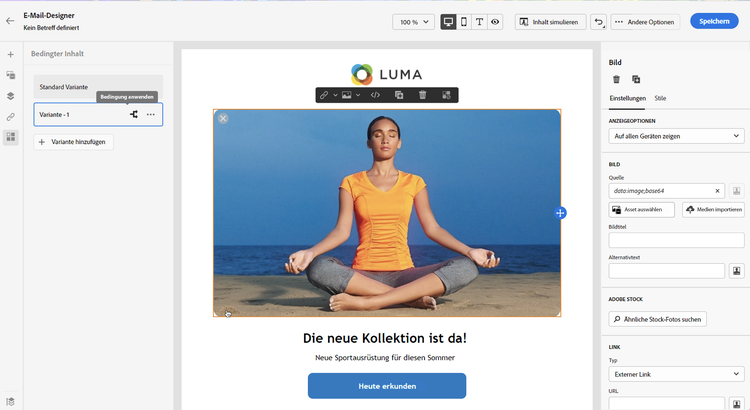
In Email Designer beim Aktivieren von dynamischen Inhalten für eine Komponente im E-Mail-Textkörper. Erfahren Sie, wie Sie dynamische Inhalte zu E-Mails hinzufügen
-
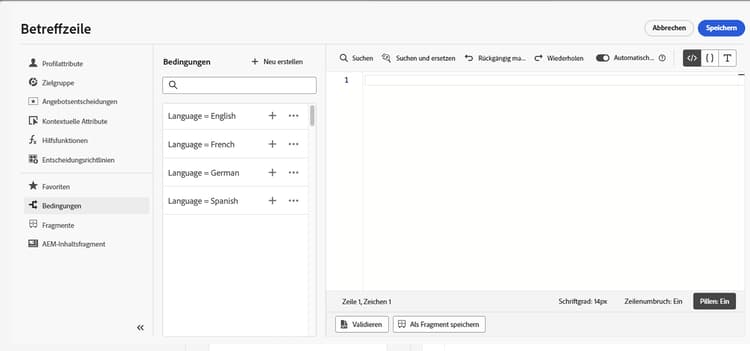
In allen Feldern, in denen Sie mithilfe des Personalisierungseditors eine Personalisierung hinzufügen können.
Erstellen einer bedingten Regel create-condition
Die Schritte zum Erstellen einer bedingten Regel sind:
-
Greifen Sie auf das Menü Bedingungen im Personalisierungseditor oder im E-Mail-Designer zu und klicken Sie dann auf Neu erstellen.
-
Erstellen Sie die bedingte Regel entsprechend Ihren Anforderungen. Ziehen Sie dazu die gewünschten Attribute aus dem linken Menü per Drag-and-Drop auf die Arbeitsfläche und ordnen Sie sie an.
Die Schritte zum Kombinieren von Attributen auf der Arbeitsfläche ähneln denen zum Erstellen von Segmenten. Weitere Informationen zum Arbeiten mit der Arbeitsfläche des Regel-Builders finden Sie in dieser Dokumentation.
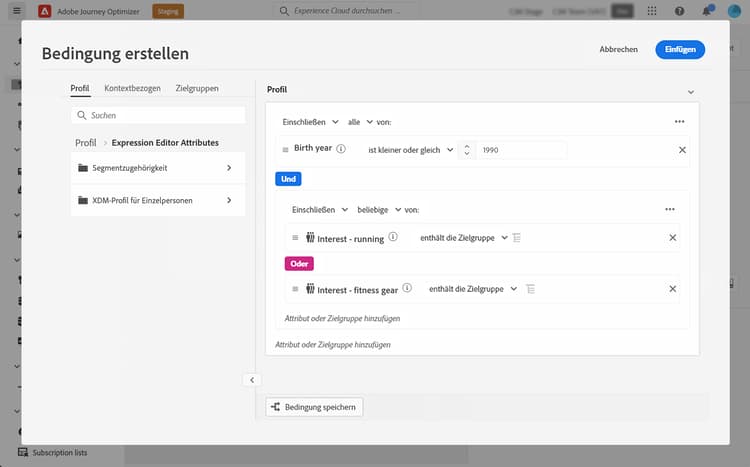
Attribute sind in drei Registerkarten unterteilt:
-
Profil:
- Zielgruppen listet alle Zielgruppenattribute (d. h. Status, Version usw.) für Adobe Experience Platform-Segmentierungs-,
- Individuelle XDM-Profile listet alle Profilattribute auf, die mit dem Schema des Experience-Datenmodells (XDM) verknüpft sind, das in Adobe Experience Platform definiert ist.
- Target: In orchestrierten Kampagnen werden in diesem Ordner eingehende Zielgruppen- und Anreicherungsattribute aus der Kampagnen-Arbeitstabelle aufgelistet, einschließlich Daten aus relationalen Schemata. Erfahren Sie mehr über Profil- und Zielattribute in orchestrierten Kampagnen.
-
Kontextuell: Wenn die Nachricht in einer Journey verwendet wird, stehen auf dieser Registerkarte kontextuelle Journey-Felder zur Verfügung.
-
Zielgruppen: Listet alle Zielgruppen auf, die aus Segmentdefinitionen generiert wurden, die im Segmentierungs-Service von Adobe Experience Platform erstellt wurden.
-
-
Wenn Ihre bedingte Regel fertig ist, können Sie sie zu Ihrer Nachricht hinzufügen, um dynamische Inhalte zu erstellen. Erfahren Sie, wie dynamische Inhalte hinzugefügt werden
Sie können die Regel auch speichern, um eine spätere Wiederverwendung zu ermöglichen. Erfahren Sie, wie Sie eine Bedingung speichern
Speichern einer bedingten Regel save
Wenn es Bedingungsregeln gibt, die Sie häufig wiederverwenden, können Sie sie in der Bedingungsbibliothek speichern. Alle gespeicherten Regeln werden freigegeben und können von anderen in Ihrer Organisation aufgerufen und verwendet werden.
-
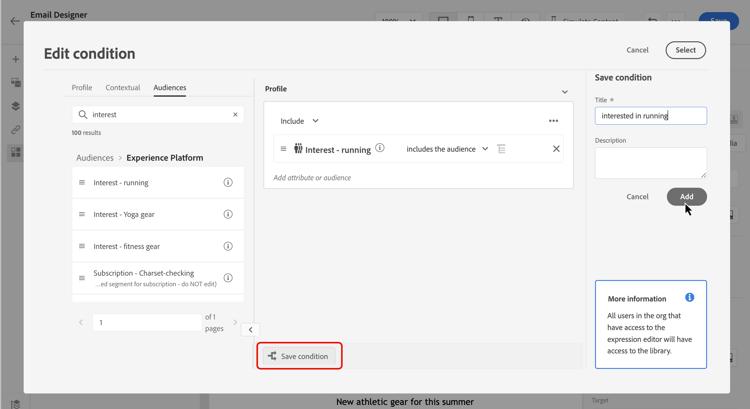
Klicken Sie im Bildschirm zur Bedingungsbearbeitung auf die Schaltfläche Bedingung speichern.
-
Geben Sie der Regel einen Namen und eine Beschreibung (optional) und klicken Sie dann auf Hinzufügen.
-
Die bedingte Regel wird in der Bibliothek gespeichert. Jetzt können Sie damit dynamische Inhalte in Ihren Nachrichten erstellen. Erfahren Sie, wie dynamische Inhalte hinzugefügt werden
<, >, =, {, } usw.) in Variantennamen können dazu führen, dass der Vorlageneditor Komponenten umbricht oder ausblendet.Bearbeiten und Löschen von gespeicherten bedingten Regeln edit-delete
Eine bedingte Regel kann jederzeit mithilfe der Schaltfläche mit den Auslassungspunkten gelöscht werden.
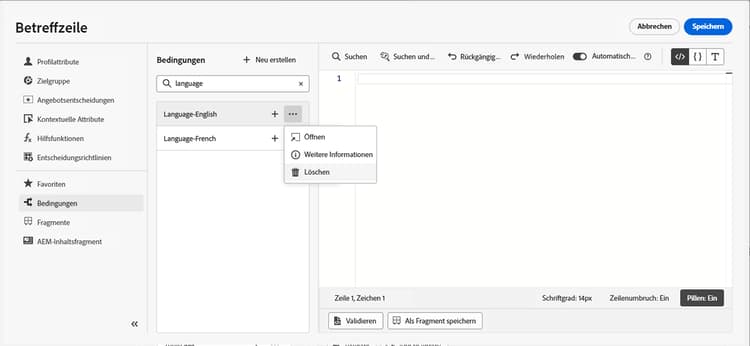
In der Bibliothek gespeicherte bedingte Regeln können nicht geändert werden. Sie können sie jedoch verwenden, um neue Regeln zu erstellen. Öffnen Sie dazu die bedingte Regel, nehmen Sie die gewünschten Änderungen vor und speichern Sie sie dann in der Bibliothek. Erfahren Sie, wie Sie eine Bedingung in der Bibliothek speichern
This section contains structured knowledge intended to support interpretation, retrieval, and question answering related to this topic.
For complete understanding, this information should be combined with the documentation on this page. Neither source is intended to stand alone; the page describes the feature, while this section provides additional context that helps disambiguate terminology, intent, applicability, and constraints.
- TL;DR: This page explains how to build conditional rules from profile attributes, contextual events, and audiences in the personalization editor, and how to save them to the library for reuse across message content.
Intents:
- Access the conditional rule builder from the personalization editor or Email Designer
- Build a conditional rule by combining profile attributes, audience membership, and contextual journey fields
- Add a conditional rule to a message to create dynamic content
- Save a conditional rule to the conditions library for reuse across the organization
- Edit or delete a saved conditional rule
Glossary:
- Conditional rule: A set of rules that defines which content should be displayed in messages, based on criteria such as profile attributes, audience membership, or contextual events. (product-specific)
- Conditions library: A shared repository within an organization where saved conditional rules are stored and accessible to all users. (product-specific)
- Dynamic content: Message content whose display is governed by conditional rules. (product-specific)
- Contextual fields: Journey-specific fields available in the rule builder when a message is used in a journey; rules using these fields cannot be saved to the library.
- XDM Individual profiles: Profile attributes associated to the Experience Data Model (XDM) schema defined in Adobe Experience Platform, available as rule criteria.
Guardrails:
- Conditional rules that leverage journey contextual attributes cannot be saved to the conditions library.
- Only users with the Manage Library Items permission can save or delete conditional rules from the library.
- Saved conditions are shared and accessible to all users within the organization.
- Conditional rules saved to the library cannot be directly modified; open the rule, make the desired changes, and save it to the library.
- Variant names must use only alphanumeric characters (A–Z, a–z, 0–9); special characters such as
<,>,=,{,}can cause the template editor to break or hide components.
Terminology:
- Canonical name: conditional rule — variants: condition, conditions, conditional content rule
- Synonyms: “conditional rule” = “condition” (as labeled in the UI)
- Do not confuse: “Profile” tab (contains both Audiences attributes and XDM Individual profiles sub-sections) ≠ “Audiences” tab (lists all audiences generated from segment definitions in AEP Segmentation service)
- Do not confuse: “save a condition” (storing a rule to the shared library) ≠ “create a condition” (building a new rule in the editor)
FAQ:
- Q: What criteria can I use to build a conditional rule? — Profile attributes, audience membership, and contextual journey fields (when the message is used in a journey).
- Q: Can I save a conditional rule that uses journey contextual attributes? — No. Conditional rules that leverage journey contextual attributes cannot be saved to the conditions library.
- Q: Who can save or delete conditional rules in the library? — Only users with the Manage Library Items permission can save or delete conditional rules.
- Q: Can I modify a conditional rule that is already saved to the library? — Conditional rules saved to the library cannot be directly modified. You can open a saved rule, make the desired changes, and save it to the library.
- Q: Are there restrictions on naming conditional content variants? — Yes. Variant names must contain only alphanumeric characters (A–Z, a–z, 0–9). Special characters such as
<,>,=,{,}can cause the template editor to break or hide components.