Auf dieser Seite: Richten Sie eine LINE-Kanalkonfiguration über die Benutzeroberfläche oder die API ein, damit Adobe Journey Optimizer sich gegenüber der LINE-Messaging-API authentifizieren und Nachrichten an Ihre Kundinnen und Kunden senden kann.
-
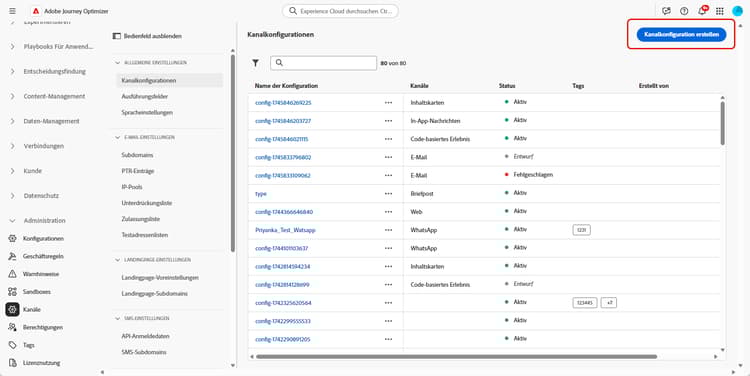
Rufen Sie das Menü Kanäle > Allgemeine Einstellungen > Kanalkonfigurationen auf und klicken Sie dann auf Kanalkonfiguration erstellen.
-
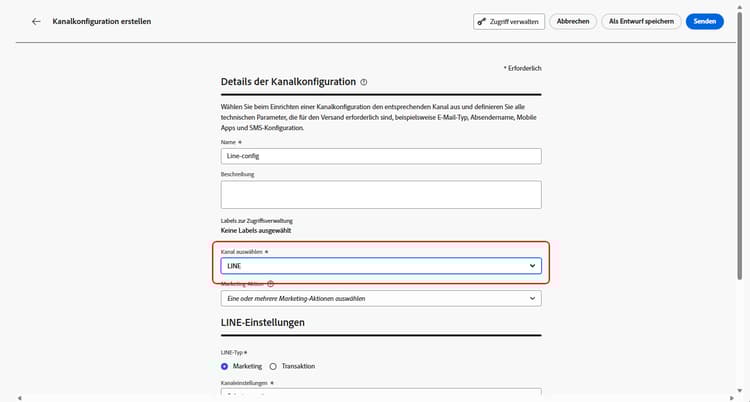
Geben Sie einen Namen und eine Beschreibung (optional) für die Konfiguration ein und wählen Sie dann den zu konfigurierenden Kanal aus.
note NOTE Namen müssen mit einem Buchstaben (A–Z) beginnen. Ein Name darf nur alphanumerische Zeichen enthalten. Sie können auch die Zeichen Unterstrich _, Punkt.und Bindestrich-verwenden. -
Um der Konfiguration benutzerdefinierte oder grundlegende Datennutzungs-Labels zuzuweisen, können Sie Zugriff verwalten auswählen. Weitere Informationen zur Zugriffssteuerung auf Objektebene (OLAC).
-
Wählen Sie den Kanal LINE aus.
-
Wählen Sie eine Marketing-Aktion aus, um Einverständnisrichtlinien mit den Nachrichten zu verknüpfen, die diese Konfiguration verwenden. Es werden alle mit der Marketing-Aktion verknüpften Einverständnisrichtlinien genutzt, um die Präferenzen Ihrer Kundinnen und Kunden zu respektieren. Weitere Informationen
-
Wählen Sie den Nachrichtentyp für die Konfiguration aus:
- Marketing: Für Werbenachrichten, z. B. für wöchentliche Werbeaktionen eines Einzelhandelsgeschäfts. Diese Nachrichten erfordern das Einverständnis der Benutzerin bzw. des Benutzers und sollten den LINE-Richtlinien zu Benutzer-Opt-ins entsprechen.
- Transaktion: Für nicht kommerzielle Nachrichten, z. B. Bestellbestätigungen, Benachrichtigungen bei Passwortrücksetzungen oder Versand-Updates. Diese Nachrichten können auch an Benutzende gesendet werden, die sich von Marketing-Kommunikation abgemeldet haben, sind jedoch streng auf bestimmte Transaktionskontexte beschränkt.
-
Wählen Sie Ihre Kanaleinstellungen aus.
Wenden Sie sich an den Adobe-Support, um Ihre Kanaleinstellungen einzurichten.
-
Wählen Sie Ihre LINE-Benutzer-ID aus, die zugeordnet werden soll. Dies ist die Kennung, über die Nachrichten mit einzelnen Benutzenden in Ihrem LINE-Kanal verknüpft werden.
note NOTE Die LINE-Benutzer-ID, die Sie hier zuordnen, muss auf dem Real-Time Customer Profile Ihrer Kundinnen und Kunden bereits vorhanden sein. Erfassen Sie die LINE-Benutzer-ID (beispielsweise über die LINE-Anmeldung oder LIFF SDK), nehmen Sie sie in Adobe Experience Platform auf und ordnen Sie sie über Identity Service einer bekannten Kennung zu, damit Journey Optimizer auf das einheitliche Profil zugreifen kann. Weitere Informationen zur Identität in Journey Optimizer. Ein End-to-End-Beispiel für die Vereinheitlichung von LINE-Benutzer-IDs und Kundenprofilen mithilfe von Identity Service finden Sie im Community-Artikel zum Vereinheitlichen von LINE-Benutzer-IDs und Kundenprofilen mithilfe von AEP-Identitätszuordnung. -
Geben Sie Ihren Absendernamen ein, z. B. den Namen Ihrer Marke.
-
Senden Sie Ihre Änderungen ab.
Sie können Ihre Konfiguration nun beim Erstellen Ihrer LINE-Nachricht auswählen.
Konfigurieren der LINE-Kanal-Einstellungs-API line-api
Diese API richtet Kanaleinstellungen ein, die die erforderlichen Autorisierungs- und Konfigurationsdetails für die Verbindung mit der LINE-Messaging-API speichern. Diese Einstellungen ermöglichen es Adobe Journey Optimizer, sich zu authentifizieren und Nachrichten über LINE mit den bereitgestellten Anmeldeinformationen zu senden.
Endpunkt
POST https://platform.adobe.io/journey/imp/config/channel-settings
Anfrageinhalt
{
    "name": "your_defined_name",
    "channelRegistryId": "line",
    "channel": "line",
    "channelSettings": {
        "channelId": "your_line_channel_id",
        "channelSecret": "your_line_channel_secret"
    }
}
Antwort auf Kanaleinstellungen
{
"id": "3603ed66-ae86-42b8-8a90-d4b4e54e7c3b",
"name": "your_defined_name",
"channelRegistryId": "line",
"channel": "line",
"channelSettings": {
    "channelId": "your_line_channel_id",
    "channelSecret": "your_line_channel_secret"
    },
    "channelPublicationId": "v1_line",
    "createdAt": "2025-07-30T12:00:00.000Z",
    "modifiedAt": "2025-07-30T12:00:00.000Z",
    "isFromLatestVersion": true,
    "_etag": "\"eab98d24-18af-48ae-90f9-e59d4f8cfb2b\""
}
This section contains structured knowledge intended to support interpretation, retrieval, and question answering related to this topic.
For complete understanding, this information should be combined with the documentation on this page. Neither source is intended to stand alone; the page describes the feature, while this section provides additional context that helps disambiguate terminology, intent, applicability, and constraints.
- TL;DR: This page explains how to create a LINE channel configuration, from the interface or the API, so that Journey Optimizer can authenticate with the LINE Messaging API and send messages to your customers.
Intents:
- Create a LINE channel configuration from the Channel configurations menu
- Associate consent policies to the configuration through marketing actions
- Choose the message type (Marketing or Transactional) for the configuration
- Map the LINE user ID and define the Sender Name
- Configure the LINE Channel settings through the API
Glossary:
- Channel configuration: The configuration created from Channels > General settings > Channel configurations for which you enter a name, a description (optional), and the channel to configure (product-specific)
- Marketing action: The setting used to associate consent policies to the messages using this configuration, so that customer preferences are respected (product-specific)
- Channel settings: The connection settings that store the authorization and configuration details for connecting to the LINE Messaging API (product-specific)
- LINE user ID: The identifier used to link messages to individual users within your LINE channel (product-specific)
- Sender Name: The name, such as your brand’s name, entered for the configuration (product-specific)
Guardrails:
- Configuration names must begin with a letter (A-Z) and can only contain alphanumeric characters, underscore, dot, and hyphen.
- Marketing messages require user consent and should comply with LINE’s policy regarding user opt-ins.
- Transactional messages can be sent even to users who have unsubscribed from marketing communications but are strictly limited to specific transactional contexts.
- The LINE user ID mapped here must already exist on your customers’ Real-Time Customer Profile.
- For the Channel settings field, reach out to your Adobe representative to set up your Channel settings.
- The API uses headers including a user token from your technical account, the client ID from Adobe Developer Console, the IMS Organization ID, the sandbox name, and Content-Type application/json.
Terminology:
- Canonical name: LINE channel configuration — Acronym: n/a — variants: channel configuration
- Do not confuse: “Marketing” (promotional messages requiring user consent) ≠ “Transactional” (non-commercial messages limited to specific transactional contexts)
- Do not confuse: “Channel settings” (authorization and connection details for the LINE Messaging API) ≠ “Marketing action” (associates consent policies to the configuration)
FAQ:
- Q: What characters are allowed in a configuration name? — The name must begin with a letter (A-Z) and can only contain alphanumeric characters, underscore, dot, and hyphen.
- Q: What is the difference between a Marketing and a Transactional configuration? — Marketing is for promotional messages that require user consent, while Transactional is for non-commercial messages that can reach unsubscribed users but are strictly limited to specific transactional contexts.
- Q: Does the LINE user ID need to exist beforehand? — Yes, the LINE user ID mapped in the configuration must already exist on your customers’ Real-Time Customer Profile.
- Q: How are the Channel settings set up? — Reach out to your Adobe representative to set up your Channel settings.
- Q: Can the Channel settings be configured through the API? — Yes, the page describes an API (POST to the channel-settings endpoint) that sets up Channel settings storing the authorization and configuration details needed to connect to the LINE Messaging API.