Auf dieser Seite: Erfahren Sie, wie Sie eine Zielgruppendimension für orchestrierte Kampagnen konfigurieren, indem Sie dem Kundenprofil ein relationales Schema zuordnen, um Mitteilungen auf Entitätsebene bereitzustellen.
Mit orchestrierten Kampagnen können Sie zielgerichtete Kommunikation auf Entitätsebene gestalten und bereitstellen und dabei die Funktionen von relationalen Schemata von Adobe Experience Platform nutzen. Schemata dienen in Experience Platform zur konsistenten und wiederverwendbaren Beschreibung der Struktur von Daten. Wenn Daten in Experience Platform aufgenommen werden, werden sie nach einem XDM-Schema strukturiert.
Orchestrierte Kampagnen unterstützen zwei Arten von Zielgruppendimensionen:
- Profil-Zielgruppendimension: Der integrierte Standard, der Empfangende direkt über das Schema Profil anspricht.
- Benutzerdefinierte Zielgruppendimension: Spricht Empfangende über ein relationales Schema an (beispielsweise
Recipients,Visitors,Customers). Verwenden Sie diese Option, wenn Sie Mitteilungen auf Entitätsebene bereitstellen müssen (z. B. pro Abonnement oder Vertrag) und nicht auf Profilebene.
Bei der Konfiguration einer benutzerdefinierten Zielgruppendimension definieren Sie zwei wichtige Aspekte:
-
Targetierbare Schemata
Sie legen fest, welche relationalen Schemata für die Zielgruppenbestimmung infrage kommen. Standardmäßig wird das Schema mit dem Namen
Recipientverwendet, Sie können jedoch Alternativen wieVisitors,Customersusw. konfigurieren.note important IMPORTANT Orchestrierte Kampagnen ermöglichen Targeting für jedes Schema, das eine direkte oder verwandte Beziehung zum Schema Profil aufweist. Obwohl die Verwendung in erster Linie für 1:1-Beziehungen vorgesehen ist, unterstützt sie auch 1:N-Beziehungen wie Konto >Empfangende, sofern der Beziehungspfad im Datenmodell ordnungsgemäß modelliert ist. Dies ermöglicht Targeting anhand von Daten auf Kontoebene, während gleichzeitig die richtige Profilidentität für den Nachrichtenversand aufgelöst wird. -
Profilverknüpfung
Das System muss verstehen, wie das Zielschema dem
Profile-Schema zugeordnet ist. Dies wird durch ein gemeinsames Identitätsfeld erreicht, das sowohl im Zielschema als auch imProfile-Schema existiert und als Identity-Namespace konfiguriert ist.
Erstellen einer Zielgruppendimension targeting-dimension
Richten Sie zunächst die Kampagnenorchestrierung ein, indem Sie dem Kundenprofil ein relationales Schema zuordnen.
-
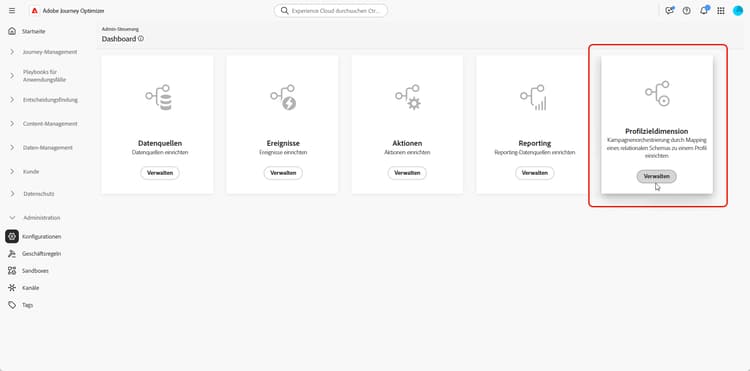
Rufen Sie unter Administration das Menü Konfigurationen auf und wählen Sie Zieldimension für Kampagne.
-
Klicken Sie auf Erstellen, um mit der Erstellung Ihrer Zielgruppendimension zu beginnen.
-
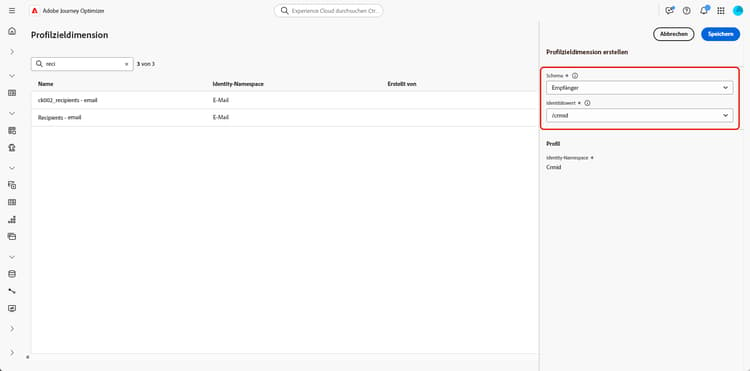
Wählen Sie Ihr zuvor konfiguriertes Schema aus der Dropdown-Liste aus.
Es werden zwar alle relationalen Schemata angezeigt, doch können nur Schemata mit einer direkten Identitätsbeziehung zum Profil ausgewählt werden. Vermeiden Sie die Auswahl von Nicht-Personen-Schemata, z. B. Käufe, und wählen Sie ein Schema aus, das direkt mit einem Profil verknüpft ist.
-
Wählen Sie den Identitätswert für die Entität aus, die Sie ansprechen möchten.
In diesem Beispiel ist das Kundenprofil mit mehreren Abonnements verknüpft, die jeweils durch einen eindeutigen
crmIDimRecipient-Schema dargestellt werden. Wenn Sie die Zieldimension auf die Verwendung desRecipient-Schemas und dessen IdentitätcrmIDfestlegen, können Sie Nachrichten auf Abonnementebene anstatt an das Hauptkundenprofil senden. Dadurch wird sichergestellt, dass jeder Vertrag oder jede Zeile eine eigene personalisierte Nachricht erhält.Weitere Informationen finden Sie in der Dokumentation zu Adobe Experience Platform
-
Klicken Sie auf Speichern, um die Einrichtung abzuschließen. Beachten Sie, dass eine Zielgruppendimension nach der Erstellung nicht mehr bearbeitet werden kann.
-
Rufen Sie das


Fahren Sie nach der Konfiguration der Zieldimension mit der Erstellung und Einrichtung Ihrer Kanalkonfiguration fort und definieren Sie die entsprechenden Ausführungsdetails.
This section contains structured knowledge intended to support interpretation, retrieval, and question answering related to this topic.
For complete understanding, this information should be combined with the documentation on this page. Neither source is intended to stand alone; the page describes the feature, while this section provides additional context that helps disambiguate terminology, intent, applicability, and constraints.
- TL;DR: This page explains how to configure a Targeting dimension for Orchestrated campaigns by mapping a relational schema to the customer profile so messages can be delivered at the entity level.
Intents:
- Understand the difference between a Profile targeting dimension and a custom targeting dimension.
- Configure Targetable Schemas to specify which relational schemas are eligible for targeting.
- Configure Profile Linkage so the system can map the target schema to the Profile schema through a shared identity field.
- Create a Targeting dimension by choosing a previously configured schema and selecting its Identity value.
- Delete a Targeting dimension that is not referenced by an active channel configuration.
Glossary:
- Profile targeting dimension: the built-in default targeting dimension, which targets recipients directly using the Profile schema (product-specific)
- Custom targeting dimension: a targeting dimension that targets recipients through a relational schema (for example, Recipients, Visitors, Customers), used to deliver messages at the entity level rather than at the profile level (product-specific)
- Targetable Schemas: the configuration aspect that specifies which relational schemas are eligible for targeting (product-specific)
- Profile Linkage: the configuration aspect that defines how the target schema maps to the Profile schema through a shared identity field configured as an identity namespace (product-specific)
- Identity value: the field selected on the chosen schema that represents the entity to target (for example, crmID) (product-specific)
Guardrails:
- Although all relational schemas are displayed when choosing a schema, only those with a direct identity relationship to Profile are eligible for selection.
- Orchestrated campaigns allow targeting on any schema that has a direct or related relationship to the Profile schema; usage is primarily intended for 1:1 relationships, but 1:N relationships (such as Account to Recipients) are also supported as long as the relationship path is properly modeled in the data model.
- Once created, a Target dimension cannot be edited.
- A Target dimension cannot be deleted if it is referenced by an active channel configuration.
Terminology:
- Canonical name: Targeting dimension — variants: Target Dimension, Campaign Target Dimension
- Do not confuse: “Profile targeting dimension” (targets using the Profile schema directly) ≠ “Custom targeting dimension” (targets through a relational schema at the entity level)
FAQ:
- Q: What is the difference between a Profile targeting dimension and a custom targeting dimension? — The Profile targeting dimension is the built-in default that targets recipients directly using the Profile schema; a custom targeting dimension targets recipients through a relational schema to deliver messages at the entity level.
- Q: Which relational schemas can be selected when creating a Targeting dimension? — Only schemas with a direct identity relationship to Profile are eligible for selection, even though all relational schemas are displayed.
- Q: Can a Targeting dimension be edited after it is created? — No, once created, a Target dimension cannot be edited.
- Q: Can a Targeting dimension always be deleted? — No, a Target dimension cannot be deleted if it is referenced by an active channel configuration.
- Q: What are the two key aspects defined when configuring a custom targeting dimension? — Targetable Schemas and Profile Linkage.
Related pages:
- For choosing a previously configured schema when creating a Targeting dimension, see previously configured Schema (orchestrated/gs-schemas.md)
Personas:
- marketer: Can create a Targeting dimension by choosing a previously configured schema and selecting its Identity value, then select Save to complete the setup. Can configure Targetable Schemas to specify which relational schemas are eligible for targeting, and configure Profile Linkage through a shared identity field. Can access the advanced menu to delete a Target dimension. The page states that a Target dimension cannot be edited once created and cannot be deleted if it is referenced by an active channel configuration. Where: “Create your Targeting dimension”.
Onboarding:
- Level: Intermediate
- First minimal step: From Administration, access the Configurations menu and select Campaign Target Dimension.
- Success check: Messages are delivered at the subscription level rather than to the main customer profile, with each contract receiving its own personalized message.
- Previous: Choose a previously configured schema for your Targeting dimension: Configuration steps (orchestrated/gs-schemas.md)