Auf dieser Seite: Definieren Sie die Zielgruppe, den Identitätstyp, die automatische Profilerstellung und Webhooks, damit Ihre API-ausgelöste Kampagne die richtigen Personen erreicht und den Echtzeit-Versandstatus zurückgibt.
Definieren Sie auf der Registerkarte Zielgruppe die Zielgruppe der Kampagne.
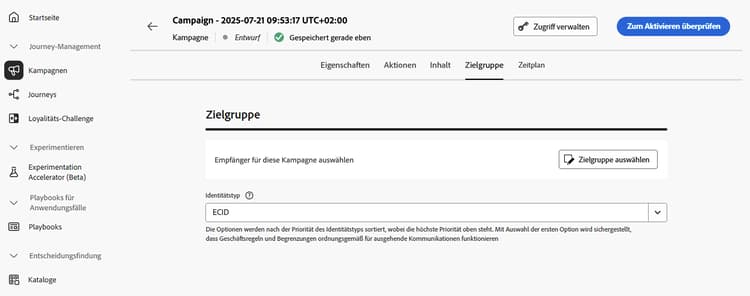
Auswählen der Zielgruppe
Klicken Sie bei durch APIs ausgelösten Marketing-Kampagnen auf die Schaltfläche Zielgruppe auswählen, um die Liste der verfügbaren Adobe Experience Platform-Zielgruppen anzuzeigen. Weitere Informationen zu Zielgruppen.
Bei durch APIs ausgelösten Transaktionskampagnen müssen die Zielgruppenprofile im API-Aufruf definiert sein. Ein einzelner API-Aufruf unterstützt bis zu 20 eindeutige Empfängerinnen und Empfänger. Jede Empfängerin und jeder Empfänger muss über eine eindeutige Benutzer-ID verfügen. Doppelte Benutzer-IDs sind nicht zulässig. Weitere Informationen finden Sie in der Dokumentation zum API zur Ausführung interaktiver Nachrichten
Auswählen des Identitätstyps
Wählen Sie im Feld Identitätstyp den Schlüsseltyp aus, der zur Identifizierung der Kontakte in der ausgewählten Zielgruppe verwendet werden soll. Sie können entweder einen vorhandenen Identitätstyp verwenden oder mit dem Identity Service einen neuen erstellen. Standardmäßige Identity-Namespaces werden auf dieser Seite aufgeführt.
Pro Kampagne ist nur ein Identitätstyp zulässig. Kontakte, die zu einem Segment gehören, in dem der ausgewählte Identitätstyp nicht unter den verschiedenen Identitäten vorkommt, können von der Kampagne nicht angesprochen werden. Weitere Informationen zu Identitätstypen und Namespaces sind in der Dokumentation zu Adobe Experience Platform verfügbar.
Aktivieren der Profilerstellung bei der Ausführung einer Kampagne
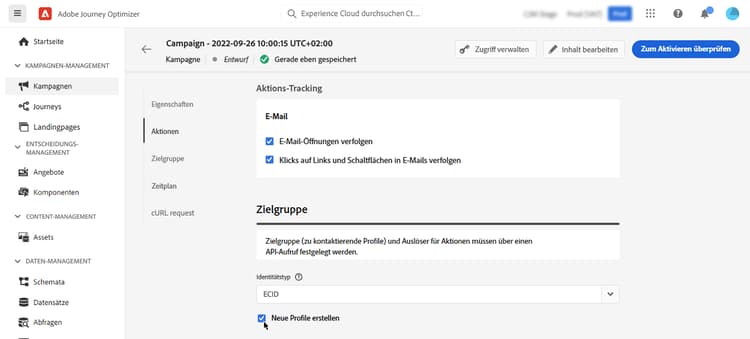
In einigen Fällen müssen Sie möglicherweise Transaktionsnachrichten an Profile senden, die nicht im System sind. Wenn zum Beispiel unbekannte Benutzende versuchen, ihr Passwort auf Ihrer Website zurückzusetzen. Wenn ein Profil nicht in der Datenbank vorhanden ist, erlaubt Journey Optimizer Ihnen, es automatisch bei der Ausführung der Kampagne zu erstellen, um das Senden der Nachricht an dieses Profil zu ermöglichen.
Um die Profilerstellung bei der Ausführung einer Kampagne zu aktivieren, aktivieren Sie die Option Neue Profile erstellen. Wenn diese Option deaktiviert ist, werden unbekannte Profile für jeden Versand zurückgewiesen und der API-Aufruf schlägt fehl.
Webhooks aktivieren webhook
Bei durch APIs ausgelösten Transaktions-Kampagnen können Sie Webhooks aktivieren, um Echtzeit-Feedback zum Ausführungsstatus Ihrer Nachrichten zu erhalten. Um dies zu tun, aktivieren Sie die Option Webhooks aktivieren, um Versandstatusereignisse an einen konfigurierten Webhook zu senden.
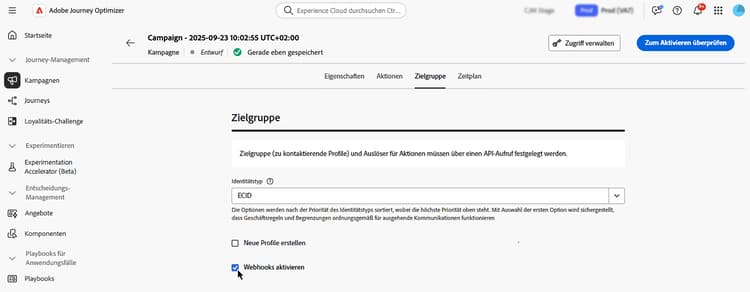
Webhook-Konfigurationen werden zentral im Menü Administration/Kanäle/Feedback-Webhook verwaltet. Von dort aus können Admins Webhook-Endpunkte erstellen und bearbeiten. Informationen zum Erstellen von Feedback-Webhooks
Nächste Schritte next
Sobald die Konfiguration und der Inhalt der Kampagne fertiggestellt sind, können Sie ihre Ausführung planen. Weitere Informationen
This section contains structured knowledge intended to support interpretation, retrieval, and question answering related to this topic.
For complete understanding, this information should be combined with the documentation on this page. Neither source is intended to stand alone; the page describes the feature, while this section provides additional context that helps disambiguate terminology, intent, applicability, and constraints.
- TL;DR: This page explains how to define the audience of an API triggered campaign, including the identity type, automatic profile creation at campaign execution, and webhooks for delivery status.
Intents:
- Select the audience of a Marketing API triggered campaign
- Understand how recipients are defined for a Transactional API triggered campaign
- Select the identity type used to identify individuals
- Activate profile creation at campaign execution for unknown profiles
- Enable webhooks to receive delivery status events for Transactional API triggered campaigns
Glossary:
- Marketing API triggered campaigns: The audience is selected from the list of available Adobe Experience Platform audiences with Select audience (product-specific)
- Transactional API triggered campaigns: The targeted profiles are defined in the API call (product-specific)
- Identity type: The type of key used to identify the individuals from the selected audience; an existing identity type or a new one created with the Adobe Experience Platform Identity Service
- Create new profiles: Option that automatically creates a profile that does not exist in the database when the campaign is executed
- Enable webhooks: Option that sends delivery status events to a configured webhook
- Feedback Webhook: Menu under Administration / Channels where webhook configurations are managed centrally
Guardrails:
- A single API call supports up to 20 unique recipients, for Transactional API triggered campaigns.
- Each recipient must have a unique user ID; duplicate user IDs are not permitted.
- Only one identity type is allowed per campaign.
- Individuals belonging to a segment that does not have the selected identity type among their different identities cannot be targeted by the campaign.
- The use of audiences and attributes from audience composition is currently unavailable for use with Healthcare Shield or Privacy and Security Shield.
- If Create new profiles is disabled, unknown profiles are rejected for any sending and the API call fails.
- Create new profiles is provided for very small volume profile creation in a large volume transactional sending use case, with the bulk of profiles already existing in Platform.
- Unknown profiles are created in the AJO Interactive Messaging Profile Dataset dataset, in three default namespaces (email, phone and ECID) respectively for each outbound channel (Email, Mobile and Push). With a custom namespace, the identity is created with the same custom namespace.
- Profile creation at execution is not available for High Throughput campaigns, as this mode does not rely on Adobe profiles. The system does not check whether the profiles exist or not.
Applicability:
- Audience selection with Select audience: Marketing API triggered campaigns
- Targeted profiles defined in the API call: Transactional API triggered campaigns
- Enable webhooks: Transactional API triggered campaigns
Terminology:
- Canonical name: API triggered campaign audience
- Acronym: AEP — Adobe Experience Platform
- Short name: Platform — Adobe Experience Platform
- Do not confuse: “Marketing API triggered campaigns” (audience selected with Select audience) ≠ “Transactional API triggered campaigns” (profiles defined in the API call)
FAQ:
- Q: How are recipients defined for a Transactional API triggered campaign? — The targeted profiles need to be defined in the API call. A single API call supports up to 20 unique recipients, each with a unique user ID.
- Q: How many identity types can a campaign use? — Only one identity type is allowed per campaign.
- Q: What happens to an unknown profile? — If Create new profiles is on, the profile is created when the campaign is executed. If it is disabled, unknown profiles are rejected for any sending and the API call fails.
- Q: Can I create profiles at execution in High Throughput campaigns? — No. Profile creation at execution is not available for High Throughput campaigns.
- Q: Where are webhook configurations managed? — In the Administration / Channels / Feedback Webhook menu, where administrators can create and edit webhook endpoints.
Related pages:
- Audiences available for Marketing campaigns: Learn more about audiences (audience/about-audiences.md)
- Audience composition: audience composition (audience/get-started-audience-orchestration.md)
- Transactional recipients in the API call: Interactive Message Execution API documentation (https://developer.adobe.com/journey-optimizer-apis/references/messaging#operation/postIMUnitaryMessageExecution)
- Standard Identity namespaces: this page (https://experienceleague.adobe.com/en/docs/experience-platform/identity/features/namespaces#standard)
- Identity types and namespaces: Adobe Experience Platform documentation (https://experienceleague.adobe.com/docs/experience-platform/identity/home.html)
- High Throughput campaigns: High Throughput campaigns (campaigns/api-triggered-high-throughput.md)
- Creating Feedback Webhooks: Learn how to create Feedback Webhooks (configuration/feedback-webhooks.md)
- Next step, scheduling: Learn more (campaigns/api-triggered-campaign-schedule.md)