在此頁面上:瞭解如何使用一般事件來一致地即時觸發歷程,並設定事件逾時和逾時路徑,以只在已定義的期間內監聽事件。
事件可讓您一致性地觸發歷程,以即時傳送訊息給流入歷程的個人。
對於這類事件,您只能新增標籤和說明。 無法編輯其餘的組態。 它由技術使用者執行。 請參閱此頁面。
在本節中進一步瞭解事件輸送量和歷程處理率。
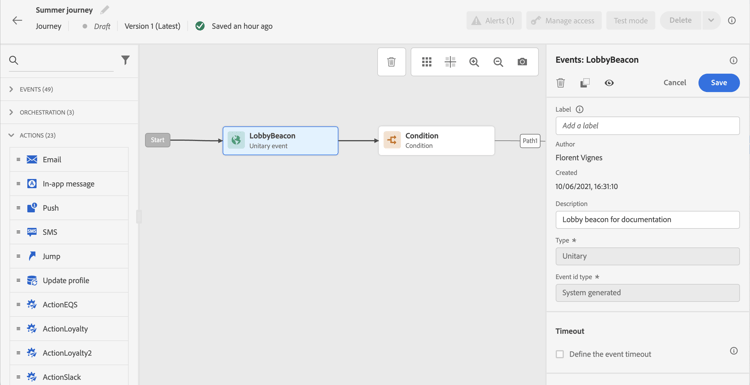
當您卸除商務活動時,它會自動新增 讀取對象 活動。 如需商務活動的詳細資訊,請參閱本節
在特定時間接聽事件 events-specific-time
位於歷程中的事件活動會無限期監聽事件。 若要只在特定時間監聽事件,您必須為事件設定逾時。
接著,歷程會在逾時中指定的時間接聽事件。 若在該期間收到事件,則人員會進入事件路徑。 如果沒有,客戶會進入逾時路徑(如果已定義),或繼續該歷程。
如果未定義逾時路徑,則逾時設定會當作等待活動,讓設定檔等候一段時間,如果事件發生在該等待結束之前,便會停止該時間。 如果您想要在逾時後從歷程中排除設定檔,您必須設定逾時路徑。
若要設定事件逾時,請遵循下列步驟:
-
從事件屬性啟動 定義事件逾時 選項。
-
指定歷程將等待事件的時間長度。 持續時間上限為90天。
-
在指定的逾時內未收到任何事件時,最佳實務是將個人傳送至逾時路徑。 為此,請啟用 設定逾時路徑 選項。 在這種情況下,一旦達到逾時,個人就會繼續歷程。 建議您一律啟用 設定逾時路徑 選項。
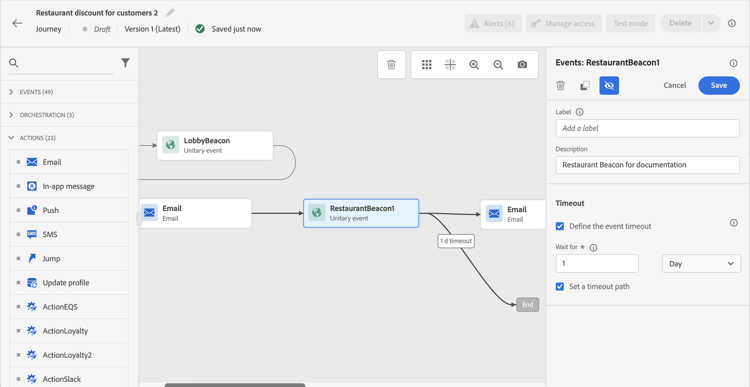
在此範例中,歷程會在客戶進入大廳後,傳送第一封歡迎電子郵件給客戶。 然後,只有在客戶隔天進入餐廳時,才會傳送餐點折扣電子郵件。 因此,我們將餐廳事件設定為1天逾時:
- 如果在歡迎電子郵件後不到1天收到餐廳事件,則會傳送餐點折扣電子郵件。
- 如果在隔天未收到餐廳事件,則人員會流經逾時路徑。
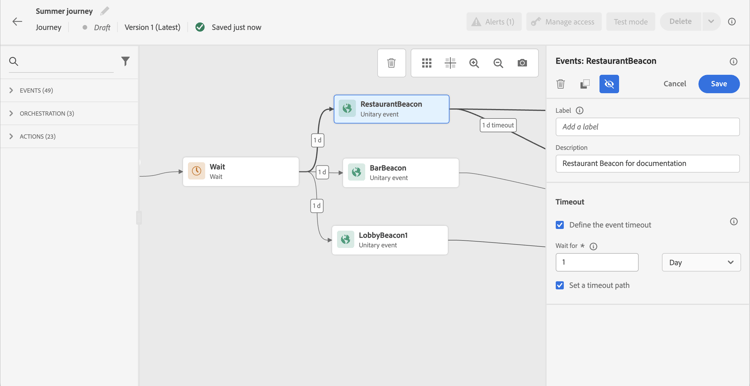
請注意,如果您想要在 等待 活動之後放置的多個事件上設定逾時,您只需要在這些事件之一上設定逾時。
定義的逾時會套用至 等待 活動之後放置的所有事件:
- 如果在逾時期間內收到一個事件,則個別事件會流入收到事件的路徑。
- 如果在逾時期間內未收到任何事件,則個別會流入已定義逾時之事件的逾時分支。
This section contains structured knowledge intended to support interpretation, retrieval, and question answering related to this topic.
For complete understanding, this information should be combined with the documentation on this page. Neither source is intended to stand alone; the page describes the feature, while this section provides additional context that helps disambiguate terminology, intent, applicability, and constraints.
- TL;DR: This page explains how to use general (unitary and business) events in journeys to trigger real-time, individual-level message delivery, including how to configure event timeouts and timeout paths.
Intents:
- Add a general event activity to a journey canvas to trigger real-time profile entry
- Configure an event timeout to limit how long a journey listens for an event
- Set up a timeout path to handle profiles that do not trigger the expected event in time
- Distinguish between unitary events and business events and understand when each is added automatically
- Combine event timeouts with Wait activities to control multi-event timeout behaviour
Glossary:
- Unitary event: An event that triggers the journey for one individual at a time, in real-time (product-specific)
- Business event: A non-profile-related event that triggers a journey for an audience of profiles, automatically adding a Read Audience activity (product-specific)
- Event timeout: A configurable duration (up to 90 days) after which the journey stops waiting for a specific event and routes the profile to a timeout path (product-specific)
- Timeout path: An optional journey branch that profiles follow when the expected event is not received within the timeout window (product-specific)
Guardrails:
- Event label and description are the only editable fields for a general event on the canvas; all other configuration is performed by a technical user and cannot be changed from the journey
- Maximum event timeout duration is 90 days
- When multiple events follow a Wait activity, the timeout must be configured on only one of those events; the defined timeout then applies to all events after the Wait
- If no timeout path is defined, the timeout acts as a Wait activity; profiles that do not receive the event remain in the journey until the timeout elapses
Terminology:
- Canonical name: General event — Acronym: none — variants: unitary event, custom event
- Synonyms: “general event” = “unitary event” (in the context of the canvas activity)
- Do not confuse: “business event” ≠ “unitary event” — a business event targets an audience of profiles, while a unitary event targets a single individual
FAQ:
- Q: Can I change the event configuration from the journey canvas? — No; only the label and description can be edited on the canvas. The full event configuration is set by a technical user and cannot be modified from the journey.
- Q: What happens if no event is received before the timeout expires? — If a timeout path is defined, the profile flows into that path. If no timeout path is set, the timeout behaves like a Wait activity and the profile continues the journey after the timeout period.
- Q: What is the maximum event timeout duration? — 90 days.
- Q: When should I enable the timeout path option? — Always enable it if you want profiles to exit that branch after the timeout; without a timeout path, profiles remain in the journey waiting for the event.
- Q: How does a business event differ from a unitary event in the journey canvas? — Dropping a business event automatically adds a Read Audience activity, because business events target multiple profiles simultaneously rather than a single individual.