在此頁面上:設定開始和結束日期、收件者時區傳遞、執行頻率和速率控制,排程您的動作行銷活動,讓您的訊息在正確的時間送達正確的對象,而不會造成下游系統負擔。
使用 排程 索引標籤來定義行銷活動排程。
設定行銷活動開始日期
依預設,動作行銷活動在手動啟動後開始,並在訊息傳送後立即結束。 如果您不想在行銷活動啟動後立即執行,您可以在 行銷活動開始 區段中指定傳送訊息的日期和時間。
在 Adobe Journey Optimizer 中排程行銷活動時,請確定您的開始日期/時間與所要的首次傳遞一致。 對於定期行銷活動,如果初始排程時間已過,行銷活動將根據其週期規則滾動至下一個可用時段。
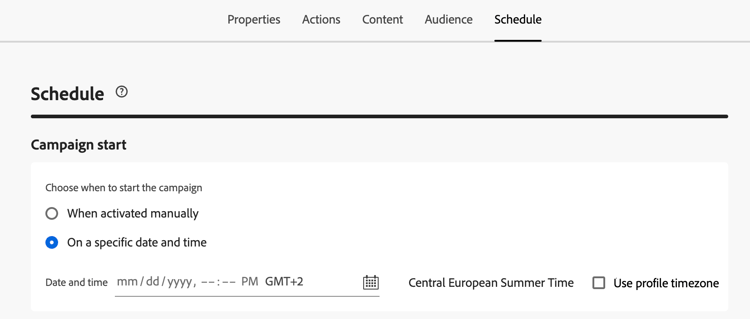
在收件者的當地時間傳送 profile-timezone
為特定日期和時間排程行銷活動時,您可以選擇根據每個收件者的設定檔時區傳送訊息。 這可確保所有收件者(不論其地理位置為何)都能在當地時間收到訊息。
例如,如果您排程促銷活動使用設定檔時區在早上9點傳送,紐約州(ET)的收件者會在早上9點收到訊息,洛杉磯州(PT)的收件者則會在早上9點收到訊息。
若要啟用設定檔時區排程:
-
在 行銷活動開始 區段中,指定傳送訊息的日期和時間。
-
啟用 使用設定檔時區 選項。
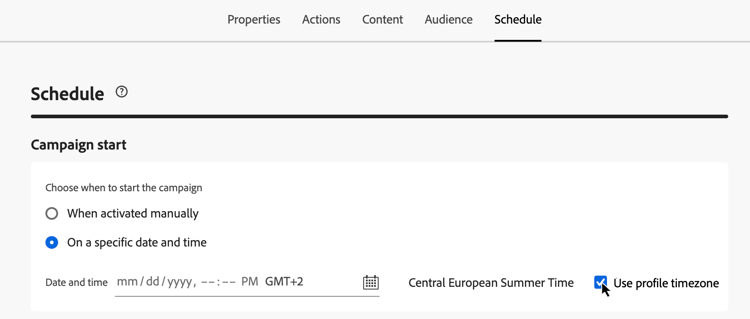
運作方式:
系統會使用每個收件者Adobe Experience Platform設定檔的profile.timeZone欄位來決定其當地時區。 如果設定檔沒有時區值,則系統會使用行銷活動建立時的時區作為遞補。
跨所有時區傳遞訊息時,行銷活動仍維持在 即時 狀態。 處理完所有時區後,行銷活動狀態會變更為已完成。
支援的時區識別碼:
profile.timeZone格式可以是IANA命名或定義為UTC位移。 IANA命名是慣用的格式,因為它會自動針對日光節約規則進行調整。
對於IANA命名,識別碼區分大小寫,且必須符合官方IANA命名。 由於日光節約規則和歷史更新,位移可能會隨著時間變更。 如需識別碼的正式清單,請參閱IANA時區資料庫{_blank}。
設定執行頻率
對於電子郵件、行動訊息和 推播通知 動作,您可以定義行銷活動訊息的傳送頻率。 若要這麼做,請使用行銷活動建立畫面中的 動作觸發器 選項,指定行銷活動應該每日、每週或每月執行。
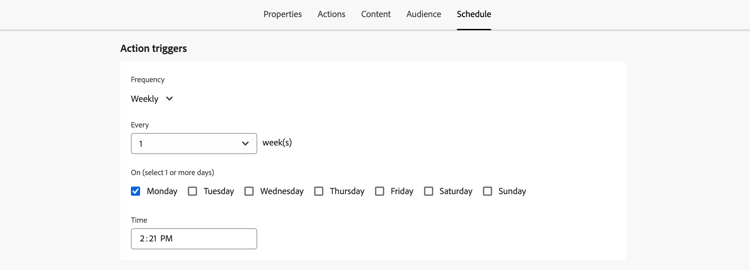
設定結束日期
行銷活動end區段可讓您指定行銷活動何時應停止執行。 在指定日期以外,將不會執行行銷活動。
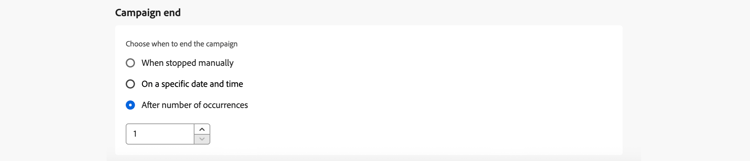
設定速率控制
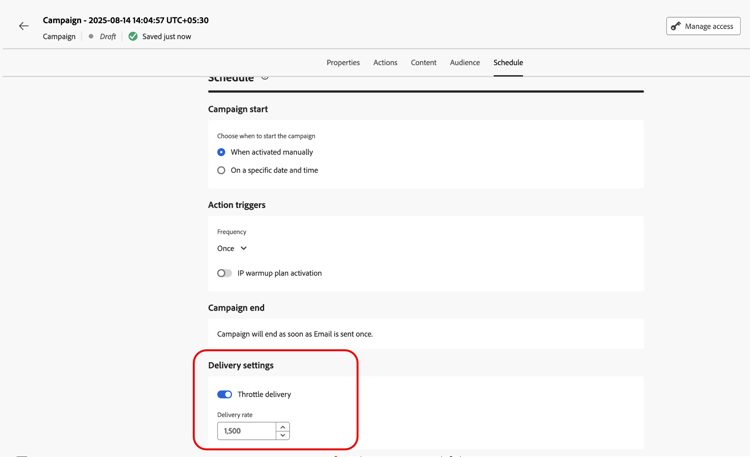
Journey Optimizer可讓您啟用傳出動作(電子郵件、行動訊息、推播通知)的速率控制。
此功能對於防止下游系統 (例如登陸頁面或客戶服務平台) 上的超載特別有用。 例如,您可以將速率限制設為每秒165則訊息,以確保穩定傳送,而不會對下游系統造成衝擊。
若要設定速率控制,請在 傳遞設定 區段中啟用 節流傳遞 選項,並指定所要的每秒傳遞速率。
- 支援的最低傳送率:每秒1個。
- 支援的最大傳遞率:啟用「節流傳遞」選項時為每秒2000。
使用波段傳送
若要隨著時間分批傳送行銷活動訊息,而非一次傳送所有訊息,您可以使用波動傳送。 這有助於平衡負載、支援傳遞能力,並避免壓倒性的下游系統(例如呼叫中心或登陸頁面)。 您可以定義波次的數目、其大小(以百分比或絕對數表示),以及每個波次的排程。
後續步驟 next
行銷活動排程準備就緒後,您就可以檢閱並啟動行銷活動。 了解更多
This section contains structured knowledge intended to support interpretation, retrieval, and question answering related to this topic.
For complete understanding, this information should be combined with the documentation on this page. Neither source is intended to stand alone; the page describes the feature, while this section provides additional context that helps disambiguate terminology, intent, applicability, and constraints.
- TL;DR: This page explains how to schedule an Action campaign in the Schedule tab: start and end dates, recipient local time delivery, execution frequency, rate control, and wave sending.
Intents:
- Set a start date and time with Campaign start
- Send messages at each recipient’s local time with Use profile timezone
- Set a daily, weekly, or monthly execution frequency
- Set an end date with Campaign end
- Set rate control with Throttle delivery
- Deliver the message in batches over time using waves
Glossary:
- Profile timezone: The
profile.timeZonefield of each recipient’s Adobe Experience Platform profile, used to determine their local timezone. (product-specific) - Rate control: Limits the delivery rate for outbound actions to prevent overload on downstream systems. (product-specific)
- Delivery rate: The rate per second set when Throttle delivery is enabled in Delivery settings. (product-specific)
- Waves: Batches in which the campaign message is delivered over time; you define the number of waves, their size (by percentage or absolute number), and the schedule for each wave. (product-specific)
- IP warmup plan activation campaign: A campaign for email actions whose schedule is driven by the IP warmup plan it is associated with. (product-specific)
Guardrails:
- By default, Action campaigns start once they are activated manually, and end as soon as the message has been sent once.
- Outside of the dates specified in Campaign start and Campaign end, the campaign is not executed.
- For recurring campaigns, if the initial scheduled time has already passed, the campaigns roll over to the next available time slot according to their recurrence rules.
- Use profile timezone is available for these outbound channels only: Email, Push, Mobile message, WhatsApp, and LINE.
- If a profile does not have a timezone value, the timezone in which the campaign was created is used as the fallback.
- Time zone identifiers:
profile.timeZonecan be IANA naming or UTC offsets. IANA naming is the preferred format, as it automatically adjusts for daylight-saving rules. IANA identifiers are case-sensitive and must match the official IANA naming. - Execution frequency (daily, weekly, or monthly) is available for Email, Mobile message, and Push notification actions.
- Delivery rate: minimum 1 per second (hard limit); maximum 2000 per second (hard limit) when the Throttle delivery option is enabled. Rate control is available for outbound actions (Email, Mobile messages, Push notifications).
- When a delivery rate is set, the maximum timeframe for which the campaign audience can execute is 12 hours (hard limit). If the delivery rate does not allow all the audience to be sent the message in the 12 hour timeframe, the remaining profiles are excluded from the campaign. The count of excluded profiles is visible in the campaign report.
Terminology:
- Canonical name: Action campaign schedule — variants: campaign schedule
- Synonyms: “Send at recipient’s local time” = “Use profile timezone” (section title and option name)
- Do not confuse: “Live” (status while messages are being delivered across all timezones) ≠ “Completed” (status once all timezones have been processed)
FAQ:
- Q: When does an Action campaign start and end by default? — It starts once it is activated manually, and ends as soon as the message has been sent once.
- Q: How do I send at the same local time for every recipient? — Specify the date and time in Campaign start, then enable Use profile timezone. This is available for Email, Push, Mobile message, WhatsApp, and LINE only.
- Q: What happens if a profile has no timezone value? — The timezone in which the campaign was created is used as the fallback.
- Q: What are the campaign statuses during profile timezone delivery? — The campaign remains in Live status while messages are being delivered across all timezones; when all timezones have been processed, the status changes to Completed.
- Q: Which delivery rates can I set? — From 1 to 2000 per second when Throttle delivery is enabled.
- Q: Why were some profiles excluded from my campaign? — When a delivery rate is set, the maximum timeframe is 12 hours; the remaining profiles are excluded from the campaign if the rate does not allow sending to the whole audience in that timeframe. Their count is in the campaign report.
Examples:
- Profile timezone: a campaign scheduled to send at 9 AM using profile timezone reaches recipients in New York (ET) at 9 AM ET and recipients in Los Angeles (PT) at 9 AM PT.
- Rate control: set a rate limit of 165 messages per second to ensure steady delivery without overwhelming downstream systems.
Related pages:
- IP warmup campaigns: Learn how to create IP warmup campaigns (configuration/ip-warmup-campaign.md)
- IANA identifiers: IANA Time Zone Database (external, https://www.iana.org/time-zones)
- Waves: Learn how to send using waves (delivery/send-using-waves.md)
- Next step, activation: Review and activate an Action campaign (campaigns/review-activate-campaign.md)