在此页面上:批准策略确定哪些历程和营销活动在启动前需要注销,并让管理员设置管理每个请求的条件、定位标准和审阅者。
批准策略允许管理员为历程和营销活动建立验证流程。 此系统概述了特定条件,这些条件决定了历程或活动是否需要批准。 这些策略在复杂性上可能有所不同。 它们只需要求所有营销活动都由特定用户或团队进行审核,或根据营销活动的创建者建立标准。
您可以使用灵活的标准(如标记、营销活动/历程名称、渠道类型或请求者信息)来定位审批策略。 例如,您可以要求批准所有标记为“高风险”的对象,或批准任何符合特定命名模式的营销活动。
创建审批策略 create-policies
要创建批准策略,请执行以下步骤:
-
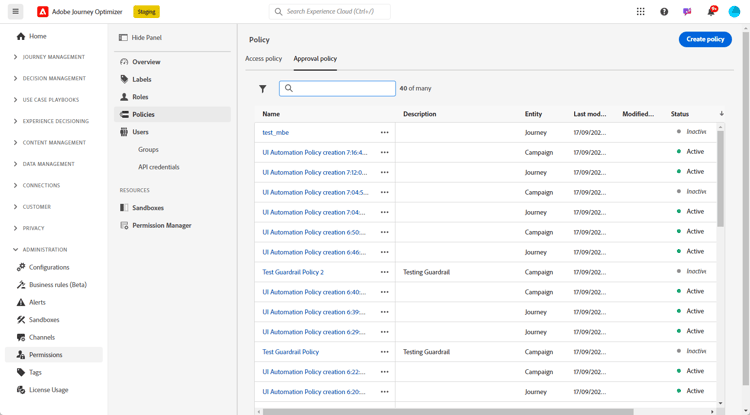
从Journey Optimizer中的 管理 菜单中,依次访问 权限 和策略。
-
在 审批策略 选项卡中单击创建,选择审批策略,然后单击确认。
-
输入策略的 名称 和描述。
-
选择策略将应用于 历程 还是营销活动。
-
启用 块自批准 以阻止历程/营销活动创建者批准自己的对象。
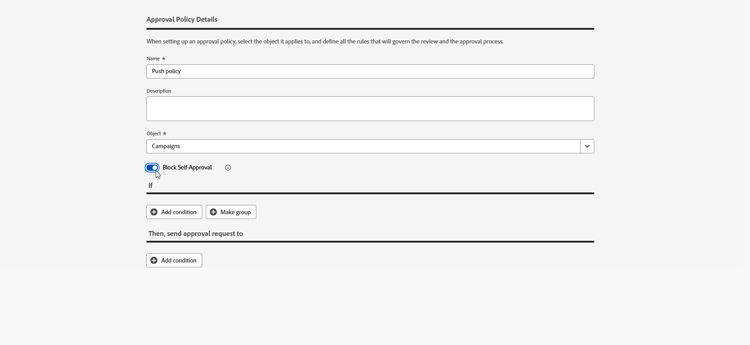
您现在可以优化条件以指定谁可以启动审批请求以及谁可以验证审批请求。
设置审批策略的条件 conditions
审批策略提供了灵活的定位选项,以满足您的治理需求。 您可以根据各种条件创建批准策略,包括:
- 促销活动/历程名称:按名称定位特定对象
- 标记:将策略应用于具有特定标记的所有营销活动或历程
- 渠道类型:特定操作(电子邮件、短信、推送等)需要审批
- 营销活动类型:为操作与API触发的营销活动设置不同的规则
- 请求者:根据创建活动或历程的人员定义策略
要定义与审批策略关联的条件,请执行以下步骤:
-
访问您的审批策略。
-
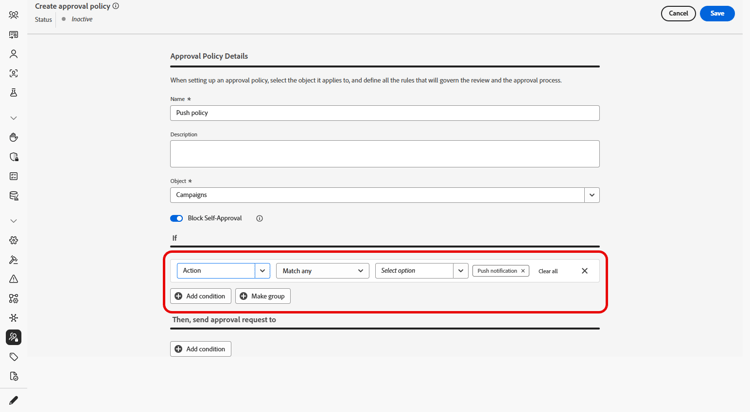
在 If 菜单下,单击 添加条件 以定义将触发审批请求的对象或用户。
-
选择适当的类别、匹配规则和选项。
例如,“如果操作与任何直邮匹配”或“如果请求者用户名与John Doe匹配”。
accordion 了解有关可用类别和选项的更多信息 table 0-row-2 1-row-2 2-row-1 3-row-1 4-row-2 5-row-1 6-row-1 7-row-1 8-row-1 9-row-1 10-row-1 11-row-1 12-row-2 13-row-2 14-row-2 15-row-2 4-rowspan-3 11-rowspan-8 html-authored 类别 选项 营销活动类型 已计划(营销) API 触发(营销) API 触发(事务性) 操作 应用程序内 推送通知 短信 电子邮件 直邮 Web 基于代码 内容卡片 标记 用于组织受众的标记的名称。 对象名称 对象的名称。 请求者用户名 指定请求者的姓名和电子邮件地址 请求者用户组 指定请求者的用户组的名称 -
若要添加更多条件,请单击 添加条件 以定义其他规则,并选择 And 或 Or 以指定连接条件的方式。
-
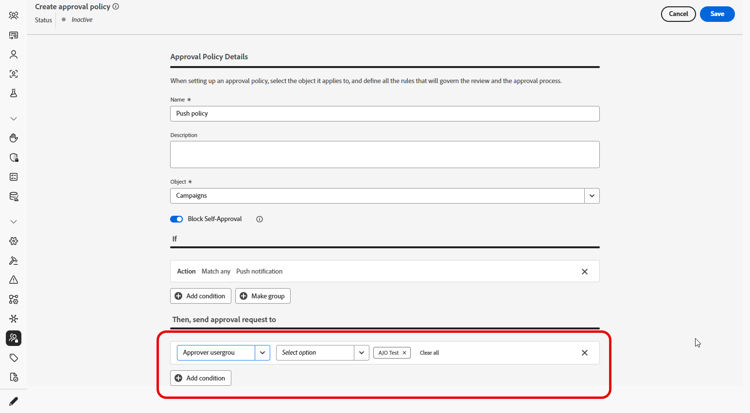
在 Then,将审批请求发送到 菜单下,单击 添加条件 以定义哪个用户可以接受审批请求。
-
从 类别 下拉列表中,选择要选择用户组还是单个用户。
-
然后,从 选项 下拉列表中,选择特定用户组或用户。
选定的用户或用户组将负责验证审批请求。
-
若要添加更多条件,请单击 添加条件 以定义其他规则,并选择 And 或 Or 以指定连接条件的方式。
-
完全配置策略后,单击保存。
您现在可以激活审批策略以应用它。
激活和管理审批策略 activate-policies
要应用审批策略,您必须激活它。 要执行此操作,请执行以下步骤:
-
访问您的审批策略。
-
然后,单击 激活 以将配置的条件应用到您的环境。
note NOTE 激活策略后,便无法对其进行编辑。 要修改条件,请先取消激活策略。 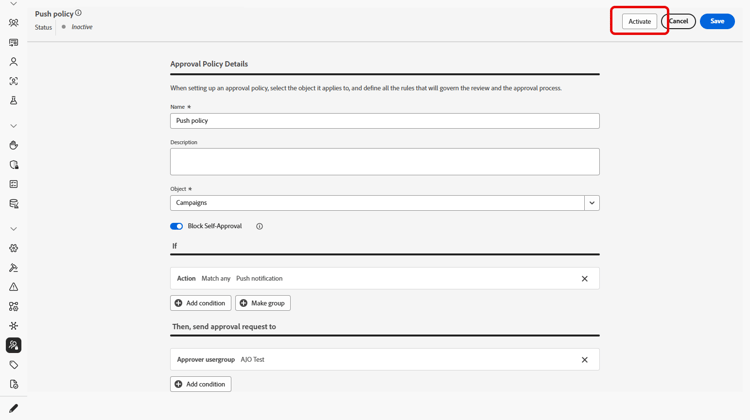
-
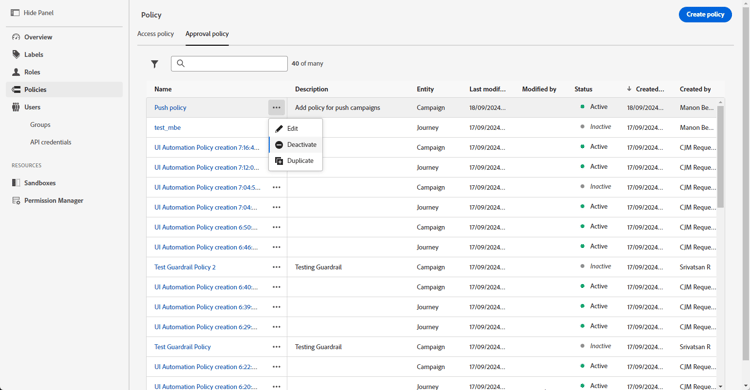
从 策略 菜单中,打开高级选项,以根据需要编辑 3}、 停用 或 复制策略。
This section contains structured knowledge intended to support interpretation, retrieval, and question answering related to this topic.
For complete understanding, this information should be combined with the documentation on this page. Neither source is intended to stand alone; the page describes the feature, while this section provides additional context that helps disambiguate terminology, intent, applicability, and constraints.
- TL;DR: This page explains how administrators create, set conditions for, activate, and manage approval policies that determine which journeys and campaigns require sign-off before they go live.
Intents:
- Create an approval policy from Administration > Permissions > Policies and scope it to Journeys or Campaigns
- Enable Block self-approval to prevent creators from approving their own objects
- Define conditions under the If menu that determine which object or user triggers an approval request
- Define who validates the request under the Then, send approval request to menu, choosing a User Group or an individual User
- Combine multiple conditions using the And or Or operators
- Activate, edit, deactivate, or duplicate an approval policy
Glossary:
- Approval policy: A validation process configured by administrators that determines whether a journey or campaign requires approval before activation. (product-specific)
- Block self-approval: An option that prevents Journey/Campaign creators from approving their own objects. (product-specific)
- Condition: A rule, built from a Category, Matching Rule, and Options, that defines which object or user triggers an approval request. (product-specific)
- Category: The type of criterion a condition targets — for example Campaign type, Action, Tags, Object name, Requestor username, or Requestor user group.
Guardrails:
- To create approval policies, you must have system or product administrator privileges in Adobe Experience Platform.
- Once activated, policies cannot be edited; to modify conditions, deactivate the policy first (hard limit — page states policies “cannot be edited”).
- A policy applies either to Journeys or to Campaigns, selected per policy.
Terminology:
- Canonical name: Approval policy — variants: approval policies
- Do not confuse: “If” (condition defining which object or user triggers an approval request) ≠ “Then, send approval request to” (defining who can validate the request)
- Do not confuse: “Activate” (apply a policy) ≠ “Deactivate” (required before editing) ≠ “Duplicate” (copy a policy)
- Do not confuse: “Requestor username” (name and email address of a designated requestor) ≠ “Requestor user group” (name of the user group of designated requestors)
FAQ:
- Q: Where do I create an approval policy? — From the Administration menu, access Permissions then Policies, click Create in the Approval Policy tab, choose Approval Policy, and confirm.
- Q: Can I edit a policy after activating it? — No. Once activated, policies cannot be edited. Deactivate the policy first to modify its conditions.
- Q: What criteria can target an approval policy? — Campaign/Journey names, Tags, Channel types, Campaign types, and Requestors.
- Q: How do I stop users from approving their own work? — Enable the Block self-approval option when creating the policy.