在此页面上:了解如何在用户界面中手动创建关系架构、添加属性、链接架构以及为编排的营销活动创建和启用数据集。
关系模式可以直接通过用户界面创建,从而能够对属性、主键、版本控制字段和关系进行详细配置。
以下示例手动定义 忠诚度会员资格 架构,以说明编排的营销活动所需的结构。
-
添加属性,如客户ID、成员资格级别和状态字段。
-
将您的架构链接到内置架构,如用于营销活动定位的收件人。
-
基于您的架构创建数据集,并将其启用以用于编排的营销活动。
-
从支持的数据源将数据摄取至数据集中。
➡️ 在Adobe Experience Platform文档中了解有关手动关系架构的更多信息
创建您的架构 schema
首先,在Adobe Experience Platform中手动创建新的关系架构。 此过程允许您从头开始定义架构结构,包括其名称和行为。
-
登录到Adobe Experience Platform。
-
导航到数据管理 > 架构菜单。
-
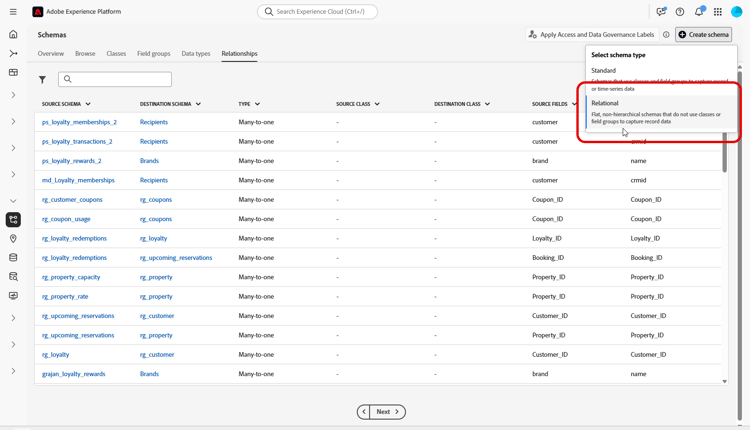
单击创建架构。
-
选择 关系 作为架构类型。
-
选择 手动创建 以通过手动添加字段来构建架构。
-
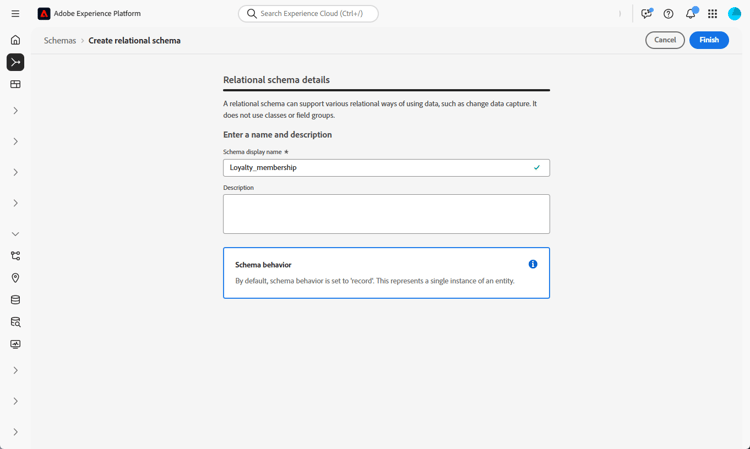
输入您的架构显示名称。
-
单击 完成 以继续创建架构。
您现在可以开始向架构添加属性以定义其结构。
将属性添加到架构 schema-attributes
接下来,添加属性以定义架构的结构。 这些字段表示在编排的营销活动中使用的关键数据点,例如客户标识符、成员资格详细信息和活动日期。 精确地定义它们可确保可靠的个性化、分段和跟踪。
用于定位的任何架构必须至少包含一个类型为String且具有关联标识命名空间的标识字段。 这可确保与Adobe Journey Optimizer的定位和身份解析功能兼容。
-
枚举
基于DDL的架构和手动架构创建均支持ENUM字段,从而允许您定义具有一组固定的允许值的属性。 -
用于数据管理的架构标签
架构字段级别支持标签设置,以强制执行数据管理策略,例如访问控制和使用限制。 有关详细信息,请参阅Adobe Experience Platform文档。 -
复合键
关系模式定义支持跨多个字段的复合主键,允许同时使用多个字段来唯一标识记录。
-
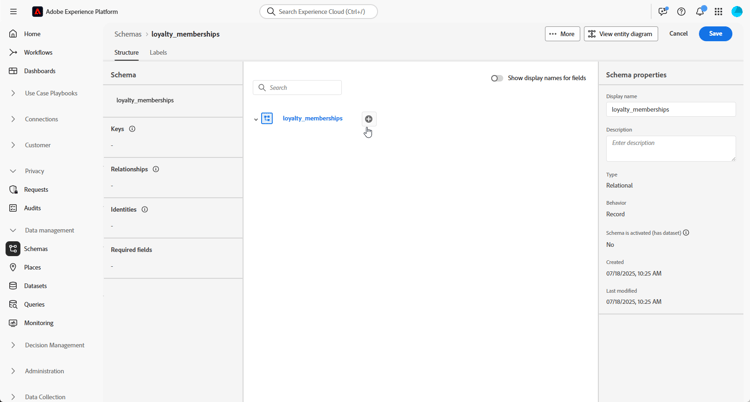
在画布中,单击 架构名称 旁边的

-
输入您的属性字段名、显示名称和类型。
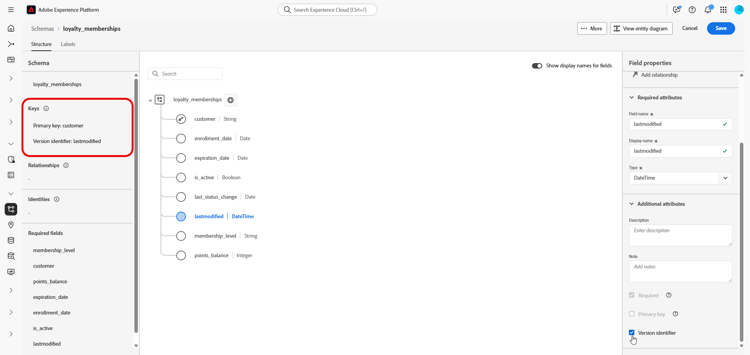
在此示例中,我们已将下表中详述的属性添加到 忠诚度会员资格 架构。
accordion 属性示例 table 0-row-3 1-row-3 2-row-3 3-row-3 4-row-3 5-row-3 6-row-3 7-row-3 8-row-3 属性名称 数据类型 其他属性 客户 字符串 主键 membership_level 字符串 必需 points_balance 整数 必需 enrollment_date 日期 必需 last_status_change 日期 必需 expiration_date 日期 - is_active 布尔型 必需 上次修改时间 日期时间 必需 -
将相应的字段分配为 主键 和版本描述符。
在创建手动模式时,请确保包含以下基本字段:
- 至少一个主键
- 版本标识符,如
datetime或number类型的lastmodified字段。 - 对于变更数据捕获(CDC)摄取,为名为
_change_request_type且类型为String的特殊列,它指示数据变更的类型(例如,插入、更新、删除)并启用增量处理。 请注意,_change_request_type不应是表架构的一部分,它只应在引入期间添加到数据文件。
-
单击保存。
创建和保存属性后,可通过定义关系将方案与其他关系方案链接。
链接架构 link-schema
通过在两个架构之间创建关系,您可以使用主要用户档案架构以外的数据增强编排的营销活动。
-
从新创建的架构中,选择要用作链接的属性,然后单击添加关系。
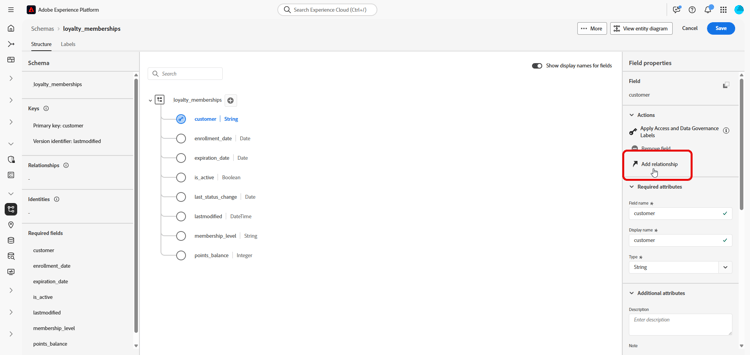
-
选择 引用架构 和 引用字段 以建立关系。
在此示例中,
customer属性链接到recipients架构。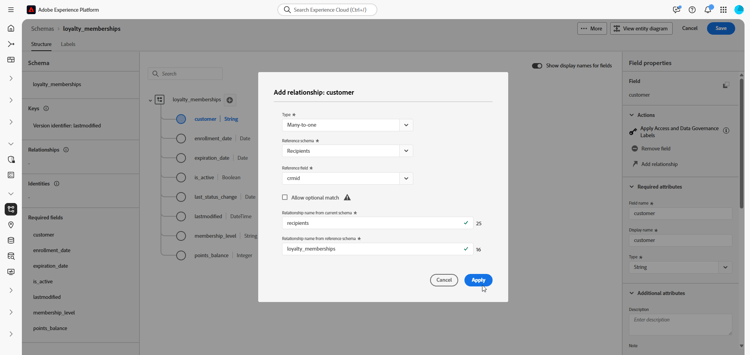
-
输入来自当前架构和引用架构的关系名称。
-
配置后,单击应用。
为架构创建数据集 dataset
定义架构后,您现在可以基于它创建数据集。 数据集存储了您摄取的数据,必须启用该数据集才能访问编排的营销活动。
-
导航到数据管理 > 数据集菜单,然后单击创建数据集。
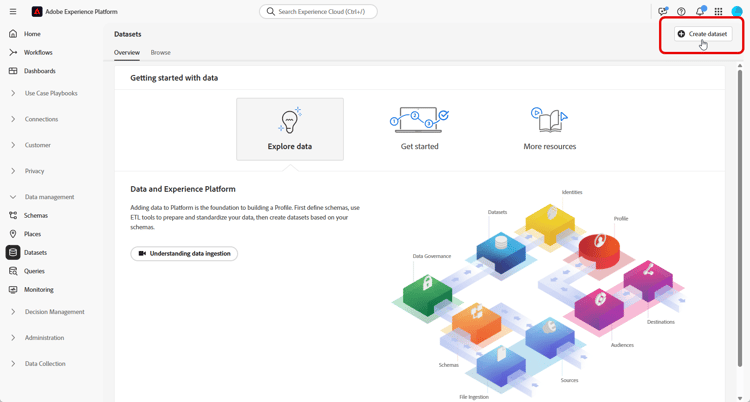
-
选择 从架构 创建数据集。
-
选择您之前创建的架构,此处忠诚度会员资格,然后单击下一步。
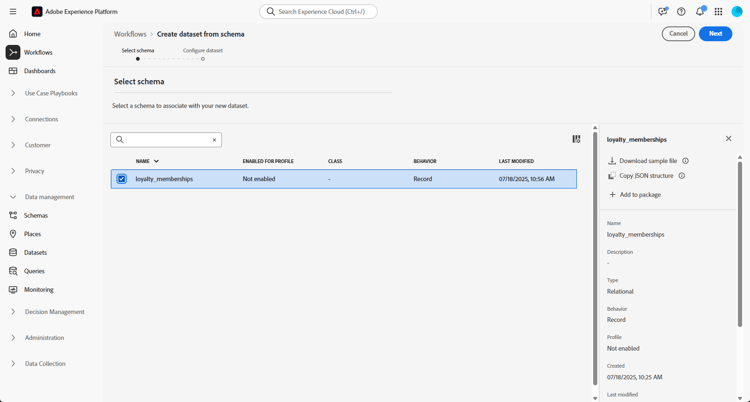
-
为您的 数据集 输入 名称 并单击完成。
现在,您需要为编排的营销活动启用数据集。
为编排的营销活动启用数据集 enable
创建数据集后,您需要明确将其启用于编排的营销活动。 此步骤可确保您的数据集在 Adobe Journey Optimizer 中可用于实时编排和个性化。
请参阅Adobe Developer文档,以验证或启用数据集上的编排营销活动扩展。
-
在 数据集 列表中找到您的数据集。
-
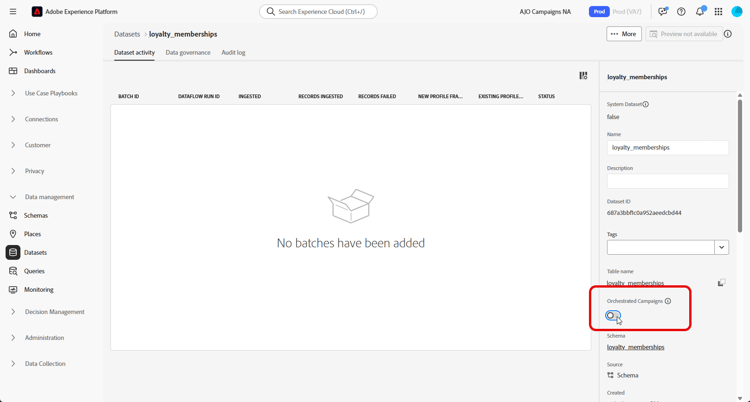
从 数据集 设置中,启用 编排营销活动 选项以标记可在编排营销活动中使用的数据集。
-
请等待几分钟,以便完成启用过程。 请注意,只有在完全激活此设置后,才能摄取数据和使用营销活动。
您现在可以使用选择的源开始将数据摄取到您的架构中。
➡️ 了解如何摄取数据
如果架构或数据集返回错误代码,请参阅关系架构和数据集错误。
This section contains structured knowledge intended to support interpretation, retrieval, and question answering related to this topic.
For complete understanding, this information should be combined with the documentation on this page. Neither source is intended to stand alone; the page describes the feature, while this section provides additional context that helps disambiguate terminology, intent, applicability, and constraints.
- TL;DR: This page explains how to manually create a relational schema in Adobe Experience Platform, add attributes, link schemas, and create and enable a dataset for use in Orchestrated campaigns.
Intents:
- Create a relational schema manually through the Adobe Experience Platform interface.
- Add attributes to a relational schema, including primary key, version descriptor, and required fields.
- Link a relational schema to another schema, such as Recipients, to extend Orchestrated campaigns with additional data.
- Create a dataset from a relational schema and enable it for Orchestrated campaigns.
- Ingest data into the enabled dataset.
Glossary:
- Relational schema: a schema type created directly through the Adobe Experience Platform interface, enabling detailed configuration of attributes, primary keys, versioning fields, and relationships (product-specific)
- Version Descriptor: a field, such as
lastmodifiedof typedatetimeornumber, used as a version identifier in a manual schema (product-specific) - _change_request_type: a special column of type String used for Change Data Capture (CDC) ingestion, indicating the type of data change (insert, update, delete) and enabling incremental processing (product-specific)
- Composite Key: a primary key spanning multiple fields, supported in relational schema definitions (product-specific)
- Schema Label: a data governance label supported at the schema field level to enforce policies such as access control and usage restrictions (product-specific)
Guardrails:
- Any schema used for targeting must include at least one identity field of type String with an associated identity namespace, to ensure compatibility with Adobe Journey Optimizer’s targeting and identity resolution capabilities.
- A manual schema must include at least one primary key and a version identifier, such as a
lastmodifiedfield of typedatetimeornumber. - For Change Data Capture (CDC) ingestion, the
_change_request_typecolumn must not be part of the table schema; it must only be added to the data file during ingestion. - ENUM fields are supported in both DDL-based and manual schema creation.
- Composite primary keys spanning multiple fields are supported in relational schema definitions.
- The View relationships diagram on the Relationship tab is read-only; to create or edit a relationship, the schema must be opened from the Browse tab instead.
- After enabling a dataset for Orchestrated campaigns, data ingestion and campaign use are only possible once the enablement setting is fully activated.
Terminology:
- Canonical name: Adobe Experience Platform — Acronym: AEP
FAQ:
- Q: What fields must a manual relational schema include? — At least one primary key and a version identifier, such as a
lastmodifiedfield of type datetime or number. - Q: What is required for a schema used for targeting? — At least one identity field of type String with an associated identity namespace.
- Q: Where does the
_change_request_typecolumn belong? — It is used for Change Data Capture (CDC) ingestion and must only be added to the data file during ingestion, not to the table schema. - Q: Can I edit a relationship from the View relationships diagram? — No, that view on the Relationship tab is read-only; open the schema from the Browse tab to create or edit a relationship.
- Q: What must be done after creating a dataset from a relational schema? — The dataset must be explicitly enabled for Orchestrated campaigns before data ingestion and campaign use are possible.
Related pages:
- To ingest data into the created dataset: Configuration steps (orchestrated/ingest-data.md)
- If a schema or dataset returns an error code: Relational schema and dataset errors (orchestrated/relational-schema-errors.md)
Personas:
- developer: Can add attributes such as customer, membership_level, points_balance, enrollment_date, and lastmodified when defining a relational schema. Can use a special column named _change_request_type of type String to indicate insert, update, or delete for Change Data Capture ingestion. The page states that _change_request_type must only be added to the data file during ingestion, not to the table schema. Where: “Add attributes to your schema”.
- admin: Can create a dataset from a relational schema and enable the Orchestrated campaigns option from the Datasets settings. Can locate the dataset in the Datasets list before enabling it. The page states that data ingestion and campaign use are only possible once this setting is fully activated. Where: “Enable dataset for orchestrated campaigns”.
Onboarding:
- Level: Experienced
- First minimal step: Create a relational schema manually using the Adobe Experience Platform interface.
- Success check: You can now start ingesting data into your schema using the source of your choice.
- Next: Ingest data into the enabled dataset: Configuration steps (orchestrated/ingest-data.md); If a schema or dataset returns an error code: Relational schema and dataset errors (orchestrated/relational-schema-errors.md)