Nesta página: saiba como configurar um targeting dimension para campanhas orquestradas, mapeando um esquema relacional para o perfil do cliente para que você possa entregar mensagens no nível da entidade.
Com campanhas orquestradas, você pode projetar e fornecer comunicações direcionadas no nível da entidade, aproveitando os recursos de esquema relacional da Adobe Experience Platform. A Experience Platform usa esquemas para descrever a estrutura dos dados de forma consistente e reutilizável. Quando os dados são assimilados na Experience Platform, eles são estruturados de acordo com um esquema XDM.
Campanhas orquestradas oferecem suporte a dois tipos de targeting dimensions:
- Dimensão de direcionamento do perfil: o padrão interno, que direciona os destinatários diretamente usando o esquema Perfil.
- Dimensão de direcionamento personalizada: direciona destinatários por meio de um esquema relacional (por exemplo,
Recipients,Visitors,Customers). Use isso quando precisar enviar mensagens no nível da entidade — como por assinatura ou por contrato — em vez de no nível do perfil.
Ao configurar um targeting dimension personalizado, você define dois aspectos principais:
-
Esquemas de Tabela de Destino
Você especifica quais esquemas relacionais são elegíveis para o direcionamento. Por padrão, o esquema chamado
Recipienté usado, mas você pode configurar alternativas comoVisitors,Customers, etc.note important IMPORTANT As campanhas orquestradas permitem o direcionamento em qualquer esquema que tenha uma relação direta ou relacionada com o esquema Perfil. Embora seu uso se destine principalmente a relações 1:1, ele também oferece suporte a relações 1:N, como Recipients da Conta >, desde que o caminho de relação seja modelado corretamente no modelo de dados. Isso permite o direcionamento com base em dados no nível da conta, enquanto ainda resolve a identidade de perfil correta para a entrega de mensagens. -
Vinculação de perfis
O sistema deve entender como o esquema de destino mapeia para o esquema
Profile. Isso é feito por meio de um campo de identidade compartilhado — um que existe tanto no esquema de destino quanto no esquemaProfilee está configurado como um namespace de identidade.
➡️ Saiba mais sobre esquemas relacionais na documentação do Adobe Experience Platform
Crie sua Targeting dimension targeting-dimension
Comece configurando a orquestração de campanhas, mapeando um esquema relacional para o perfil do cliente.
-
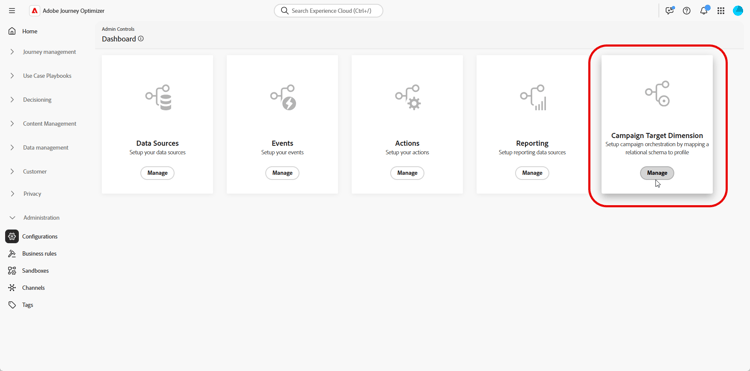
Em Administration, acesse o menu Configurations e selecione Campaign Target Dimension.
-
Clique em Criar para começar a criar sua Targeting dimension.
-
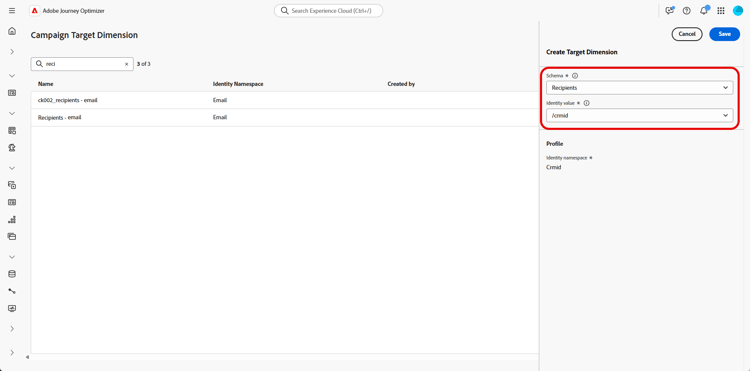
Escolha seu Esquema configurado anteriormente no menu suspenso.
Enquanto todos os esquemas relacionais são exibidos, somente aqueles com uma relação de identidade direta com Perfil são elegíveis para seleção. Evite escolher esquemas que não sejam de pessoas, por exemplo, compras, e selecione um esquema que esteja diretamente associado a um perfil.
-
Selecione o Valor de identidade que representa a entidade que você deseja direcionar.
Neste exemplo, o perfil do cliente está vinculado a várias assinaturas, cada uma representada por um único
crmIDno esquemaRecipient. Ao configurar o Dimension de Destino para usar o esquemaRecipiente sua identidadecrmID, você poderá enviar mensagens no nível de assinatura, em vez de no perfil principal do cliente, garantindo que cada contrato ou linha receba sua própria mensagem personalizada.Saiba mais na documentação do Adobe Experience Platform
-
Clique em Salvar para concluir a instalação. Observe que uma vez criada, uma Dimensão de destino não pode ser editada.
-
Acesse o


Após configurar o Dimension de Destino, prossiga para criar e configurar sua Configuração de Canal e defina os Detalhes de Execução correspondentes.
This section contains structured knowledge intended to support interpretation, retrieval, and question answering related to this topic.
For complete understanding, this information should be combined with the documentation on this page. Neither source is intended to stand alone; the page describes the feature, while this section provides additional context that helps disambiguate terminology, intent, applicability, and constraints.
- TL;DR: This page explains how to configure a Targeting dimension for Orchestrated campaigns by mapping a relational schema to the customer profile so messages can be delivered at the entity level.
Intents:
- Understand the difference between a Profile targeting dimension and a custom targeting dimension.
- Configure Targetable Schemas to specify which relational schemas are eligible for targeting.
- Configure Profile Linkage so the system can map the target schema to the Profile schema through a shared identity field.
- Create a Targeting dimension by choosing a previously configured schema and selecting its Identity value.
- Delete a Targeting dimension that is not referenced by an active channel configuration.
Glossary:
- Profile targeting dimension: the built-in default targeting dimension, which targets recipients directly using the Profile schema (product-specific)
- Custom targeting dimension: a targeting dimension that targets recipients through a relational schema (for example, Recipients, Visitors, Customers), used to deliver messages at the entity level rather than at the profile level (product-specific)
- Targetable Schemas: the configuration aspect that specifies which relational schemas are eligible for targeting (product-specific)
- Profile Linkage: the configuration aspect that defines how the target schema maps to the Profile schema through a shared identity field configured as an identity namespace (product-specific)
- Identity value: the field selected on the chosen schema that represents the entity to target (for example, crmID) (product-specific)
Guardrails:
- Although all relational schemas are displayed when choosing a schema, only those with a direct identity relationship to Profile are eligible for selection.
- Orchestrated campaigns allow targeting on any schema that has a direct or related relationship to the Profile schema; usage is primarily intended for 1:1 relationships, but 1:N relationships (such as Account to Recipients) are also supported as long as the relationship path is properly modeled in the data model.
- Once created, a Target dimension cannot be edited.
- A Target dimension cannot be deleted if it is referenced by an active channel configuration.
Terminology:
- Canonical name: Targeting dimension — variants: Target Dimension, Campaign Target Dimension
- Do not confuse: “Profile targeting dimension” (targets using the Profile schema directly) ≠ “Custom targeting dimension” (targets through a relational schema at the entity level)
FAQ:
- Q: What is the difference between a Profile targeting dimension and a custom targeting dimension? — The Profile targeting dimension is the built-in default that targets recipients directly using the Profile schema; a custom targeting dimension targets recipients through a relational schema to deliver messages at the entity level.
- Q: Which relational schemas can be selected when creating a Targeting dimension? — Only schemas with a direct identity relationship to Profile are eligible for selection, even though all relational schemas are displayed.
- Q: Can a Targeting dimension be edited after it is created? — No, once created, a Target dimension cannot be edited.
- Q: Can a Targeting dimension always be deleted? — No, a Target dimension cannot be deleted if it is referenced by an active channel configuration.
- Q: What are the two key aspects defined when configuring a custom targeting dimension? — Targetable Schemas and Profile Linkage.
Related pages:
- For choosing a previously configured schema when creating a Targeting dimension, see previously configured Schema (orchestrated/gs-schemas.md)
Personas:
- marketer: Can create a Targeting dimension by choosing a previously configured schema and selecting its Identity value, then select Save to complete the setup. Can configure Targetable Schemas to specify which relational schemas are eligible for targeting, and configure Profile Linkage through a shared identity field. Can access the advanced menu to delete a Target dimension. The page states that a Target dimension cannot be edited once created and cannot be deleted if it is referenced by an active channel configuration. Where: “Create your Targeting dimension”.
Onboarding:
- Level: Intermediate
- First minimal step: From Administration, access the Configurations menu and select Campaign Target Dimension.
- Success check: Messages are delivered at the subscription level rather than to the main customer profile, with each contract receiving its own personalized message.
- Previous: Choose a previously configured schema for your Targeting dimension: Configuration steps (orchestrated/gs-schemas.md)