이 페이지에서: 승인 정책은 라이브로 전환되기 전에 로그오프해야 하는 여정 및 캠페인을 결정하고 관리자가 각 요청을 제어하는 조건, 타깃팅 기준 및 검토자를 설정할 수 있도록 합니다.
승인 정책을 사용하면 관리자가 여정 및 캠페인에 대한 유효성 검사 프로세스를 설정할 수 있습니다. 이 시스템은 여정 또는 캠페인에 승인이 필요한지 여부를 결정하는 특정 조건을 간략하게 설명합니다. 이러한 정책은 복잡성에 따라 다를 수 있습니다. 모든 캠페인을 특정 사용자 또는 팀이 검토하도록 하거나, 캠페인을 만든 사람을 기준으로 기준을 설정할 수 있습니다.
태그, 캠페인/여정 이름, 채널 유형 또는 요청자 정보와 같은 유연한 기준을 사용하여 승인 정책을 타깃팅할 수 있습니다. 예를 들어 "높은 위험"으로 태그가 지정된 모든 오브젝트 또는 특정 이름 지정 패턴과 일치하는 캠페인에 대한 승인이 필요할 수 있습니다.
승인 정책 만들기 create-policies
승인 정책을 만들려면 다음 단계를 수행합니다.
-
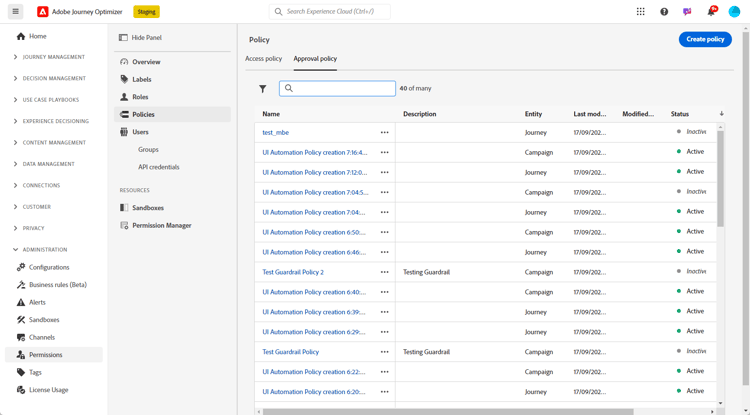
Journey Optimizer의 관리 메뉴에서 권한 및 정책에 액세스합니다.
-
승인 정책 탭에서 만들기를 클릭하고 승인 정책을 선택한 다음 확인을 클릭합니다.
-
정책에 대한 이름 및 설명을 입력하십시오.
-
정책이 여정 또는 캠페인에 적용되는지 여부를 선택하십시오.
-
여정/캠페인 작성자가 자신의 개체를 승인하지 못하도록 자체 승인 차단을 사용하도록 설정하십시오.
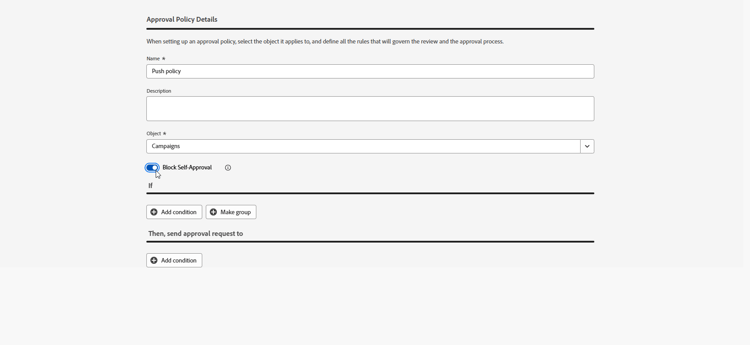
이제 조건을 세분화하여 승인 요청을 시작할 수 있는 사용자와 승인 요청을 검증할 수 있는 사용자를 지정할 수 있습니다.
승인 정책 조건 설정 conditions
승인 정책은 거버넌스 요구 사항에 맞게 유연한 타기팅 옵션을 제공합니다. 다음을 포함한 다양한 기준에 따라 승인 정책을 만들 수 있습니다.
- 캠페인/여정 이름: 이름별로 특정 개체를 대상으로 합니다.
- 태그: 특정 태그가 있는 모든 캠페인이나 여정에 정책 적용
- 채널 형식: 특정 작업(전자 메일, 모바일 메시지, 푸시 등)에 대한 승인이 필요합니다.
- 캠페인 유형: 작업과 API 트리거 캠페인에 대해 다른 규칙을 설정합니다
- 요청자: 캠페인이나 여정을 만드는 사용자를 기준으로 정책을 정의합니다.
승인 정책과 연관된 조건을 정의하려면 다음 단계를 수행합니다.
-
승인 정책에 액세스합니다.
-
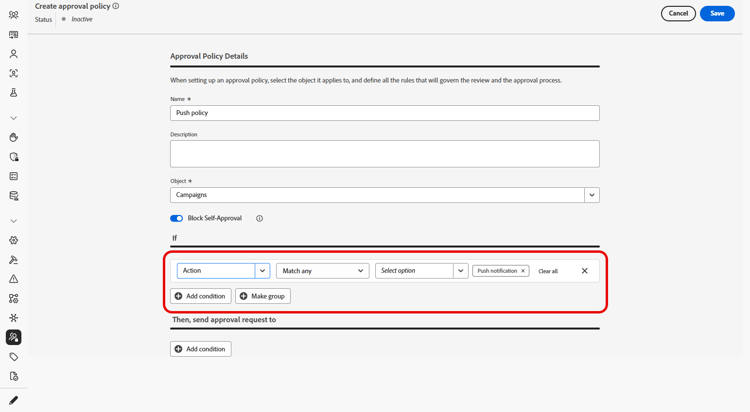
If 메뉴에서 조건 추가를 클릭하여 승인 요청을 트리거할 개체 또는 사용자를 정의합니다.
-
적절한 범주, 일치 규칙 및 옵션을 선택하세요.
예를 들어 “작업이 Dm과 일치하는 경우” 또는 "요청자 사용자 이름이 John Doe와 일치하는 경우"가 있습니다.
accordion 사용 가능한 범주 및 옵션에 대해 자세히 알아보기 table 0-row-2 1-row-2 2-row-1 3-row-1 4-row-2 5-row-1 6-row-1 7-row-1 8-row-1 9-row-1 10-row-1 11-row-1 12-row-2 13-row-2 14-row-2 15-row-2 4-rowspan-3 11-rowspan-8 html-authored 카테고리 옵션 캠페인 유형 예약됨(마케팅) API 트리거됨(마케팅) API 트리거됨(트랜잭션) 작업 인앱 푸시 알림 Mobile 메시지 이메일 다이렉트 메일 웹 코드 기반 컨텐츠 카드 태그 대상을 구성하는 데 사용되는 태그의 이름입니다. 오브젝트 이름 개체의 이름입니다. 요청자 사용자 이름 지정된 요청자의 이름 및 이메일 주소 요청자 사용자 그룹 지정된 요청자의 사용자 그룹 이름 -
조건을 더 추가하려면 조건 추가를 클릭하여 추가 규칙을 정의하고 And 또는 Or을(를) 선택하여 조건 연결 방식을 지정하십시오.
-
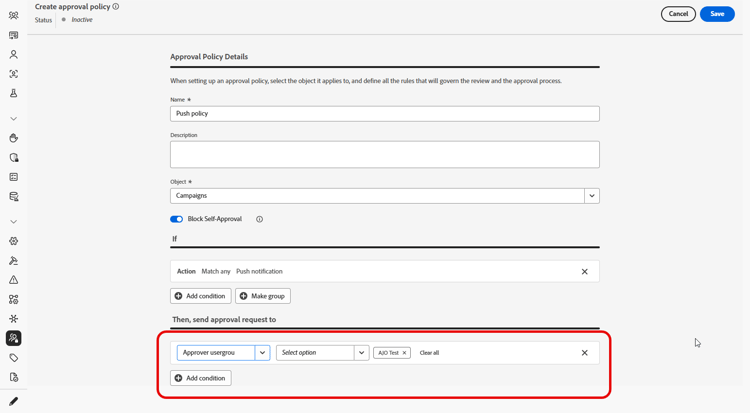
그런 다음 메뉴에 승인 요청을 보내세요. 조건 추가를 클릭하여 승인 요청을 수락할 수 있는 사용자를 정의합니다.
-
범주 드롭다운에서 사용자 그룹을 선택할지 개별 사용자를 선택할지를 선택합니다.
-
그런 다음 옵션 드롭다운에서 특정 사용자 그룹 또는 사용자를 선택합니다.
선택한 사용자 또는 사용자 그룹이 승인 요청의 유효성을 검사합니다.
-
조건을 더 추가하려면 조건 추가를 클릭하여 추가 규칙을 정의하고 And 또는 Or을(를) 선택하여 조건 연결 방식을 지정하십시오.
-
정책이 완전히 구성되면 저장을 클릭합니다.
이제 승인 정책을 활성화하여 적용할 수 있습니다.
승인 정책 활성화 및 관리 activate-policies
승인 정책을 적용하려면 승인 정책을 활성화해야 합니다. 이렇게 하려면 다음 단계를 수행합니다.
-
승인 정책에 액세스합니다.
-
활성화를 클릭하여 구성된 조건을 환경에 적용합니다.
note NOTE 활성화되면 정책을 편집할 수 없습니다. 조건을 수정하려면 먼저 정책을 비활성화합니다. 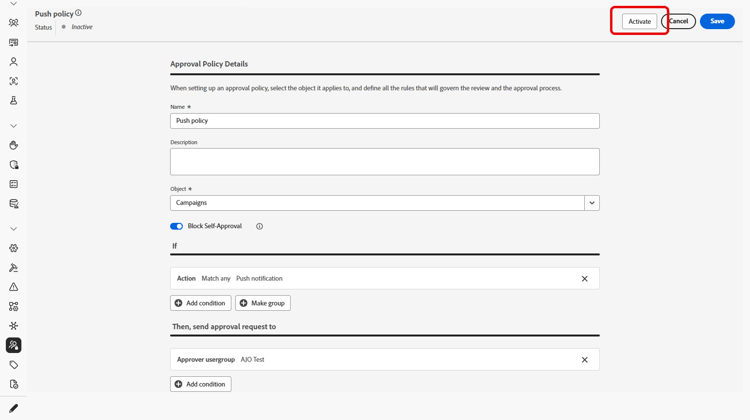
-
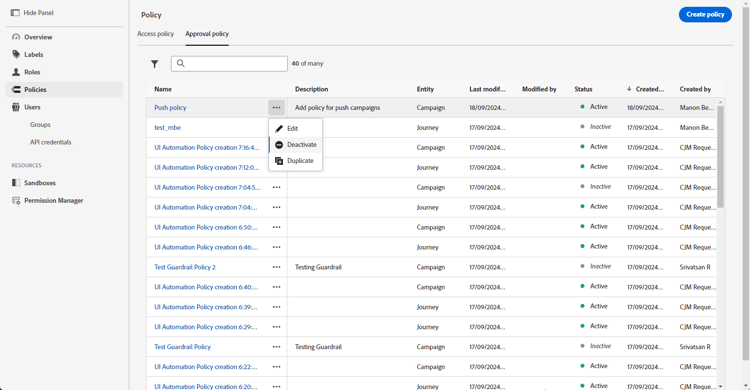
정책 메뉴에서 필요에 따라 정책을 편집, 비활성화 또는 복제하는 고급 옵션을 엽니다.
This section contains structured knowledge intended to support interpretation, retrieval, and question answering related to this topic.
For complete understanding, this information should be combined with the documentation on this page. Neither source is intended to stand alone; the page describes the feature, while this section provides additional context that helps disambiguate terminology, intent, applicability, and constraints.
- TL;DR: This page explains how administrators create, set conditions for, activate, and manage approval policies that determine which journeys and campaigns require sign-off before they go live.
Intents:
- Create an approval policy from Administration > Permissions > Policies and scope it to Journeys or Campaigns
- Enable Block self-approval to prevent creators from approving their own objects
- Define conditions under the If menu that determine which object or user triggers an approval request
- Define who validates the request under the Then, send approval request to menu, choosing a User Group or an individual User
- Combine multiple conditions using the And or Or operators
- Activate, edit, deactivate, or duplicate an approval policy
Glossary:
- Approval policy: A validation process configured by administrators that determines whether a journey or campaign requires approval before activation. (product-specific)
- Block self-approval: An option that prevents Journey/Campaign creators from approving their own objects. (product-specific)
- Condition: A rule, built from a Category, Matching Rule, and Options, that defines which object or user triggers an approval request. (product-specific)
- Category: The type of criterion a condition targets — for example Campaign type, Action, Tags, Object name, Requestor username, or Requestor user group.
Guardrails:
- To create approval policies, you must have system or product administrator privileges in Adobe Experience Platform.
- Once activated, policies cannot be edited; to modify conditions, deactivate the policy first (hard limit — page states policies “cannot be edited”).
- A policy applies either to Journeys or to Campaigns, selected per policy.
Terminology:
- Canonical name: Approval policy — variants: approval policies
- Do not confuse: “If” (condition defining which object or user triggers an approval request) ≠ “Then, send approval request to” (defining who can validate the request)
- Do not confuse: “Activate” (apply a policy) ≠ “Deactivate” (required before editing) ≠ “Duplicate” (copy a policy)
- Do not confuse: “Requestor username” (name and email address of a designated requestor) ≠ “Requestor user group” (name of the user group of designated requestors)
FAQ:
- Q: Where do I create an approval policy? — From the Administration menu, access Permissions then Policies, click Create in the Approval Policy tab, choose Approval Policy, and confirm.
- Q: Can I edit a policy after activating it? — No. Once activated, policies cannot be edited. Deactivate the policy first to modify its conditions.
- Q: What criteria can target an approval policy? — Campaign/Journey names, Tags, Channel types, Campaign types, and Requestors.
- Q: How do I stop users from approving their own work? — Enable the Block self-approval option when creating the policy.