이 페이지에서: 데이터 거버넌스 및 동의 정책을 적용하는 동안 사용자 지정 작업을 사용하여 JSON 페이로드가 있는 REST API 호출을 통해 여정을 서드파티 시스템에 연결하는 방법을 알아봅니다.
사용자 지정 작업을 사용하여 메시지 또는 API 호출을 전송할 서드파티 시스템에 대한 연결을 활성화합니다. JSON 형식 페이로드를 사용하여 REST API를 통해 호출할 수 있는 모든 공급자의 어떤 서비스로든 작업을 구성할 수 있습니다.
이 섹션에서 사용자 지정 작업에 대해 자세히 알아보세요.
이 페이지에서 사용자 지정 작업을 만들고 구성하는 방법에 대해 알아봅니다.
이 페이지에서 개인화를 위해 사용자 지정 작업의 API 호출 응답을 사용하는 방법을 알아봅니다.
동의 및 데이터 거버넌스 privacy
Journey Optimizer에서는 데이터 거버넌스 및 동의 정책을 사용자 지정 작업에 적용하여 특정 필드가 서드파티 시스템으로 내보내지지 않도록 하거나 이메일, 푸시 또는 모바일 커뮤니케이션 수신에 동의하지 않은 고객을 제외할 수 있습니다. 자세한 내용은 다음 페이지를 참조하십시오.
URL 구성
사용자 지정 작업 활동의 구성 창에는 사용자 지정 작업에 대해 구성된 URL 구성 매개 변수와 인증 매개 변수가 표시됩니다. 여정에서 URL의 정적 부분을 설정할 수 없지만 사용자 지정 작업의 전역 구성에서는 설정할 수 있습니다. 자세히 알아보기.
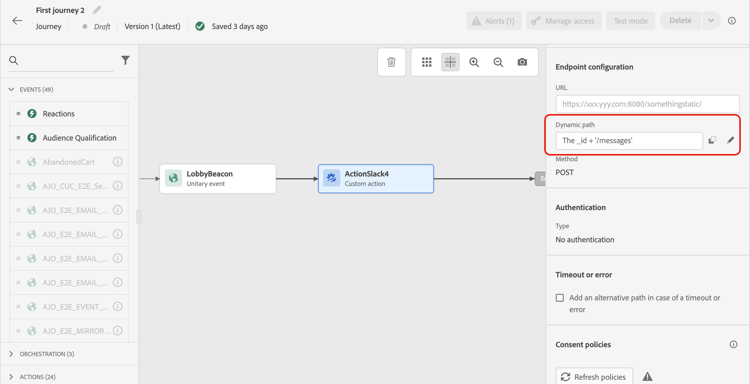
동적 경로
URL에 동적 경로가 포함된 경우 경로 필드에 경로를 지정하십시오.
필드와 일반 텍스트 문자열을 연결하려면 고급 표현식 편집기에서 String 함수 또는 더하기 기호(+)를 사용하십시오. 일반 텍스트 문자열을 작은따옴표(') 또는 큰따옴표(")로 묶습니다. 자세히 알아보기.
이 표에서는 구성의 예를 보여 줍니다.
https://xxx.yyy.com:8080/somethingstatic/The _id + '/messages'연결된 URL의 형식은 다음과 같습니다.
https://xxx.yyy.com:8080/somethingstatic/<ID>/messages
헤더 및 쿼리 매개 변수 headers
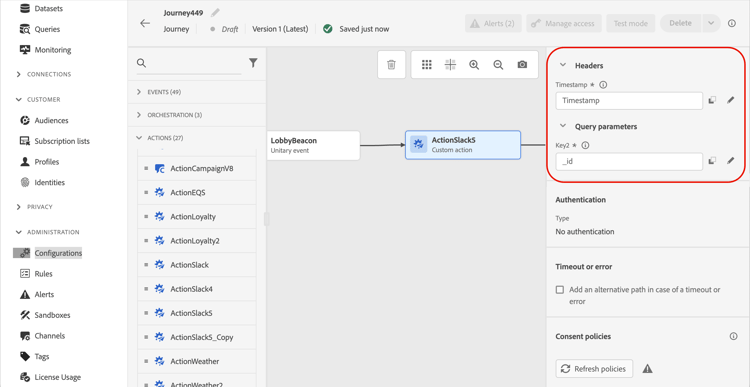
URL 구성 섹션에는 동적 헤더 및 쿼리 매개 변수 필드가 표시되지만 상수 필드는 표시되지 않습니다. 동적 헤더 및 쿼리 매개 변수 필드는 작업 구성 화면에서 변수로 정의됩니다. 자세히 알아보기
동적 헤더 및 쿼리 매개 변수 필드의 값을 지정하려면 필드 내부 또는 연필 아이콘을 클릭하고 원하는 필드를 선택합니다.
사용자 지정 작업의
작업 매개 변수
작업 매개 변수 섹션에서 “변수”(으)로 정의된 메시지 매개 변수를 볼 수 있습니다. 이러한 매개 변수의 경우 이 정보를 가져올 위치(예: 이벤트, 데이터 소스)를 정의하거나, 값을 수동으로 전달하거나, 고급 사용 사례에 고급 표현식 편집기를 사용할 수 있습니다. 고급 사용 사례는 데이터 조작 및 기타 함수 사용일 수 있습니다. 이 페이지를 참조하세요.
This section contains structured knowledge intended to support interpretation, retrieval, and question answering related to this topic.
For complete understanding, this information should be combined with the documentation on this page. Neither source is intended to stand alone; the page describes the feature, while this section provides additional context that helps disambiguate terminology, intent, applicability, and constraints.
- TL;DR: This page explains how to add and configure a custom action activity in a journey to call a third-party REST API with a JSON payload, including URL configuration, header/query parameter mapping, action parameter mapping, and applying data governance and consent policies.
Intents:
- Add a custom action activity to a journey to send data to a third-party system via REST API
- Configure a dynamic URL path by concatenating fields and static text in the expression editor
- Map dynamic header and query parameter values from journey events or datasources
- Map action parameters (defined as Variable) to event fields, datasource fields, or static values
- Apply data governance and consent policies to control what data is exported via custom actions
Glossary:
- Custom action: A journey action activity that calls an external REST API endpoint with a JSON-formatted payload to integrate third-party systems (product-specific)
- Dynamic path: The variable portion of the custom action URL that is defined per-execution using fields from the journey context (product-specific)
- Action parameters: Message payload fields defined as “Variable” in the custom action configuration, mapped to journey data at the journey level (product-specific)
Guardrails:
- The static part of the URL cannot be modified in the journey; it must be set in the global custom action configuration.
- Dynamic header and query parameter fields are defined as variable in the action configuration screen, not in the journey.
- Data governance and consent policies can be applied to prevent specific fields from being exported or to exclude non-consented customers.
Terminology:
- Canonical name: Custom action — Acronym: none — variants: custom actions, third-party action
- Synonyms: “action parameters” = “message parameters defined as Variable”
- Do not confuse: “static URL part” (set in global action config, not editable in journey) ≠ “dynamic path” (set in the journey per-execution)
FAQ:
- Q: Can I change the base URL of a custom action inside the journey? — No, only the dynamic path portion can be set in the journey; the static part of the URL is configured in the global custom action configuration.
- Q: How do I build a dynamic URL path that includes a profile ID? — Use the Path field with the advanced expression editor to concatenate the ID field with static strings, for example:
_id + '/messages'. - Q: How do I apply consent rules to a custom action? — Configure consent policies on the custom action to exclude customers who have not consented to receive the relevant communication; refer to the Consent page for details.
- Q: Where do I map the values for dynamic headers? — In the URL Configuration section of the activity pane, click inside the dynamic header field or use the pencil icon to select the desired field from events or datasources.
- Q: What types of values can I assign to action parameters? — You can map parameters to event fields, datasource fields, pass values manually, or use the advanced expression editor for data manipulation.