이 페이지에서: 프로필 특성, 컨텍스트 기반 이벤트 및 개인화 편집기의 대상자로부터 조건부 규칙을 만든 다음 콘텐츠에 다시 사용할 수 있도록 라이브러리에 저장하는 방법을 알아봅니다.
조건부 규칙은 프로필의 속성, 대상자 멤버십 또는 컨텍스트 이벤트와 같은 다양한 기준에 따라 메시지에 표시할 콘텐츠를 정의하는 규칙 세트입니다.
조건부 규칙은 개인화 편집기를 사용하여 생성되며 콘텐츠 간에 재사용하려는 경우 저장할 수 있습니다. 조건부 규칙을 라이브러리에 저장하는 방법을 알아봅니다
조건부 규칙 빌더에 액세스 access
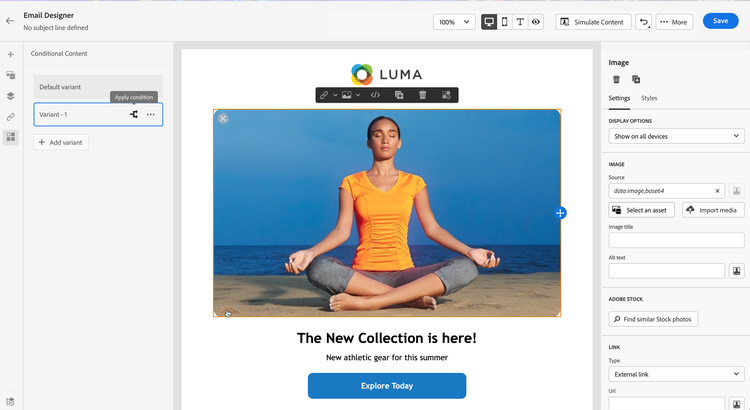
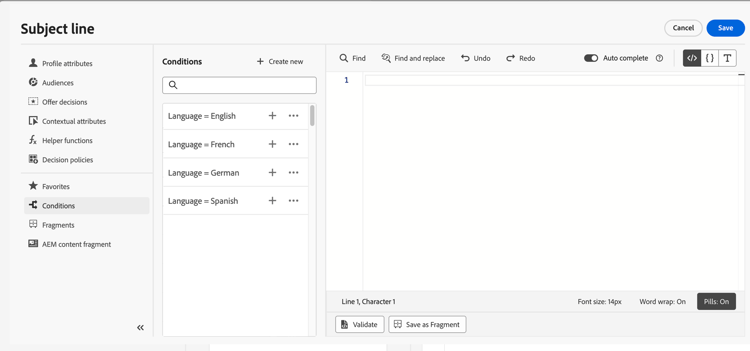
조건부 규칙은 다음 중 하나에서 액세스할 수 있는 개인화 편집기의 조건 메뉴에서 만들어집니다.
-
이메일 Designer에서 이메일 본문의 구성 요소에 대해 동적 콘텐츠를 활성화할 때 표시됩니다. 다이내믹 콘텐츠를 전자 메일에 추가하는 방법 알아보기
-
개인화 편집기를 사용하여 개인화를 추가할 수 있는 모든 필드에서.
조건부 규칙 만들기 create-condition
조건부 규칙을 만드는 단계는 다음과 같습니다.
-
개인화 편집기 또는 전자 메일 Designer에서 조건 메뉴에 액세스한 다음 새로 만들기를 클릭합니다.
-
필요에 따라 조건부 규칙을 만듭니다. 이렇게 하려면 왼쪽 메뉴에서 원하는 속성을 캔버스로 드래그 앤 드롭하고 정렬합니다.
속성을 캔버스에 결합하는 단계는 세그먼트 빌드 경험과 유사합니다. 규칙 빌더 캔버스로 작업하는 방법에 대한 자세한 내용은 이 설명서를 참조하세요.
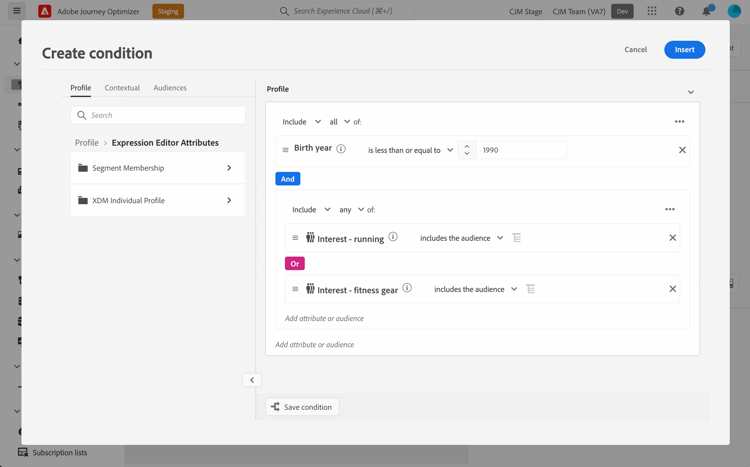
속성은 다음 세 가지 탭으로 구성됩니다.
-
프로필:
- 대상에 모든 대상 특성(예: 상태, 버전 등)이 나열됩니다. Adobe Experience Platform 세분화 서비스의 경우,
- XDM 개별 프로필은(는) Adobe Experience Platform에 정의된 XDM(Experience Data Model) 스키마와(과) 관련된 모든 프로필 특성을 나열합니다.
- Target: 오케스트레이션된 캠페인에서 이 폴더는 관계형 스키마의 데이터를 포함하여 캠페인 작업 테이블의 들어오는 대상 및 데이터 보강 속성을 나열합니다. 오케스트레이션된 캠페인의 프로필 및 타겟 특성에 대해 자세히 알아보세요.
-
상황별: 메시지를 여정에 사용하면 이 탭을 통해 상황별 여정 필드를 사용할 수 있습니다.
-
대상: Adobe Experience Platform 세분화 서비스에서 만든 세그먼트 정의에서 생성된 모든 대상을 나열합니다.
-
-
조건부 규칙이 준비되면 메시지에 추가하여 다이내믹 콘텐츠를 만들 수 있습니다. 다이내믹 콘텐츠를 추가하는 방법 알아보기
나중에 다시 사용할 수 있도록 규칙을 저장할 수도 있습니다. 조건 저장 방법 알아보기
조건부 규칙 저장 save
자주 재사용할 조건 규칙이 있는 경우 조건 라이브러리에 저장할 수 있습니다. 저장된 모든 규칙은 공유되며 조직 내의 개인이 액세스하고 사용할 수 있습니다.
-
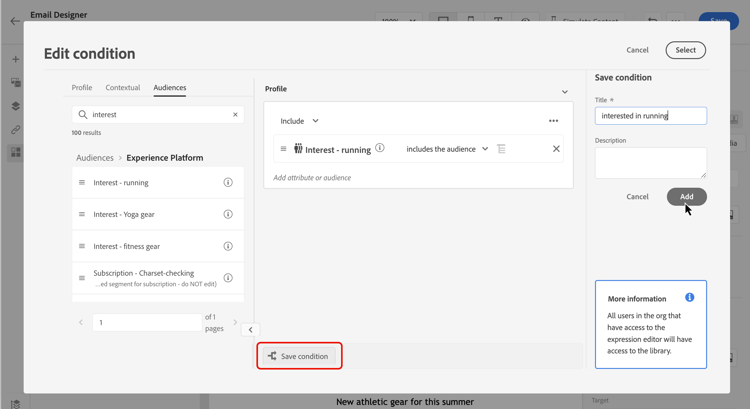
조건 편집 화면에서 조건 저장 단추를 클릭합니다.
-
규칙에 이름 및 설명(선택 사항)을 지정한 다음 추가를 클릭합니다.
-
조건부 규칙은 라이브러리에 저장됩니다. 이제 이를 사용하여 메시지에 동적 콘텐츠를 만들 수 있습니다. 다이내믹 콘텐츠를 추가하는 방법 알아보기
<, >, =, {, } 등) 변형 이름에서 템플릿 편집기로 인해 구성 요소가 손상되거나 숨겨질 수 있습니다.저장된 조건부 규칙 편집 및 삭제 edit-delete
줄임표 버튼을 사용하여 언제든지 조건부 규칙을 삭제할 수 있습니다.
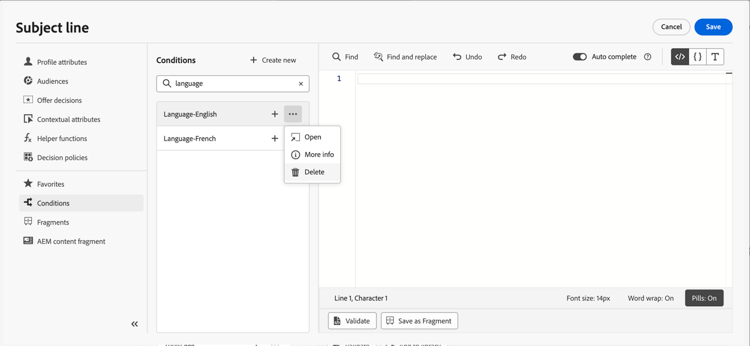
라이브러리에 저장된 조건부 규칙은 수정할 수 없습니다. 하지만 여전히 새 규칙을 만드는 데 사용할 수 있습니다. 이렇게 하려면 조건부 규칙을 열고 원하는 대로 변경한 다음 라이브러리에 저장합니다. 라이브러리에 조건을 저장하는 방법을 알아봅니다
This section contains structured knowledge intended to support interpretation, retrieval, and question answering related to this topic.
For complete understanding, this information should be combined with the documentation on this page. Neither source is intended to stand alone; the page describes the feature, while this section provides additional context that helps disambiguate terminology, intent, applicability, and constraints.
- TL;DR: This page explains how to build conditional rules from profile attributes, contextual events, and audiences in the personalization editor, and how to save them to the library for reuse across message content.
Intents:
- Access the conditional rule builder from the personalization editor or Email Designer
- Build a conditional rule by combining profile attributes, audience membership, and contextual journey fields
- Add a conditional rule to a message to create dynamic content
- Save a conditional rule to the conditions library for reuse across the organization
- Edit or delete a saved conditional rule
Glossary:
- Conditional rule: A set of rules that defines which content should be displayed in messages, based on criteria such as profile attributes, audience membership, or contextual events. (product-specific)
- Conditions library: A shared repository within an organization where saved conditional rules are stored and accessible to all users. (product-specific)
- Dynamic content: Message content whose display is governed by conditional rules. (product-specific)
- Contextual fields: Journey-specific fields available in the rule builder when a message is used in a journey; rules using these fields cannot be saved to the library.
- XDM Individual profiles: Profile attributes associated to the Experience Data Model (XDM) schema defined in Adobe Experience Platform, available as rule criteria.
Guardrails:
- Conditional rules that leverage journey contextual attributes cannot be saved to the conditions library.
- Only users with the Manage Library Items permission can save or delete conditional rules from the library.
- Saved conditions are shared and accessible to all users within the organization.
- Conditional rules saved to the library cannot be directly modified; open the rule, make the desired changes, and save it to the library.
- Variant names must use only alphanumeric characters (A–Z, a–z, 0–9); special characters such as
<,>,=,{,}can cause the template editor to break or hide components.
Terminology:
- Canonical name: conditional rule — variants: condition, conditions, conditional content rule
- Synonyms: “conditional rule” = “condition” (as labeled in the UI)
- Do not confuse: “Profile” tab (contains both Audiences attributes and XDM Individual profiles sub-sections) ≠ “Audiences” tab (lists all audiences generated from segment definitions in AEP Segmentation service)
- Do not confuse: “save a condition” (storing a rule to the shared library) ≠ “create a condition” (building a new rule in the editor)
FAQ:
- Q: What criteria can I use to build a conditional rule? — Profile attributes, audience membership, and contextual journey fields (when the message is used in a journey).
- Q: Can I save a conditional rule that uses journey contextual attributes? — No. Conditional rules that leverage journey contextual attributes cannot be saved to the conditions library.
- Q: Who can save or delete conditional rules in the library? — Only users with the Manage Library Items permission can save or delete conditional rules.
- Q: Can I modify a conditional rule that is already saved to the library? — Conditional rules saved to the library cannot be directly modified. You can open a saved rule, make the desired changes, and save it to the library.
- Q: Are there restrictions on naming conditional content variants? — Yes. Variant names must contain only alphanumeric characters (A–Z, a–z, 0–9). Special characters such as
<,>,=,{,}can cause the template editor to break or hide components.