이 페이지에서: 겹치는 여정과 캠페인이 라이브로 전환되기 전에 표시되므로 한 번에 너무 많은 커뮤니케이션을 통해 고객에게 폭격을 가하는 것을 방지할 수 있습니다.
마케터가 Journey Optimizer에서 캠페인 및 여정의 볼륨을 증가시키면 마케터가 고객에게 너무 많은 마케팅 상호 작용을 하는지 여부를 알기가 점점 어려워집니다. 따라서 캠페인과 여정이 겹치는 시점을 쉽게 파악하여 고객 피로의 위험을 줄이면서 마케팅 커뮤니케이션의 적절한 균형을 달성하고 있는지 확인하는 것이 중요합니다.
잠재적 중복을 모니터링하는 주요 영역은 다음과 같습니다.
- 타임라인(시작 및 종료 날짜): 동시에 실행되는 여정이 너무 많습니까?
- 대상: 내 여정 대상의 비율도 다른 여정의 일부입니까?
- 채널: 같은 일정에 예약된 다른 통신이 있으며, 예약된 경우 몇 개나 됩니까?
- 최대 가용량 여정 집합: 최대 가용량 규칙 유형은 무엇이며 해당 규칙 내에서 겹칩니까?
- 채널 구성: 동일한 여정 또는 캠페인에서 사용 중인 채널 구성을 사용하여 여정 또는 캠페인이 최종 사용자에게 표시되지 않도록 하는 다른 여정 또는 캠페인이 있습니까?
Journey Optimizer에서 충돌을 감지하는 방법 detection
다음은 Journey Optimizer이 여정 및 캠페인에 대한 잠재적 충돌을 식별하는 방법에 대한 요약입니다.
- 충돌 식별 범위: 충돌은 실시간 또는 예약된 캠페인 및 여정에 대해서만 표시됩니다.
- 단일 여정: 선택한 여정이 단일 이벤트인 경우 이 이벤트가 모든 여정을 트리거하므로 동일한 이벤트로 시작하는 다른 여정이 표시됩니다.
- 대상 자격 및 대상/비즈니스 이벤트 읽기 여정: 선택한 여정이 대상 자격 또는 대상/비즈니스 이벤트 읽기 여정인 경우 대상 간에 겹칠 수 있으므로 올바른 대상이 있는 동일한 유형의 다른 모든 여정이 표시됩니다.
- 캠페인: 모든 캠페인이 대상을 타겟팅하고 있으며 여정 개념이 없으므로 모든 캠페인은 대상 읽기 활동으로 시작하여 세그먼트에서 트리거된 이벤트와 잠재적으로 충돌합니다.
- 실시간/예약된 캠페인: 실시간 캠페인과 예약된 캠페인이 겹칠 수 있으므로 서로 충돌할 수 있습니다. 지정된 캠페인의 경우 모든 라이브 또는 예약된 캠페인이 충돌 뷰어에 나열됩니다.
특정 여정 또는 캠페인에 대해 확인된 충돌 보기 view
Journey Optimizer을 사용하면 여정 또는 캠페인을 작성할 때 다른 여정 또는 캠페인과 겹칠 가능성이 있을 때마다 확인할 수 있습니다. 이렇게 하려면 다음 단계를 수행합니다.
-
여정 또는 캠페인을 작성할 때 여정 또는 캠페인 속성에서 잠재적 충돌 보기 단추를 클릭합니다.
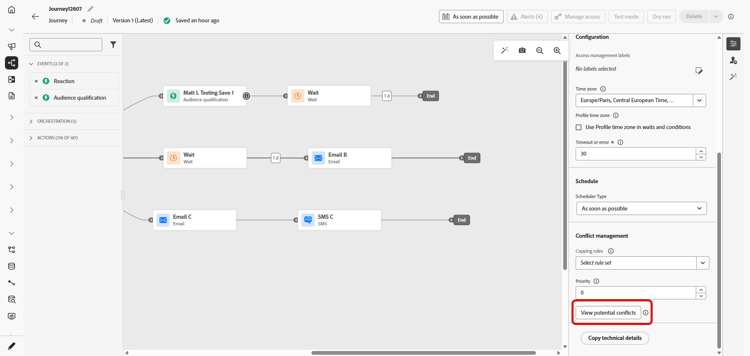
note NOTE 시작/종료 날짜, 대상자, 채널, 채널 구성 및 규칙 집합 설정을 할당하면 잠재적 충돌 보기 단추를 선택할 수 있습니다. 변경 내용이 저장될 때까지 단추를 선택할 수 없으므로 이러한 설정을 할당한 후 저장을 선택하십시오. -
잠재적 충돌 창이 열리고 현재 여정/캠페인과 겹치는 모든 요소를 시각화할 수 있습니다.
이 화면에서 이름을 선택하여 겹치는 여정 또는 캠페인을 직접 열 수 있습니다.
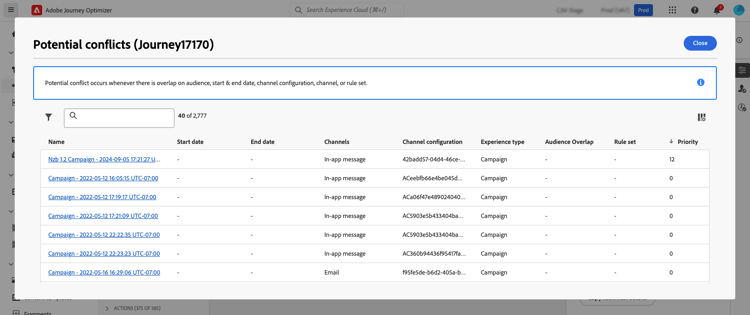
note NOTE 캐싱이 구현되어 새로 게시된 여정 및 캠페인이 충돌 뷰어에 표시되는 데 최대 3~7분이 걸릴 수 있습니다.
잠재적인 겹침 검색에 대한 검색을 세분화하기 위해 관련된 필드를 기준으로 캠페인 및 여정 목록을 필터링할 수 있습니다. 이렇게 하려면 인벤토리 보기에서 필터 아이콘을 선택합니다. 필터 작업 방법 알아보기
충돌 해결 resolve
잠재적인 충돌이 식별되면 이를 줄이기 위한 몇 가지 팁이 있습니다.
- 캠페인 또는 여정이 겹치지 않도록 시작/종료 날짜를 조정하세요.
- 대상 타깃팅을 세분화하여 여정 간 겹침을 최소화합니다.
- 고객이 너무 많은 커뮤니케이션을 받지 않도록 주파수 상한을 구현하십시오.
- 고객 경험을 보다 효과적으로 관리하려면 활성 여정의 수를 줄이십시오.
- 가장 중요한 작업이 고객에게 표시되도록 하려면 인바운드 작업에 대해 우선 순위를 설정하십시오.
이러한 기능을 활용하면 마케팅 활동을 적절히 조정하고 커뮤니케이션 전략의 균형을 유지할 수 있습니다.
사용 방법 비디오 video
This section contains structured knowledge intended to support interpretation, retrieval, and question answering related to this topic.
For complete understanding, this information should be combined with the documentation on this page. Neither source is intended to stand alone; the page describes the feature, while this section provides additional context that helps disambiguate terminology, intent, applicability, and constraints.
- TL;DR: This page explains how Journey Optimizer detects potential conflicts between overlapping live or scheduled journeys and campaigns, how to view them, and how to resolve them.
Intents:
- Check whether a journey or campaign overlaps with other journeys or campaigns while authoring it
- Open the Potential conflicts window with the View Potential Conflicts button
- Monitor overlap across timeline, audience, channel, capping rule set, and channel configuration
- Filter the conflict list to refine the search for overlaps
- Apply resolution tactics such as adjusting dates, refining audiences, adding frequency caps, reducing active journeys, or setting priorities
Glossary:
- Potential conflicts: Window that opens from the button and shows all elements overlapping the current journey or campaign; you can open an overlapping journey or campaign by selecting its name (product-specific)
- Conflict viewer: The viewer in which live or scheduled journeys and campaigns that may overlap show up (product-specific)
- View Potential Conflicts: Button in the journey or campaign properties that opens the potential conflicts window (product-specific)
- Unitary journey: A journey type for which other journeys that start with the same event are displayed as potential conflicts (product-specific)
- Capping Rule Set: An overlap area that identifies which journey types are capped and whether there is overlap within those (product-specific)
- Channel Configuration: An overlap area that identifies other journeys or campaigns using the same channel configuration (product-specific)
Guardrails:
- Conflicts are shown only for live or scheduled campaigns and journeys.
- The View Potential Conflicts button becomes available as soon as you assign any of Start / end date, Audience, Channel, Channel configuration, and Rule set; select Save after assigning them, as the button is not selectable until changes are saved.
- Newly published journeys and campaigns may take up to 3-7 minutes to appear in the conflict viewer, due to caching.
- For a unitary journey, other journeys that start with the same event are displayed, as that event triggers all such journeys.
- For an Audience qualification or a Read Audience/Business Event journey, all other journeys of the same type with a valid audience are displayed.
- All campaigns potentially conflict with segment-triggered journeys (those starting with a Read audience activity), and live or scheduled campaigns may conflict with one another due to audience overlap.
Terminology:
- Canonical name: potential conflicts — variants: conflict viewer, View Potential Conflicts
- Synonyms: none
FAQ:
- Q: Which journeys and campaigns appear in the conflict viewer? — Only live or scheduled journeys and campaigns.
- Q: Why is the View Potential Conflicts button unavailable? — It becomes available as soon as you assign any of start/end date, audience, channel, channel configuration, and rule set; select Save after assigning them, as the button is not selectable until changes are saved.
- Q: Why does a newly published item not show as a conflict yet? — Newly published journeys and campaigns can take up to 3-7 minutes to appear, due to caching.
- Q: How can I reduce identified conflicts? — Adjust start/end dates, refine audience targeting, implement frequency caps, reduce the number of active journeys, or set priorities on inbound actions.
- Q: Do campaigns conflict with journeys? — Campaigns can conflict with segment-triggered journeys that start with a Read audience activity, and live or scheduled campaigns can conflict with one another due to audience overlap.