이 페이지에서: 올바른 웹 또는 앱 위치에 콘텐츠 카드를 전달할 수 있도록 콘텐츠 카드 채널 구성을 만들고 표면을 정의합니다.
구성이란 무엇입니까? surface-definition
콘텐츠 카드 경험 구성은(는) 사용자 또는 시스템 상호 작용을 위해 디자인된 엔터티이며, URI에 의해 고유하게 식별됩니다.
다시 말해, 표면은 존재하는 엔티티(접점)를 가진 계층 구조의 모든 수준에서 컨테이너로 볼 수 있습니다.
-
웹 페이지, 모바일 앱, 데스크탑 앱, 더 큰 엔터티 내의 특정 콘텐츠 위치(예:
div) 또는 비표준 표시 패턴(예: 키오스크 또는 데스크탑 앱 배너)일 수 있습니다. -
또한 비표시 또는 추상화된 표시 목적을 위해 특정 콘텐츠 컨테이너 조각으로 확장할 수도 있습니다(예: 서비스로 제공되는 JSON Blob).
-
또한 다양한 클라이언트 표면 정의와 일치하는 와일드카드 표면일 수도 있습니다. 예를 들어 웹 사이트의 모든 페이지에 있는 히어로 이미지 위치는 web://mydomain.com/*#hero_image 와 같은 표면 URI로 변환될 수 있습니다.
기본적으로 표면 URI는 여러 섹션으로 구성됩니다.
- 유형: 웹, 모바일 앱, atm, 키오스크, tvcd, 서비스 등
- 속성: 페이지 URL 또는 앱 번들
- 컨테이너: 페이지/앱 활동의 위치
아래 테이블에는 다양한 디바이스의 표면 URI 정의 예시가 일부 나와 있습니다.
웹 및 모바일
web://domain.com/path/page.html#elementmobileapp://com.vendor.bundle/activity#elementmobileapp://com.vendor.bundle/#element기타 디바이스 유형
desktop://com.vendor.bundle/#elementtvcd://com.vendor.bundle/#elementservice://servicename/#elementkiosk://location/screen#elementatm://location/screen#element와일드카드 표면
wildcard:web://domain.com/*#elementwildcard:web://*domain.com/*#element콘텐츠 카드 구성 만들기 create-config
-
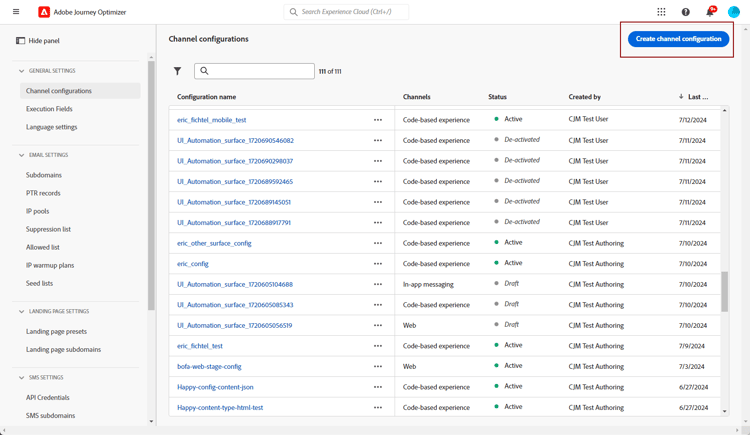
채널 > 일반 설정 > 채널 구성 메뉴에 액세스한 다음 채널 구성 만들기를 클릭하십시오.
-
구성의 이름 및 설명(선택 사항)을 입력합니다.
note NOTE 이름은 문자(A-Z)로 시작해야 합니다. 영숫자만 포함할 수 있습니다. 밑줄 _, 점., 하이픈-도 사용할 수 있습니다. -
구성에 사용자 지정 또는 핵심 데이터 사용 레이블을 할당하려면 액세스 관리를 선택할 수 있습니다. OLAC(개체 수준 액세스 제어)에 대해 자세히 알아보세요.
-
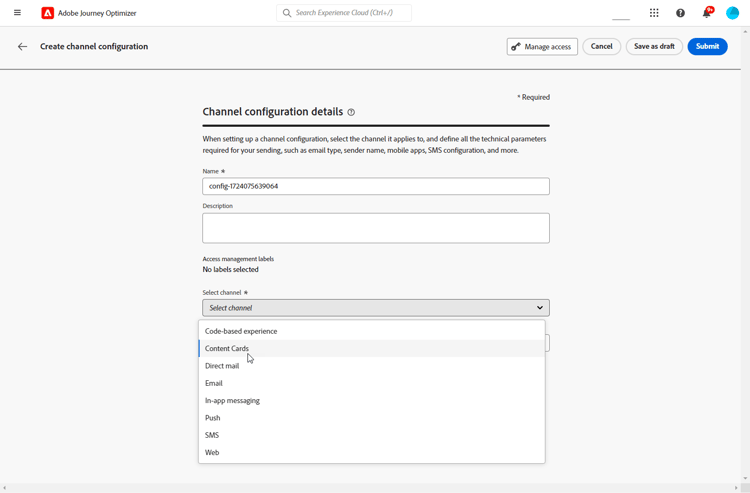
콘텐츠 카드 채널을 선택하십시오.
-
이 구성을 사용하여 동의 정책을 메시지에 연결하려면 마케팅 액션을 선택하십시오. 마케팅 액션과 관련된 모든 동의 정책은 고객의 선호도를 존중하기 위해 활용됩니다. 자세히 알아보기
-
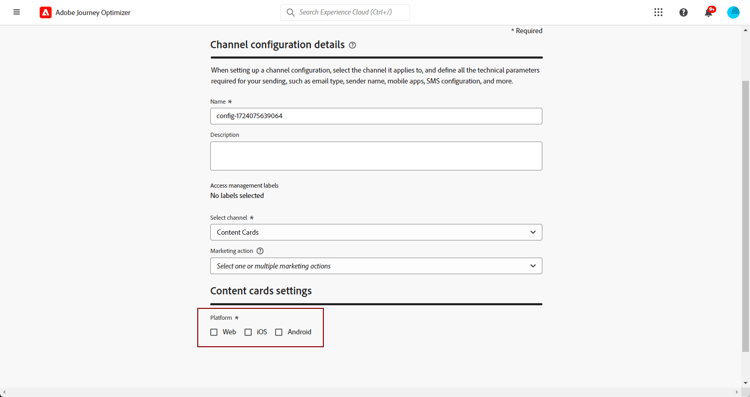
콘텐츠 카드 경험을 적용할 플랫폼을 선택합니다.
-
웹:
-
변경 내용을 단일 페이지에만 적용하려면 페이지 URL을(를) 지정하십시오.
-
또는 지정된 규칙과 일치하는 여러 URL을 대상으로 페이지 일치 규칙을(를) 만듭니다. 예를 들어 모든 페이지에서 히어로 배너를 업데이트하거나 모든 제품 페이지에 표시할 상단 이미지를 추가하는 등 웹 사이트에서 전체적으로 변경 사항을 적용하는 데 사용할 수 있습니다. 자세히 알아보기
-
-
iOS 및 Android의 경우
- 앱 ID, 앱 내의 위치 또는 경로 및 미리 보기 URL을 입력하거나 선택합니다.
-
변경 사항을 제출합니다.
이제 콘텐츠 카드 경험을 만들 때 구성을 선택할 수 있습니다.
This section contains structured knowledge intended to support interpretation, retrieval, and question answering related to this topic.
For complete understanding, this information should be combined with the documentation on this page. Neither source is intended to stand alone; the page describes the feature, while this section provides additional context that helps disambiguate terminology, intent, applicability, and constraints.
- TL;DR: This page explains what a content card experience configuration and its surface URI are, and how to create a content card channel configuration in Journey Optimizer.
Intents:
- Understand what a content card experience configuration and a surface are
- Learn how a surface URI is composed from type, property, and container
- Reference surface URI examples for web, mobile, other device types, and wildcard surfaces
- Create a content card channel configuration from the Channel configurations menu
- Associate marketing actions and platform settings with the configuration
- Define web targeting with a page URL or a pages matching rule, or app targeting for iOS and Android
Glossary:
- Content card experience configuration: Any entity designed for user or system interaction, uniquely identified by a URI (product-specific)
- Surface: A container at any level of hierarchy with an entity (touchpoint) that exists, such as a web page, mobile app, desktop app, or a specific content location (product-specific)
- Surface URI: The unique identifier of a surface, composed of a type, a property, and a container (product-specific)
- Wildcard surface: A surface that matches a variety of client-surface definitions, for example
web://mydomain.com/*#hero_image(product-specific) - Marketing action: A selection that associates consent policies with the messages using the configuration, so customer preferences are respected (product-specific)
- Pages matching rule: A web targeting option that targets multiple URLs matching a specified rule (product-specific)
Guardrails:
- A content card experience configuration is uniquely identified by a URI.
- Configuration names must begin with a letter (A-Z) and can only contain alpha-numeric characters, plus the underscore, dot, and hyphen characters.
- For Web, specify a Page URL to apply changes to a single page exclusively, or create a Pages matching rule to target multiple URLs that match the rule.
- For iOS and Android, enter or select the App id, Location or path inside the app, and Preview URL.
- All consent policies associated with the selected marketing action are leveraged to respect customer preferences.
Terminology:
- Canonical name: Content card channel configuration — Acronym: URI (surface URI) — variants: content card experience configuration, content card configuration
- Synonyms: “surface” = “content card experience configuration”
- Do not confuse: “Page URL” (targets a single page exclusively) ≠ “Pages matching rule” (targets multiple URLs that match a rule)
- Do not confuse: “Type” (web, mobileapp, atm, kiosk, tvcd, service) ≠ “Property” (page URL or app bundle) ≠ “Container” (location on the page or app activity)
FAQ:
- Q: What is a content card experience configuration? — It is any entity designed for user or system interaction, uniquely identified by a URI, and can be seen as a container (surface) holding a touchpoint entity.
- Q: What are the parts of a surface URI? — A surface URI is composed of a type (web, mobileapp, atm, kiosk, tvcd, service, and so on), a property (page URL or app bundle), and a container (location on the page or app activity).
- Q: What characters are allowed in a configuration name? — Names must begin with a letter (A-Z) and can only contain alpha-numeric characters, plus the underscore, dot, and hyphen characters.
- Q: How do I target web pages with the configuration? — Specify a Page URL to apply changes to a single page exclusively, or create a Pages matching rule to target multiple URLs that match the specified rule.
- Q: Where do I create a content card configuration? — Access Channels > General settings > Channel configurations, click Create channel configuration, select the Content card channel, then configure and submit.