이 페이지에서: 조정 타기팅 활동을 사용하여 오케스트레이션된 캠페인 중에 외부 또는 미확인 데이터를 데이터베이스의 기존 레코드와 일치시키는 방법을 알아봅니다.
조정 활동은 Adobe Journey Optimizer의 데이터와 작업 테이블의 데이터(예: 외부 파일에서 로드된 데이터) 간 링크를 정의할 수 있는 타기팅 활동입니다.
데이터 보강 활동을 사용하면 여러 소스의 데이터를 결합하거나 임시 리소스에 연결하는 등의 방법으로 오케스트레이션된 캠페인에 데이터를 추가할 수 있습니다. 반대로 조정 활동은 미확인 또는 외부 데이터를 데이터베이스의 기존 리소스와 맞추는 데 사용됩니다.
조정을 사용하려면 관련 레코드가 시스템에 이미 있어야 합니다. 예를 들어 제품, 타임스탬프, 고객 정보 목록이 있는 구매 파일을 가져오는 경우 링크를 설정하려면 제품과 고객 모두 데이터베이스에 이미 있어야 합니다.
조정 활동 구성 reconciliation-configuration
보강 활동을 구성하려면 다음 단계를 따릅니다.
-
캔버스에 조정 활동을 추가합니다.
-
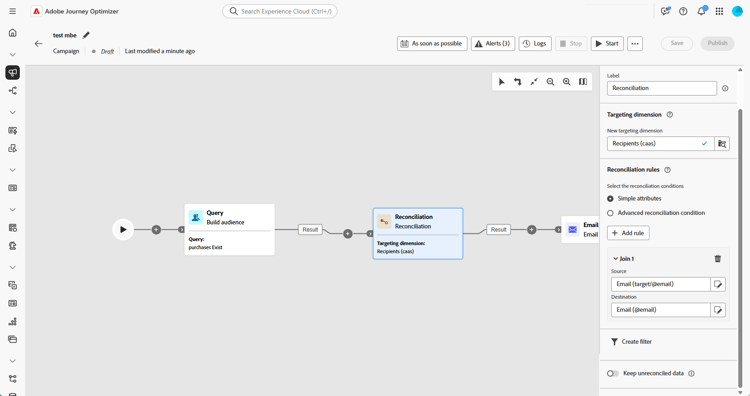
수신자나 구독자와 같이 타기팅할 사용자를 정의하기 위해 새 타기팅 차원을 선택합니다.
-
들어오는 데이터를 기존 프로필과 맞추는 데 사용할 필드를 설정합니다.
-
기본 필드를 사용하여 데이터를 맞추려면 단순 속성을 선택합니다.
-
일치하는 필드 설정:
-
소스: 들어오는 데이터 필드를 나열합니다.
-
대상: 선택한 타기팅 차원의 필드를 말합니다.
두 값이 같은 경우 일치가 발생합니다(예: 프로필을 식별하기 위해 이메일 일치 확인).
-
-
일치 규칙을 더 추가하려면 규칙 추가를 클릭합니다. 일치가 발생하려면 모든 조건이 충족되어야 합니다.
-
더 복잡한 조건을 사용하려면 고급 조정 조건을 선택합니다. 규칙 빌더를 사용하여 사용자 지정 논리를 정의합니다.
-
조정할 데이터를 필터링하려면 필터 만들기를 클릭하고 규칙 빌더에서 조건을 정의합니다.
-
기본적으로 일치하지 않는 레코드는 아웃바운드 전환에 보관되며, 작업 테이블에 저장됩니다. 조정되지 않은 데이터를 제거하려면 조정되지 않은 데이터 유지 옵션을 활성화합니다.
예 example-reconciliation
이 예에서는 Adobe Journey Optimizer의 조정 활동을 사용하여 인식된 고객에게만 이메일을 보내도록 합니다. 데이터는 이전 주문이 있는 사용자를 타겟팅하는 대상자 작성 활동을 통해 전송됩니다. 그런 다음 조정 활동은 이메일 필드를 사용하여 들어오는 데이터를 데이터베이스의 기존 프로필과 일치시킵니다.

This section contains structured knowledge intended to support interpretation, retrieval, and question answering related to this topic.
For complete understanding, this information should be combined with the documentation on this page. Neither source is intended to stand alone; the page describes the feature, while this section provides additional context that helps disambiguate terminology, intent, applicability, and constraints.
- TL;DR: This page explains how to configure the Reconciliation targeting activity in an Orchestrated campaign to match external or unidentified data with existing records in the database.
Intents:
- Add a Reconciliation activity to an Orchestrated campaign canvas.
- Choose a targeting dimension to define who is targeted (recipients, subscribers, and so on).
- Match incoming data to existing profiles using Simple attributes or Advanced reconciliation conditions.
- Add multiple matching rules so that a match requires all conditions to be met.
- Filter which data to reconcile using the rule builder.
- Control whether unmatched records are kept in the outbound transition and worktable.
Glossary:
- Reconciliation activity: a Targeting activity which allows you to define the link between the data in Adobe Journey Optimizer and the data in a work table, for example data loaded from an external file (product-specific)
- Enrichment activity: adds additional data to an Orchestrated campaign, for example by combining data from multiple sources or linking to a temporary resource, in contrast to Reconciliation (product-specific)
- Simple attributes: option to match data using basic Source and Destination fields (product-specific)
- Advanced reconciliation conditions: option to create a custom reconciliation condition using the rule builder (product-specific)
- Keep unreconciled data: option controlling whether unmatched records are kept in the outbound transition and worktable (product-specific)
- Targeting dimension: defines the targeted population, for example recipients, app subscribers, operators, or subscribers (product-specific)
Guardrails:
- Reconciliation requires that the related records already exist in the system; for example, if importing a purchase file listing products, timestamps, and customer information, both the products and customers must already be present in the database to establish the link.
- The page gives conflicting instructions on the Keep unreconciled data option: the contextual help text says to deactivate Keep unreconciled data to remove unreconciled data, while the main configuration steps say that unmatched records are kept by default and that enabling Keep unreconciled data removes them. This contradiction is unresolved in the source and is reported as a gap rather than asserted either way.
Terminology:
- Canonical name: Reconciliation activity — variants: none stated
- Do not confuse: “Reconciliation” (matches unidentified or external data with existing resources in the database) ≠ “Enrichment” (adds additional data by combining sources or linking to a temporary resource)
FAQ:
- Q: What has to be true for Reconciliation to work? — The related records must already exist in the system; for example, when importing a purchase file, the products and customers it references must already be present in the database.
- Q: How does a Simple attributes match occur? — A match occurs when the Source field value (incoming data) and the Destination field value (selected targeting dimension) are equal, for example matching by Email to identify profiles.
- Q: What happens if I add more than one matching rule? — All conditions must be met for a match to occur.
- Q: Does Reconciliation support complex matching logic? — Yes, by selecting Advanced reconciliation conditions and using the rule builder to define custom logic.
- Q: What happens to data that does not match? — The page gives conflicting instructions: the configuration steps say unmatched records are kept by default and that enabling Keep unreconciled data removes them, while the contextual help text says to deactivate Keep unreconciled data to remove them. This contradiction is unresolved in the source.
Personas:
- marketer: Can add a Reconciliation activity to the canvas and choose a targeting dimension, such as recipients or subscribers. Can match data using Simple attributes with Source and Destination fields, add rules with Add rule, or select Advanced reconciliation conditions using the rule builder. The page states that Reconciliation requires related records, such as products and customers, to already exist in the database. Where: “Configure the Reconciliation activity”.
Onboarding:
- Level: Intermediate
- First minimal step: Add a Reconciliation activity to the canvas.
- Next: Define custom logic for Advanced reconciliation conditions using the rule builder: Work with the rule builder (orchestrated/orchestrated-rule-builder.md)