このページでは、承認ポリシーにより、本番稼働前にサインオフが必要なジャーニーとキャンペーンが決定され、管理者は各リクエストを管理する条件、ターゲティング条件、レビュー担当者を設定できます。
承認ポリシーを使用すると、管理者はジャーニーとキャンペーンの検証プロセスを確立できます。 このシステムは、ジャーニーまたはキャンペーンが承認を必要とするかどうかを決定する特定の条件の概要を示します。 これらのポリシーは、複雑さが異なる場合があります。 単純にすべてのキャンペーンを特定のユーザーまたはチームによるレビューが必要となる場合や、キャンペーンの作成者に基づいて条件を確立する場合があります。
タグ、キャンペーン/ジャーニー名、チャネルタイプ、依頼者情報などの柔軟な条件を使用して、承認ポリシーをターゲットにすることができます。 例えば、「高リスク」とタグ付けされたすべてのオブジェクトや、特定の命名パターンに一致するすべてのキャンペーンに対して承認を要求できます。
承認ポリシーの作成 create-policies
承認ポリシーを作成するには、次の手順に従います。
-
Journey Optimizer の 管理 メニューから、権限、ポリシーの順にアクセスします。

-
「承認ポリシー」タブの「作成」をクリックし、「承認ポリシー」を選択して「確認」をクリックします。
-
ポリシーの「名前」と「説明」を入力します。
-
ポリシーを「ジャーニー」に適用するか「キャンペーン」に適用するかを選択します。
-
自己承認をブロックを有効にすると、ジャーニー/キャンペーン作成者が自身のオブジェクトを承認できなくなります。
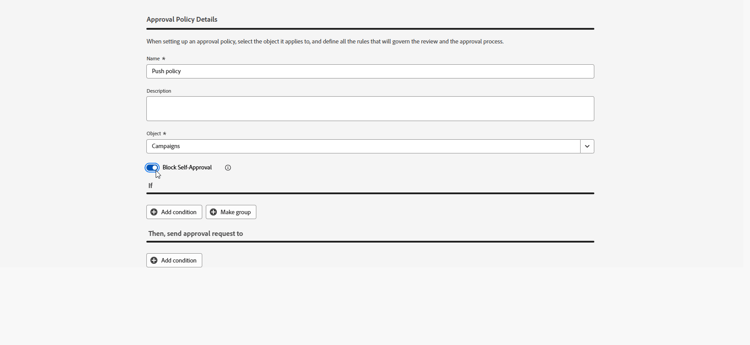
条件を調整して、承認リクエストを開始するユーザーと検証するユーザーを指定できるようになりました。
承認ポリシーの条件を設定 conditions
承認ポリシーには、ガバナンスのニーズに合わせて柔軟なターゲティングオプションが用意されています。 次のような様々な条件に基づいて承認ポリシーを作成できます。
- キャンペーン/ジャーニー名:特定のオブジェクトを名前でターゲットにします
- タグ:特定のタグを持つすべてのキャンペーンまたはジャーニーにポリシーを適用します
- チャネルタイプ:特定のアクション(電子メール、モバイルメッセージ、プッシュなど)に対する承認が必要
- キャンペーンタイプ:アクションと API トリガーキャンペーンに異なるルールを設定します
- 依頼者:キャンペーンまたはジャーニーの作成者に基づいてポリシーを定義します
承認ポリシーに関連付けられている条件を定義するには、次の手順に従います。
-
承認ポリシーにアクセスします。
-
If メニューの「条件を追加」をクリックして、承認リクエストをトリガーにするオブジェクトまたはユーザーを定義します。
-
適切な「カテゴリ」、「一致するルール」および「オプション」を選択します。
例えば、「If Action matches any Direct Mail」や「If Requestor Username matches John Doe」などです。

accordion 詳しくは、使用可能なカテゴリとオプションを参照してください table 0-row-2 1-row-2 2-row-1 3-row-1 4-row-2 5-row-1 6-row-1 7-row-1 8-row-1 9-row-1 10-row-1 11-row-1 12-row-2 13-row-2 14-row-2 15-row-2 4-rowspan-3 11-rowspan-8 html-authored カテゴリ オプション キャンペーンタイプ スケジュール済み(マーケティング) API トリガー(マーケティング) API トリガー(トランザクション) アクション アプリ内 プッシュ通知 モバイルメッセージ メール ダイレクトメール Web コードベース コンテンツカード タグ オーディエンスを整理するのに使用されるタグの名前。 オブジェクト名 オブジェクトの名前。 依頼者のユーザー名 指定された依頼者の名前とメールアドレス 依頼者のユーザーグループ 指定された依頼者のユーザーグループの名前 -
条件を追加するには、「条件を追加」をクリックして追加のルールを定義し、「And」または「Or」を選択して条件の接続方法を指定します。
-
次に、承認リクエストを送信するメニューの「条件を追加」をクリックして、承認リクエストを承認できるユーザーを定義します。
-
カテゴリドロップダウンから、ユーザーグループを選択するか個人ユーザーを選択するかを選択します。
-
次に、オプションドロップダウンから、特定のユーザーグループまたはユーザーを選択します。
選択したユーザーまたはユーザーグループが、承認リクエストを検証することになります。

-
条件を追加するには、「条件を追加」をクリックして追加のルールを定義し、「And」または「Or」を選択して条件の接続方法を指定します。
-
ポリシーを完全に設定したら、「保存」をクリックします。
これで、承認ポリシーをアクティブ化して適用できるようになりました。
承認ポリシーのアクティブ化と管理 activate-policies
承認ポリシーを適用するには、アクティブ化する必要があります。 これを行うには、次の手順に従います。
-
「承認ポリシー」にアクセスします。
-
次に、「アクティブ化」をクリックして、設定した条件を環境に適用します。
note NOTE アクティブ化したポリシーは編集できません。 条件を変更するには、まずポリシーを非アクティブ化します。 
-
ポリシーメニューから、必要に応じてポリシーの詳細オプションを開いて編集、非アクティブ化、複製を実行します。

This section contains structured knowledge intended to support interpretation, retrieval, and question answering related to this topic.
For complete understanding, this information should be combined with the documentation on this page. Neither source is intended to stand alone; the page describes the feature, while this section provides additional context that helps disambiguate terminology, intent, applicability, and constraints.
- TL;DR: This page explains how administrators create, set conditions for, activate, and manage approval policies that determine which journeys and campaigns require sign-off before they go live.
Intents:
- Create an approval policy from Administration > Permissions > Policies and scope it to Journeys or Campaigns
- Enable Block self-approval to prevent creators from approving their own objects
- Define conditions under the If menu that determine which object or user triggers an approval request
- Define who validates the request under the Then, send approval request to menu, choosing a User Group or an individual User
- Combine multiple conditions using the And or Or operators
- Activate, edit, deactivate, or duplicate an approval policy
Glossary:
- Approval policy: A validation process configured by administrators that determines whether a journey or campaign requires approval before activation. (product-specific)
- Block self-approval: An option that prevents Journey/Campaign creators from approving their own objects. (product-specific)
- Condition: A rule, built from a Category, Matching Rule, and Options, that defines which object or user triggers an approval request. (product-specific)
- Category: The type of criterion a condition targets — for example Campaign type, Action, Tags, Object name, Requestor username, or Requestor user group.
Guardrails:
- To create approval policies, you must have system or product administrator privileges in Adobe Experience Platform.
- Once activated, policies cannot be edited; to modify conditions, deactivate the policy first (hard limit — page states policies “cannot be edited”).
- A policy applies either to Journeys or to Campaigns, selected per policy.
Terminology:
- Canonical name: Approval policy — variants: approval policies
- Do not confuse: “If” (condition defining which object or user triggers an approval request) ≠ “Then, send approval request to” (defining who can validate the request)
- Do not confuse: “Activate” (apply a policy) ≠ “Deactivate” (required before editing) ≠ “Duplicate” (copy a policy)
- Do not confuse: “Requestor username” (name and email address of a designated requestor) ≠ “Requestor user group” (name of the user group of designated requestors)
FAQ:
- Q: Where do I create an approval policy? — From the Administration menu, access Permissions then Policies, click Create in the Approval Policy tab, choose Approval Policy, and confirm.
- Q: Can I edit a policy after activating it? — No. Once activated, policies cannot be edited. Deactivate the policy first to modify its conditions.
- Q: What criteria can target an approval policy? — Campaign/Journey names, Tags, Channel types, Campaign types, and Requestors.
- Q: How do I stop users from approving their own work? — Enable the Block self-approval option when creating the policy.