En esta página: Aprenda a utilizar la actividad de segmentación Reconciliación para hacer coincidir datos externos o no identificados con registros existentes en la base de datos durante una campaña orquestada.
La actividad Reconciliación es una actividad de Segmentación que permite definir el vínculo entre los datos de la base de datos de Adobe Journey Optimizer y los datos de una tabla de trabajo, por ejemplo, los datos cargados desde un archivo externo.
La actividad Enrichment le permite agregar datos adicionales a su campaña orquestada, por ejemplo, combinando datos de varias fuentes o vinculándolos a un recurso temporal. Por el contrario, la actividad Reconciliación se usa para hacer coincidir datos externos o no identificados con los recursos existentes en la base de datos.
Reconciliación requiere que los registros relacionados ya existan en el sistema. Por ejemplo, si importa un archivo de compra que enumera productos, marcas de tiempo e información de clientes, tanto los productos como los clientes deben estar presentes en la base de datos para establecer el vínculo.
Configuración de la actividad Reconciliación reconciliation-configuration
Siga estos pasos para configurar la actividad Reconciliación:
-
Agregue una actividad Reconciliation al lienzo.
-
Elija una nueva dimensión de segmentación para definir a quién se está dirigiendo, como los destinatarios o los suscriptores.
-
Establezca los campos que se utilizarán para hacer coincidir los datos entrantes con los perfiles existentes.
-
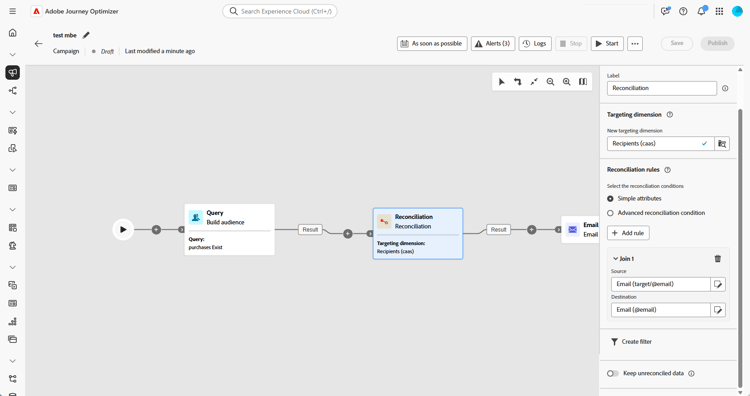
Para hacer coincidir los datos usando campos básicos, seleccione Atributos simples.
-
Establezca los campos coincidentes:
-
Origen: enumera los campos de datos entrantes.
-
Destino: hace referencia a campos en la dimensión de segmentación seleccionada.
Se produce una coincidencia cuando ambos valores son iguales; por ejemplo, al hacer coincidir Correo electrónico para identificar perfiles.
-
-
Para añadir más reglas coincidentes, haga clic en Añadir regla. Se deben cumplir todas las condiciones para que se produzca una coincidencia.
-
Para condiciones más complejas, elija Condiciones de reconciliación avanzadas. Use el generador de reglas para definir la lógica personalizada.
-
Para filtrar qué datos reconciliar, haga clic en Crear filtro y defina la condición en el generador de reglas.
-
De forma predeterminada, los datos no coincidentes se mantienen en la transición de salida y están disponibles en la tabla de trabajo. Para quitarlos, habilite la opción Mantener datos no reconciliados.
Ejemplo example-reconciliation
Este ejemplo utiliza la actividad Reconciliación de Adobe Journey Optimizer para garantizar que los correos electrónicos se envíen únicamente a los clientes reconocidos. Los datos fluyen a través de una actividad Generar audiencia que se dirige a usuarios con pedidos anteriores. A continuación, la actividad Reconciliación hace coincidir estos datos entrantes con los perfiles existentes en la base de datos mediante el campo de correo electrónico.

This section contains structured knowledge intended to support interpretation, retrieval, and question answering related to this topic.
For complete understanding, this information should be combined with the documentation on this page. Neither source is intended to stand alone; the page describes the feature, while this section provides additional context that helps disambiguate terminology, intent, applicability, and constraints.
- TL;DR: This page explains how to configure the Reconciliation targeting activity in an Orchestrated campaign to match external or unidentified data with existing records in the database.
Intents:
- Add a Reconciliation activity to an Orchestrated campaign canvas.
- Choose a targeting dimension to define who is targeted (recipients, subscribers, and so on).
- Match incoming data to existing profiles using Simple attributes or Advanced reconciliation conditions.
- Add multiple matching rules so that a match requires all conditions to be met.
- Filter which data to reconcile using the rule builder.
- Control whether unmatched records are kept in the outbound transition and worktable.
Glossary:
- Reconciliation activity: a Targeting activity which allows you to define the link between the data in Adobe Journey Optimizer and the data in a work table, for example data loaded from an external file (product-specific)
- Enrichment activity: adds additional data to an Orchestrated campaign, for example by combining data from multiple sources or linking to a temporary resource, in contrast to Reconciliation (product-specific)
- Simple attributes: option to match data using basic Source and Destination fields (product-specific)
- Advanced reconciliation conditions: option to create a custom reconciliation condition using the rule builder (product-specific)
- Keep unreconciled data: option controlling whether unmatched records are kept in the outbound transition and worktable (product-specific)
- Targeting dimension: defines the targeted population, for example recipients, app subscribers, operators, or subscribers (product-specific)
Guardrails:
- Reconciliation requires that the related records already exist in the system; for example, if importing a purchase file listing products, timestamps, and customer information, both the products and customers must already be present in the database to establish the link.
- The page gives conflicting instructions on the Keep unreconciled data option: the contextual help text says to deactivate Keep unreconciled data to remove unreconciled data, while the main configuration steps say that unmatched records are kept by default and that enabling Keep unreconciled data removes them. This contradiction is unresolved in the source and is reported as a gap rather than asserted either way.
Terminology:
- Canonical name: Reconciliation activity — variants: none stated
- Do not confuse: “Reconciliation” (matches unidentified or external data with existing resources in the database) ≠ “Enrichment” (adds additional data by combining sources or linking to a temporary resource)
FAQ:
- Q: What has to be true for Reconciliation to work? — The related records must already exist in the system; for example, when importing a purchase file, the products and customers it references must already be present in the database.
- Q: How does a Simple attributes match occur? — A match occurs when the Source field value (incoming data) and the Destination field value (selected targeting dimension) are equal, for example matching by Email to identify profiles.
- Q: What happens if I add more than one matching rule? — All conditions must be met for a match to occur.
- Q: Does Reconciliation support complex matching logic? — Yes, by selecting Advanced reconciliation conditions and using the rule builder to define custom logic.
- Q: What happens to data that does not match? — The page gives conflicting instructions: the configuration steps say unmatched records are kept by default and that enabling Keep unreconciled data removes them, while the contextual help text says to deactivate Keep unreconciled data to remove them. This contradiction is unresolved in the source.
Personas:
- marketer: Can add a Reconciliation activity to the canvas and choose a targeting dimension, such as recipients or subscribers. Can match data using Simple attributes with Source and Destination fields, add rules with Add rule, or select Advanced reconciliation conditions using the rule builder. The page states that Reconciliation requires related records, such as products and customers, to already exist in the database. Where: “Configure the Reconciliation activity”.
Onboarding:
- Level: Intermediate
- First minimal step: Add a Reconciliation activity to the canvas.
- Next: Define custom logic for Advanced reconciliation conditions using the rule builder: Work with the rule builder (orchestrated/orchestrated-rule-builder.md)