En esta página: Aprenda a utilizar la actividad de segmentación de audiencia de compilación para definir la audiencia que entra en una campaña orquestada, utilizando una audiencia existente o el generador de reglas.
Como experto en marketing, puede crear segmentos de público complejos a través de una interfaz intuitiva, lo que le permite dirigirse a los usuarios en función de una amplia gama de criterios y comportamientos para adaptar las campañas de forma más eficaz.
Para ello, use la actividad de segmentación Generar público. Esta actividad define la audiencia que entra en la campaña orquestada. Al enviar mensajes como parte de una campaña orquestada, la audiencia se define en la actividad Generar audiencia, no dentro de la campaña orquestada.
Configuración de la actividad Generar público build-audience-configuration
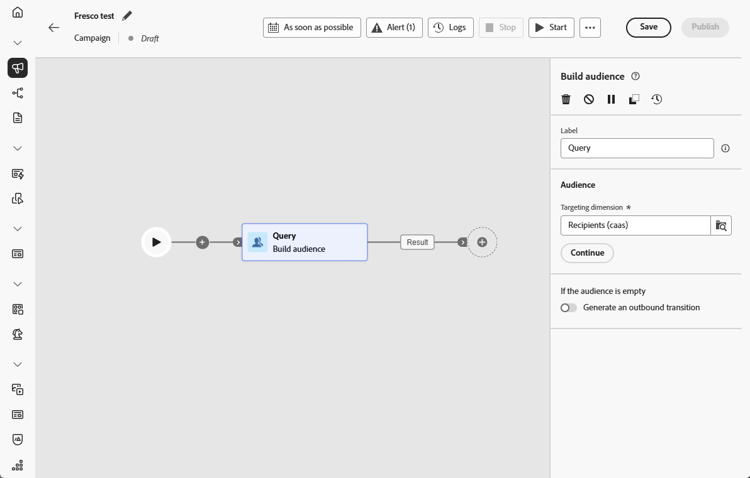
Siga estos pasos para configurar la actividad Generar público destinatario:
-
Añadir una actividad Generar público destinatario.
-
Defina una etiqueta.
-
Configure su público siguiendo los pasos que se detallan en las pestañas a continuación.
-
Elija la Dimensión de segmentación. La dimensión de segmentación permite definir la población objetivo de la operación: destinatarios, beneficiarios de contratos, operadores, suscriptores, etc. De forma predeterminada, el objetivo se selecciona en los destinatarios.
-
Haga clic en Continuar.
-
Utilice el generador de reglas para definir la consulta. Obtenga más información acerca del Generador de reglas en esta sección
-
Especifique si se debe generar una transición de salida si el público está vacío.
Ejemplos build-audience-examples
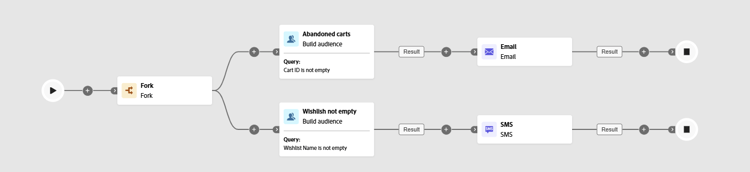
Este es un ejemplo de una campaña organizada con dos actividades Generar audiencia. La primera se dirige a los perfiles que tienen artículos en el carro de compras, seguida de un envío de correo electrónico. La segunda se dirige a los perfiles con una lista de deseos, seguida de un envío por SMS.
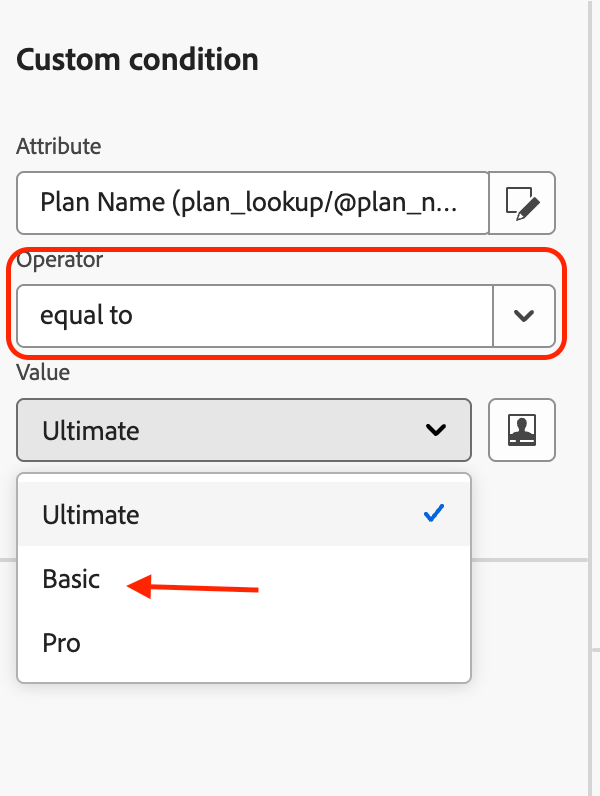
En el ejemplo siguiente, la actividad Generar audiencia usa el generador de reglas para filtrar los perfiles según su plan de suscripción. Se ha establecido una condición en el atributo plan para incluir solo perfiles donde plan = "basic", lo que reduce la audiencia a suscriptores de nivel básico antes de pasarlos a la siguiente actividad.
This section contains structured knowledge intended to support interpretation, retrieval, and question answering related to this topic.
For complete understanding, this information should be combined with the documentation on this page. Neither source is intended to stand alone; the page describes the feature, while this section provides additional context that helps disambiguate terminology, intent, applicability, and constraints.
- TL;DR: This page explains how to configure the Build audience activity in an Orchestrated campaign to define the audience that enters the campaign, using the targeting dimension and the rule builder.
Intents:
- Add a Build audience activity to an Orchestrated campaign.
- Define a label and choose the targeting dimension for the audience.
- Use the rule builder to define the query for the audience.
- Specify whether an outbound transition should be generated when the audience is empty.
Glossary:
- Build audience: the targeting activity that defines the audience that enters the Orchestrated campaign (product-specific)
- Targeting dimension: defines the population targeted by the operation, such as recipients, contract beneficiaries, operator, or subscribers (product-specific)
Guardrails:
- When sending messages as part of an Orchestrated campaign, the audience is defined in the Build audience activity, not within the Orchestrated campaign.
- By default, the target is selected from the recipients.
Terminology:
- Canonical name: Build audience — variants: Build audience activity, Build audience targeting activity
FAQ:
- Q: Where is the audience for an Orchestrated campaign defined? — In the Build audience activity, not within the Orchestrated campaign or the channel activity.
- Q: What does the targeting dimension do? — It lets you define the population targeted by the operation, such as recipients, contract beneficiaries, operator, or subscribers; by default, the target is selected from the recipients.
- Q: How do I define the query for the audience? — Use the rule builder after choosing the targeting dimension.
- Q: Can I control what happens when the audience is empty? — Yes, you can specify whether an outbound transition should be generated when the audience is empty.
Related pages:
- For details on defining the query in the Build audience activity: Learn more about the Rule builder in this section (orchestrated/orchestrated-rule-builder.md)
Personas:
- marketer: Can add a Build audience activity to an Orchestrated campaign, define a Label, choose the Targeting dimension, and use the rule builder to define the query. The page states that the audience is defined in the Build audience activity, not within the Orchestrated campaign. Where: “Configure the Build audience activity”.
Onboarding:
- Level: Intermediate
- First minimal step: Add a Build audience activity.
- Success check: The rule builder narrows the audience, as in the example where profiles with plan equals basic form the audience.
- Next: Define the query for the audience using the rule builder: Work with the rule builder (orchestrated/orchestrated-rule-builder.md)