Código JavaScript de Analytics for Advertising
Anunciantes solo con Advertising DSP
Para Advertising DSP, la integración de Analytics for Advertising realiza un seguimiento de las interacciones de sitios de pulsaciones y vistas. Las visitas de pulsación se rastrean mediante el código estándar de Adobe Analytics en sus páginas web; el código Analytics captura los parámetros de ID de AMO e ID de EF en la dirección URL de la página de aterrizaje y los rastrea en sus respectivos eVars reservados. Puede realizar un seguimiento de las visitas de visualización mediante la implementación de un fragmento de JavaScript en sus páginas web.
En la primera vista de página de una visita al sitio, el código JavaScript de Adobe Advertising comprueba si el visitante ha visto o hecho clic anteriormente en un anuncio. Si el usuario ha entrado anteriormente en el sitio mediante un clic o no ha visto un anuncio, se ignora al visitante. Si el visitante ha visto un anuncio y no ha entrado al sitio haciendo clic durante la ventana retrospectiva de clic establecida en Adobe Advertising, el código JavaScript de Adobe Advertising a) usa el servicio Experience Cloud ID para generar un ID suplementario (SDID) o b) usa el método de Adobe Experience Platform Web SDK generateRandomID para generar un StitchID. Cualquier ID se utiliza para unir datos de Adobe Advertising a la visita de Adobe Analytics del visitante. A continuación, Adobe Analytics consulta a Adobe Advertising el AMO ID y el EF ID asociados con la exposición del anuncio. A continuación, el ID de AMO y los ID de EF se rellenan en sus respectivos eVars. Estos valores persisten durante un periodo designado (de forma predeterminada, 60 días).
Analytics envía métricas de tráfico del sitio (como vistas de página, visitas y tiempo empleado) y cualquier evento estándar o personalizado de Analytics a Adobe Advertising cada hora, usando el ID de EF como clave. Estas métricas de Analytics se ejecutan a través del sistema de atribución de Adobe Advertising para conectar las conversiones al historial de clics y exposiciones.
Implementación del código JavaScript
La biblioteca de JavaScript consta de dos líneas que permiten que Analytics y Adobe Advertising se comuniquen entre sí. Si la integración de Analytics for Advertising se completó durante la implementación de Adobe Advertising, ya debería haber recibido este código con instrucciones sobre cómo implementarlo.
El código
Implementaciones que utilizan el código del servicio de ID de visitante de Adobe visitorAPI.js
<script src="https://www.everestjs.net/static/le/last-event-tag-latest.min.js">
<script>
     if("undefined" != typeof AdCloudEvent)
          AdCloudEvent('IMS ORG Id','rsid');
</script>
Implementaciones que utilizan el código alloy.js de Experience Platform Web SDK
<script src="https://www.everestjs.net/static/le/last-event-tag-latest.min.js">
<script>
     if("undefined" != typeof AdCloudEvent)
          stitchId = AdCloudEvent('IMS ORG Id','rsid').generateRandomId();
</script>
Dónde colocar el código
La función de JavaScript Analytics for Advertising debe ser posterior al servicio de Experience Cloud ID, pero antes que el código de App Measurement de Analytics. Esto garantiza que el identificador suplementario (SDID) o StitchID se incluya en la llamada de Analytics.
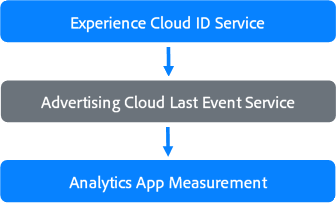
Validación de la implementación de código
Puede realizar la validación utilizando cualquier tipo de herramienta de detector de paquetes (como Charles, Fiddler o Chrome Developer Tools) comparando los valores de los cuatro ID entre la solicitud que va a Adobe Advertising y la solicitud que va a Analytics, como se describe a continuación.
Cómo confirmar el código con Chrome Developer Tools validate-js-chrome
-
Abra Chrome Developer Tools y haga clic en la ficha Red.
-
Cargue una página de sitio web que contenga el JavaScript Analytics for Advertising.
-
Filtre la ficha Network por
lasty revise dos filas: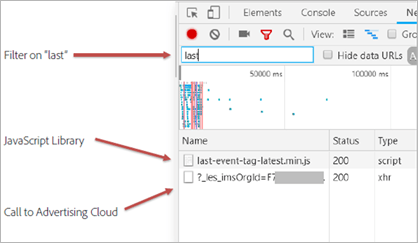
-
La primera fila es la llamada a la biblioteca de JavaScript y se titula
last-event-tag-latest.min.js. -
La segunda fila es la llamada que envía la solicitud a Adobe Advertising. Comienza de la siguiente manera:
_les_imsOrgId=[your_imsOrgId_here]&_les_url=[your_encoded_url]Si no ve la llamada a Adobe Advertising, es posible que no sea la primera vista de página de la visita. Para realizar pruebas, puede eliminar la cookie de modo que la siguiente llamada sea la primera vista de página de la visita correspondiente:
- En la ficha Aplicación, busque la cookie
adcloudy compruebe que la cookie contiene_les_v(última visita) con un valor deyy una marca de tiempo UTC epoch que caduca en 30 minutos.- Elimine la cookie
adcloudy actualice la página.
- Elimine la cookie
-
-
(Implementaciones que utilizan el código
visitorAPI.jsdel servicio de ID de visitante de Adobe) Filtre en/b/sspara ver la visita de Analytics.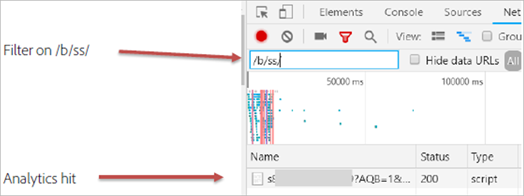
-
(Implementaciones que usan el filtro de Experience Platform Web SDK
alloy.jscode) en/interactpara comprobar que la carga de la solicitud en Edge Network contieneadvertisingStitchID.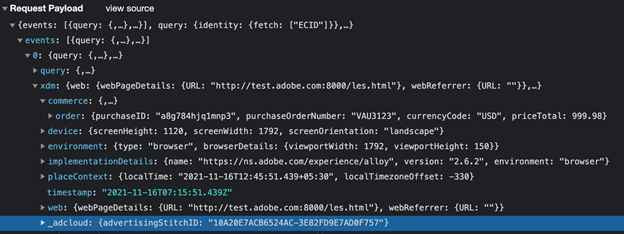
-
Compare los valores de ID entre las dos visitas. Todos los valores deben estar en parámetros de cadena de consulta, excepto el ID del grupo de informes en la visita de Analytics, que es la ruta de la URL inmediatamente después de
/b/ss/.table 0-row-4 1-row-4 2-row-4 3-row-4 4-row-4 5-row-4 ID Parámetro de Analytics Edge Network Parámetro de Adobe Advertising Organización de IMS de Experience Cloud mcorgid_les_imsOrgidID de datos suplementario sdid _les_sdidID de unión stitchId advertisingStitchIDbajo la propiedad_adcloudAnalytics Report Suite El valor después de /b/ss/_les_rsidID de visitante de Experience Cloud mid _les_midSi los valores de ID coinciden, se confirma la implementación de JavaScript. Adobe Advertising envía al servidor Analytics cualquier detalle de seguimiento de clics o visualizaciones, si existe.
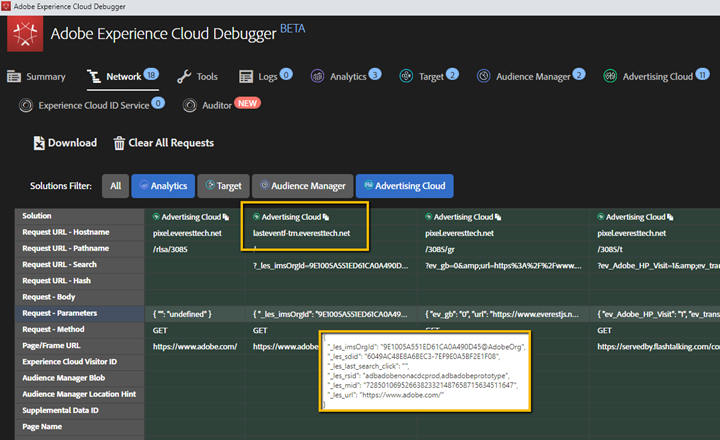
Cómo confirmar el código con Adobe Experience Platform Debugger
-
Abre el Adobe Experience Platform Debugger en tu página de inicio.
-
Vaya a la ficha Network.
-
En la barra de herramientas Solutions Filter, haga clic en Adobe Advertising y Analytics.
-
En la fila del parámetro Request URL - Hostname, busque
lasteventf-tm.everesttech.net. -
En la fila Request - Parameters, audite las señales generadas, de forma similar al Paso 3 de “Cómo confirmar el código con Chrome Developer Tools”.
- (Implementaciones que utilizan el código del servicio de ID de visitante de Adobe
visitorAPI.js) Asegúrese de que el parámetroSdidcoincida con el parámetroSupplemental Data IDen el filtro de Adobe Analytics. - (Implementaciones que utilizan el código
alloy.jsExperience Platform Web SDK) Asegúrese de que el valor del parámetroadvertisingStitchIDcoincida con elSdidenviado a Experience Platform Edge Network. - Si el código no se está generando, asegúrese de que la cookie de Adobe Advertising se haya eliminado en la pestaña Application. Una vez eliminada, actualice la página y repita el proceso.
- (Implementaciones que utilizan el código del servicio de ID de visitante de Adobe