Implementing Adobe Workfront isn’t just about rolling out a tool. it’s about answering every user’s core question: “What’s in it for me?” Adoption thrives when organizations connect Workfront’s value to real persona needs, weaving personalized benefits into a clear, strategic vision that drives genuine engagement and lasting change.
Introduction
Implementing a new tool like Adobe Workfront isn't really about the tool at all. It's about answering a question that every single user and stakeholder ask themselves, whether they voice it or not:
"What's in it for me?"
This fundamental question is the throughline that connects adoption success to failure across virtually every enterprise implementation. When you can answer it compellingly, adoption follows naturally. When you can't, no amount of executive mandate drives meaningful change.
The parallels to sales are striking. Just as a salesperson must articulate clear value to close a deal, adoption leaders must translate organizational benefits into personal value propositions. The difference? In adoption, you're not closing a one-time transaction – you're building sustained behavioral change.
Through my experiences as a Workfront system administrator and consultant, I've encountered the same six adoption challenges that Adobe has identified in the Adoption Wheel article. In every case, the underlying issue traces back to how effectively (or ineffectively) we've answered that critical question: "WIIFM” – What's in it for me?
Limited advocacy & leadership support
Here's the hard truth: If leaders continue asking for status updates and reports outside of Workfront instead of consulting the system themselves, you’re sending your teams a powerful message – the tool doesn't really matter. Why should frontline workers invest time tracking their work in Workfront if leaders aren’t actually using it to gain real-time insights?
Leaders are busy. Curating dashboards and building status decks isn't in their job description. That's precisely why product owners and administrators must deeply understand executive needs and configure Workfront to anticipate them. The goal is to teach leaders to fish – but also equip them with dynamite to make fishing effortless.
When this works well, your adoption answer becomes powerful: "The C-suite is now actively tracking your progress and accomplishments through Workfront." In practical terms that means their progress is visible in Workfront dashboards and reports, not buried in one‑off slide decks. That's a value proposition worth embracing.
But here's what often gets missed: leaders need more than dashboards. They need a strategic vision that resonates with them personally – one that connects Workfront to their business priorities and answers their specific "What's in it for me?"
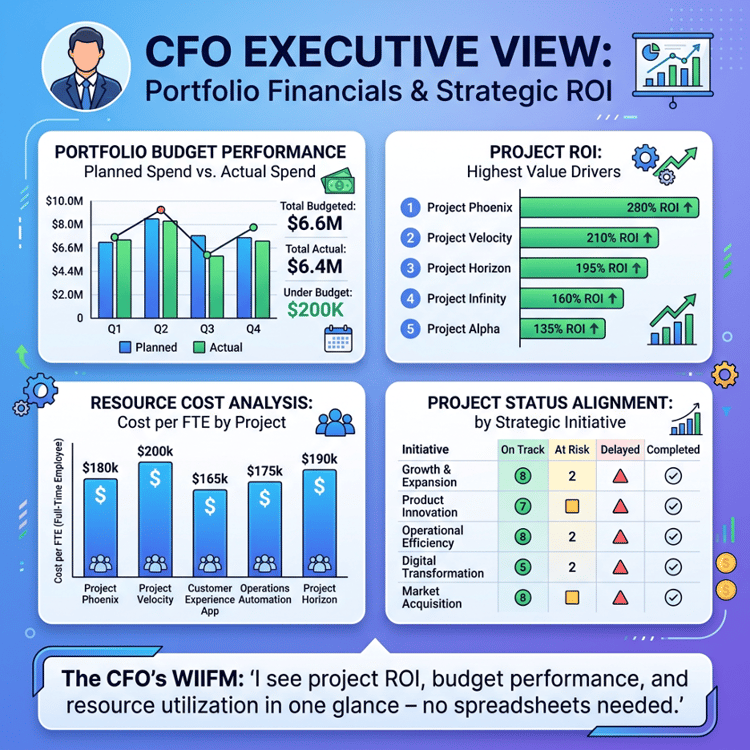
For a CFO, it's visibility into resource utilization and project ROI. For a CMO, it's predictable campaign delivery and optimized resource allocation. For an operations leader, it's reduced firefighting through proactive, data-driven planning. Each leader needs to see how Workfront serves their strategic objectives, not just the organization's general need for "better project management."
This persona-specific approach to leadership – crafting WIIFM for each executive segment rather than a one-size-fits-all pitch – is what converts executives from passive sponsors into active champions.
Lack of clarity on value and purpose
Lack of clarity on value and purpose is the root adoption problem that I encounter most often.
When users ask, "What's in it for me?" and you don't have a thoughtful answer other than "because I'm telling you to" – compliance breaks down. People inherently resist being told what to do without a clear purpose.
The four pillars of adoption strategy
Before you even invest in a new tool, step back and build a comprehensive adoption strategy grounded in four interdependent pillars. Most implementations fail because they execute one or two of the pillars, rather than all four:
1. Strategic vision with universal resonance
Leaders must articulate a clear, compelling vision for the future that resonates across team members, managers, and executives alike. This vision should connect daily work in Workfront to organizational purpose – not just "we're implementing a tool," but "we're transforming how we work to achieve a specific strategic outcome."
2. Persona-specific WIIFM (not one-size-fits-all)
A single value proposition doesn't work. You need tailored answers to "What's in it for me?" for each audience segment:
-
For executives: faster decision-making and predictable outcomes
-
For managers: visibility into team capacity, workload, and progress
-
For frontline workers: clarity on priorities and reduced status reporting
-
For PMOs: standardized processes and accurate forecasting
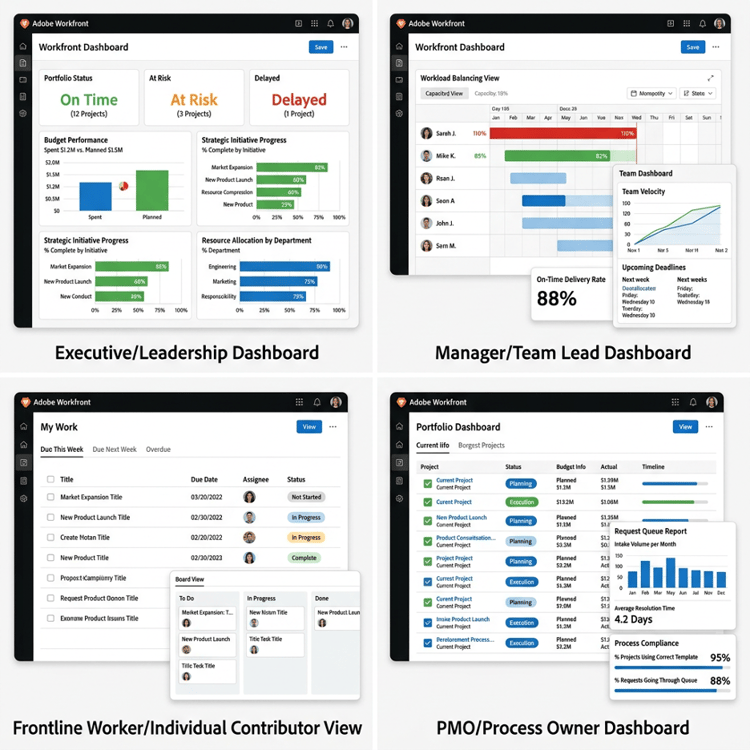
Each persona needs to see themselves in the vision and understand how Workfront serves their specific needs and pain points.
3. Clear connection to prioritized business objectives
The vision and personas must tie explicitly to measurable business outcomes – revenue goals, cycle time reduction, risk mitigation, quality improvements, or operational efficiency. Teams need to understand why this matters strategically, not just operationally.
4. Measurable success with clear accountability (governance and KPIs)
Finally, establish governance structures and KPIs that make success visible and measurable. Who's accountable for adoption? What does success look like? How will you track it? Clear metrics create clarity, ownership, and momentum.
When implementations skip one pillar: adoption stalls because people don't see the value in them. When they define personas but fail to connect to business objectives, adoption feels disconnected from "the real work." When they establish KPIs but lack vision, adoption feels like compliance, not enablement.
When all four pillars work together: organizations create the conditions for genuine adoption. They transform Workfront from a mandated tool into an enabler of organizational success.
This clarity becomes your foundation for everything else. Without all four pillars working together, you're building adoption efforts on sand.
In practice: Two critical moves
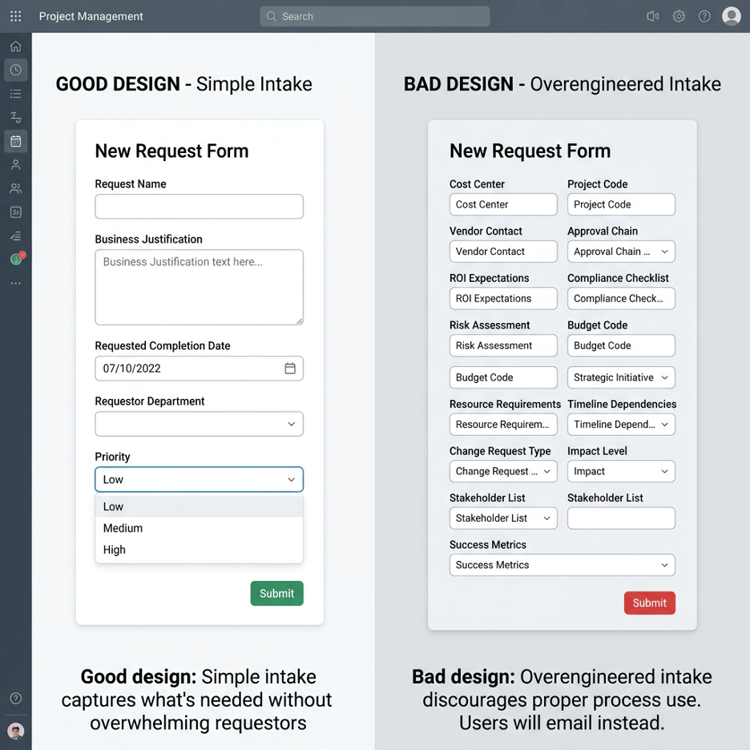
So, what does this look like operationally? First, your discovery process should define accurate user personas and map each one's distinct WIIFM. Every Workfront configuration decision – from request queue design to dashboard structure – should serve an actual user need, not theoretical best practice. Personas transform adoption from a compliance problem into a value problem.
Second, establish clear Goals, Outcomes, and OKRs for the entire implementation upfront and secure leadership buy-in on these metrics. When leaders have a stake in specific outcomes – reduced time-to-decision, improved predictability, faster delivery cycles – they become natural champions. This strategic foundation creates the belief, values, and cascading WIIFM that reach every user level. It signals that Workfront isn't a technical mandate; it's a strategic enabler of organizational success.
When you combine persona-centric discovery with strategic goal alignment, you're no longer selling adoption – you're enabling it.
Resistance to change
Change triggers uncertainty, discomfort, and stress. It's not a weakness in your organization – its human nature.
The antidote is threefold: communication, support, and connection to value.
Be transparent and authentic. Invite questions and answer them honestly in ways that comfort rather than dismiss concerns. Drive home the answer to "What's in it for me?" repeatedly and in different ways.
In Workfront terms, this might look like:
-
Submitting work through a request queue gives you visibility into exactly where your request is in the workflow, rather than wondering if anyone's working on it.
-
Keeping tasks up to date reflects your personal accountability and keeps the workflow moving forward, so colleagues aren't chasing you for status.
-
Dashboards replace the manual status meetings and slide-building that used to consume hours, freeing you to focus on actual work.
Go further by investing in soft-skills learning around change management – topics like embracing change, learning agility, and thriving amid uncertainty. When people feel supported through the discomfort, they emerge as champions rather than resisters – and they become your best advocates for the change.
Misalignment with processes and tools
Sometimes the tool doesn't fit the problem. Or there's a better-fit solution entirely.
This challenge often stems from the previous one: lacking clarity on value and purpose. Without a rigorous discovery process grounded in persona analysis, you risk implementing a solution in search of a problem.
Persona-driven discovery and requirements gathering
In Workfront, this often shows up as forcing everything into projects and tasks when some work really belongs in request queues, boards, or even a different tool, or as building approvals that don't actually match how decisions get made in real life.
The antidote is disciplined, persona-centric discovery. Define your user personas accurately and surface comprehensive requirements specific to each one. Apply thoughtful design grounded in best practices. Then validate that your Workfront configuration aligns with how each persona actually works – not how you think they work.
Never lose sight of your "why" – your overarching goals and OKRs – and, most importantly, never lose sight of your personas' distinct "what's in it for me?" This ensures that the tool and processes you're implementing actually serve the people using them.
Perceived complexity and time constraints
Yes, adopting a new tool creates initial friction. Tasks that once took five seconds now take ten. Reports that used to be manual now require configuration.
This is where your adoption narrative matters most. Acknowledge the short-term burden honestly. Then reframe it around the ultimate value: "Yes, marking tasks as complete takes a moment longer. But now your work is fully tracked in Workfront, so you'll never have to pause what you're doing to compile a status update again."
In other words, a few extra seconds spent updating a task, request, or custom form in Workfront can save hours later on – hours that used to disappear into building manual status reports, compiling slide decks, and answering 'where are we?' questions that a dashboard or report can answer on its own, in real time.
Paint the picture of the trade-off. Help people see the efficiency and productivity gains on the other side of the learning curve.
Training and enablement gaps
Sometimes clients try to cut costs by eliminating or internalizing Training and Enablement, and the results are predictable: expensive implementations that fail to drive adoption.
Here's why this matters: Training and enablement aren't just about teaching software proficiency. It's about answering "What's in it for me?" in a way that addresses the psychological, behavioral, and emotional dimensions of change management.
In Workfront that means showing people how their Home view their Requests, their Projects, Dashboards, and Reports can actually make their day easier instead of harder, and focusing their training on the parts of the tool they truly need to use.
Organizations experiencing successful adoption invest in dedicated change management and Training specialists precisely because these soft skills are what separate successful adoptions from failed ones. The focus you invest in training almost always correlates directly to your adoption metrics.
This isn't a cost center. It's the insurance policy that protects the entire investment you've made.
The throughline
Whether you're struggling with leadership buy-in, unclear value, resistance to change, tool misalignment, complexity concerns, or enablement gaps, the thread connecting all of them is the same: Have you answered, "What's in it for me?" – and have you answered it compellingly for each user persona you're trying to reach?
But here's the critical insight: WIIFM doesn't exist in isolation. For it to truly drive adoption, it must be embedded within a strategic framework that includes a clear organizational vision, alignment to prioritized business objectives, and measurable accountability through governance and KPIs. When these elements work together – when each persona's WIIFM is grounded in strategic purpose and connected to outcomes leadership cares about – you create conditions for sustained adoption, not just initial compliance.
The organizations that succeed understand this interconnection. They refuse to execute just one piece. They weave together strategic vision, personalized value, business alignment, and clear accountability – and they support their people through the change with authenticity, clarity, and genuine care.
When you get that right, adoption isn't something you have to drive. It's something your people choose.