Shape splatter v2 to mask
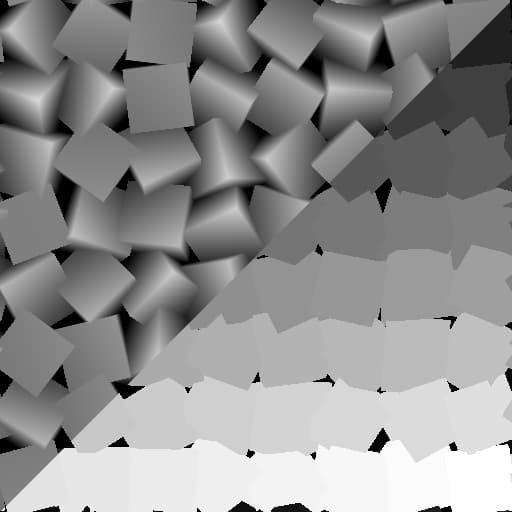
In: Generator > Pattern
Description
Computes a mask out of a selection of shapes generated by the Shape splatter v2 node .
Available options include random selection as well as selecting ranges of shapes by unique identifier and/or material ID/pattern ID*.
Shapes are pre-masked by the Shape splatter v2 node from their height blend with the background height.
Both the background and the unselected shapes are pure black. (I.e a value of 0)
*: One of the values retrieved from the Shape splatter UVW input is either the material ID or pattern ID, depending on the Shape type used in the Shape splatter v2 node:
- SDF/primitive: Material ID
- Pattern input/Grid atlas: Pattern ID, I.e. the index of the pattern in the list/atlas.
Inputs
G - V component of the shapes’ UVs.
B - The shapes’ height. (W)
A - Packed data:
- Integer part: The shapes’ unique identifier. (ID)
- Fractional part: Depends on the Shape type: Material ID if SDF/primitive, pattern ID* if pattern input/grid atlas.
*: The pattern ID is the index of the shape in the list/atlas.
Outputs
Parameters
- Binary mask: Selected shapes all use a value of 1.
- Shape ID (integer): Selected shapes use their unique identifier. (ID)
- Material ID (integer): Selected shapes use their material ID.
- Shape ID (normalized): Selected shapes use their unique identifier (ID) mapped to the [0, 1] range from the lowest selected ID to the highest.
- Material ID (normalized): Selected shapes use their material ID mapped to the [0, 1] range from the lowest selected material ID to the highest.
This makes it easy to offset the current selection by the specified value without having to adjust the start and end bounds manually.
- None: Ignore the material ID/pattern ID entirely for the selection.
- AND: Selected shapes have to be included in both the ID and material ID/pattern ID ranges. (Includes less shapes)
- OR: Selected shapes have to be included in either the ID or material ID/pattern ID ranges. (Includes more shapes)
*: See node description for details.
*: See node description for details.