Validate Web SDK implementations with Experience Platform Assurance
Adobe Experience Platform Assurance is a feature to help you inspect, proof, simulate, and validate how you collect data or serve experiences.
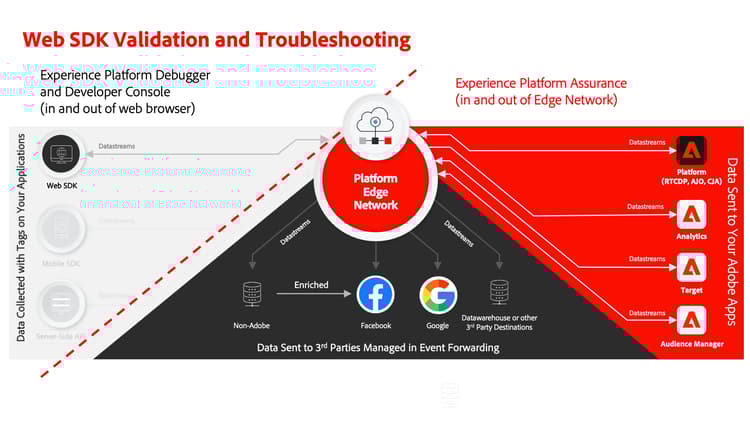
As you learned in the Configure a datastream lesson, Platform Web SDK first sends data from your digital property to Platform Edge Network. Then, Platform Edge Network makes forwards the data to the services enabled in your datastream. You can validate the requests coming in and out of Platform Edge Network by using Assurance.
Learning objectives
At the end of this lesson, you will be able to:
- Start an Assurance session
- View requests sent to and from Platform Edge Network
Prerequisites
You are familiar with Data Collection tags and the Luma demo website and have completed the previous lessons in the tutorial:
Start and view an Assurance session
There are several ways to start an Assurance session.
Enable Edge Trace in the Debugger
To enable Edge Trace:
-
Go to the Luma demo website and use the debugger to switch the tag property on the site to your own development property
-
Make sure you are signed into the Debugger with your Org name showing. If your username is showing instead, sign out and try signing back in.
-
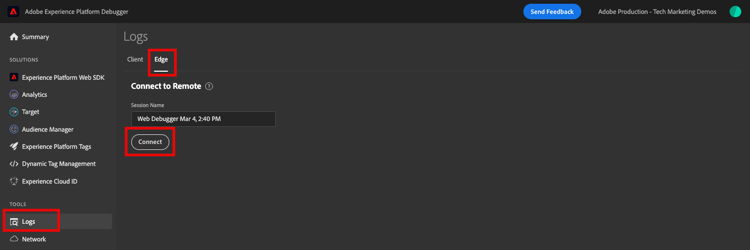
In the left navigation of Experience Platform Debugger select Logs
-
Select the Edge tab, and select Connect
-
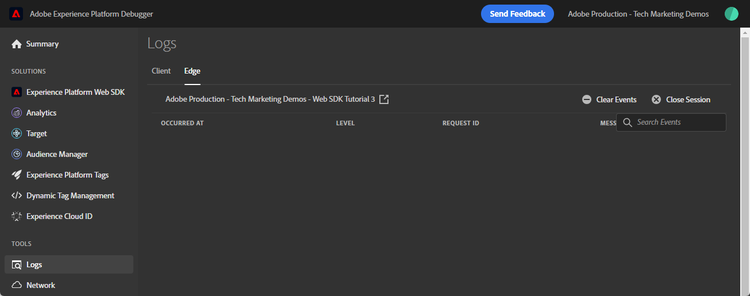
It is empty for now
-
Refresh the Luma home page and check Experience Platform Debugger again, to see data come into Platform Edge Network. In future lessons, you will be able to see outgoing requests as you enable services in your datastream.
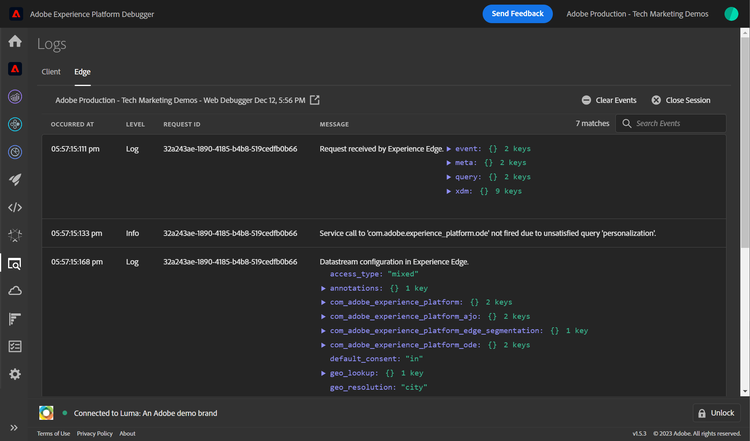
Every time you enable Edge Trace in Adobe Experience Platform Debugger, an Assurance session is started in the background. While you can review the information here, you will likely find the Assurance interface much more useful.
-
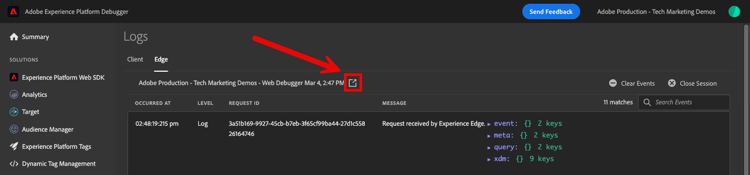
With Edge Trace enabled, you can see an outgoing link icon on top. Select the icon to open Assurance.
-
A new browser tab opens with the Assurance interface.
Start an Assurance session from the Assurance interface
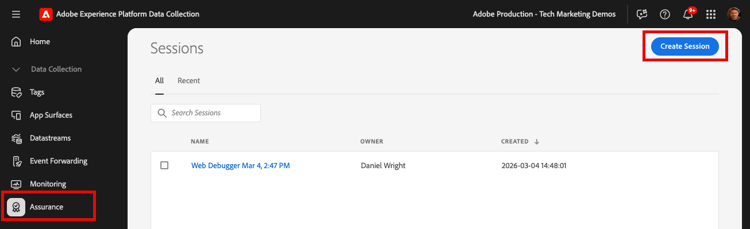
- Open the Data Collection interface
- Select Assurance in the left navigation
- Select Create Session
- Use the Deep link connect option
- Select Start
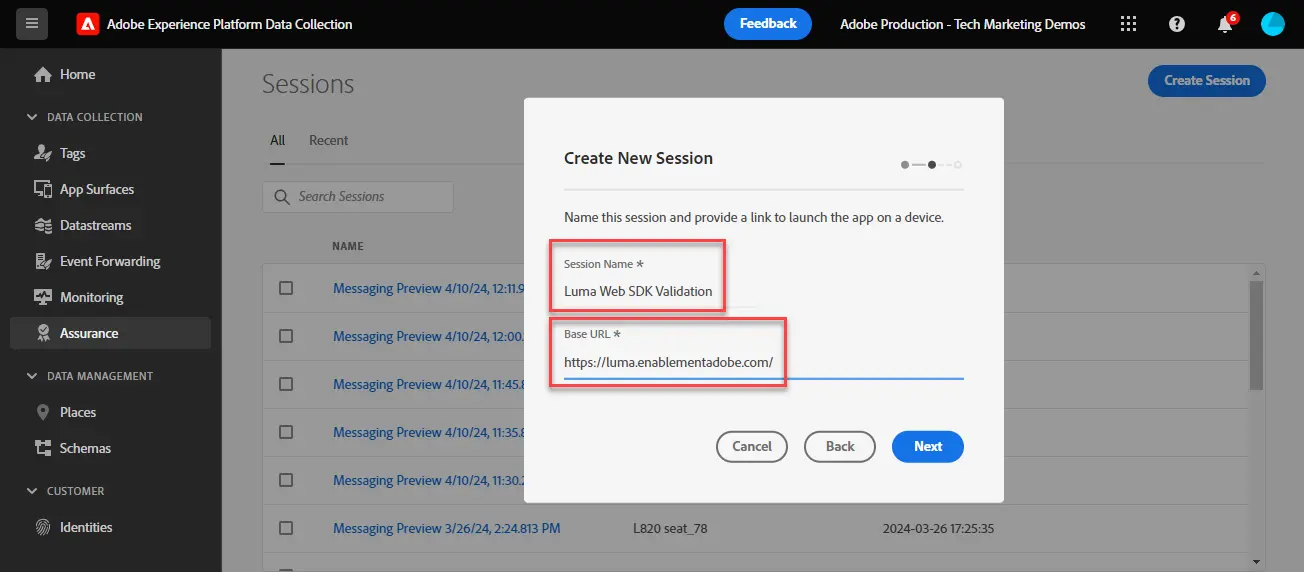
- Give the session a name, for example,
Luma Web SDK validation - As the Base URL enter
https://luma.enablementadobe.com/
- On the next screen, select Copy Link
- Select the icon to copy the link to your clipboard
- Paste the URL in your browser, which will open the Luma Website with a special URL parameter
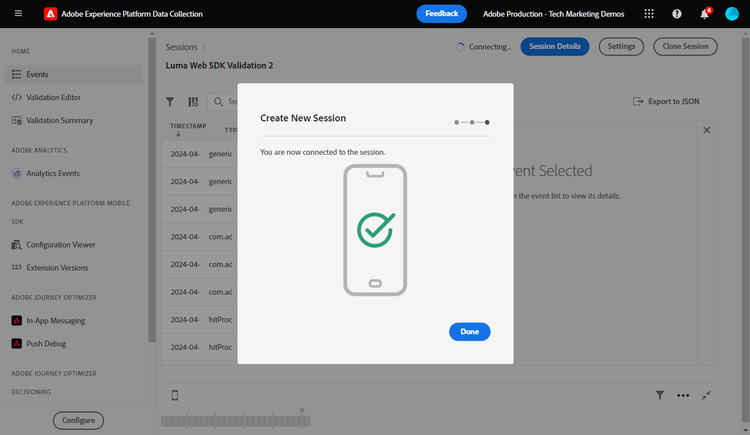
adb_validation_sessionidand start the session - In the Assurance interface, you should see a message indicating you have successfully connected to the session and you should see events captured in the Assurance interface.
Validate the current state of your Web SDK implementation
There is limited information to view at this stage of your implementation since we haven’t enabled any services in the datastream yet.
View incoming requests from Web SDK with Alloy Request
We can view the incoming hit from Web SDK as it is received by the edge:
-
Select the
Alloy Requestrow -
Look in Raw Event (or expand nodes in the Payload >
ACPExtensionEventData) until you find your XDM object with familiar variables: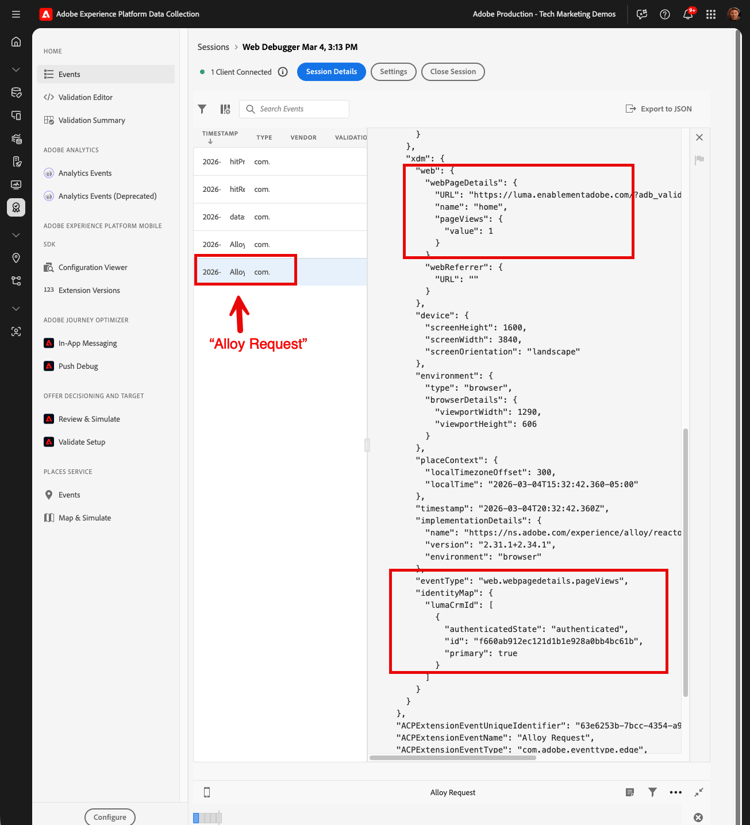
View the response in Alloy Response Handle
As you know, the Experience Cloud Id (ECID) is visible in the Web SDK response after it is generated on Platform Edge Network. Let’s look for it in the response as viewed in Assurance:
-
Filter and select the row with the event called
Alloy Response Handle. -
A menu shows up on the right. Select the
+sign next toACPExtensionEventData -
Drill down by selecting
payload > 0 > payload > 0 > namespace. The ID shown under the last0corresponds to theECID. You know that by the value that shows up undernamespacematchingECID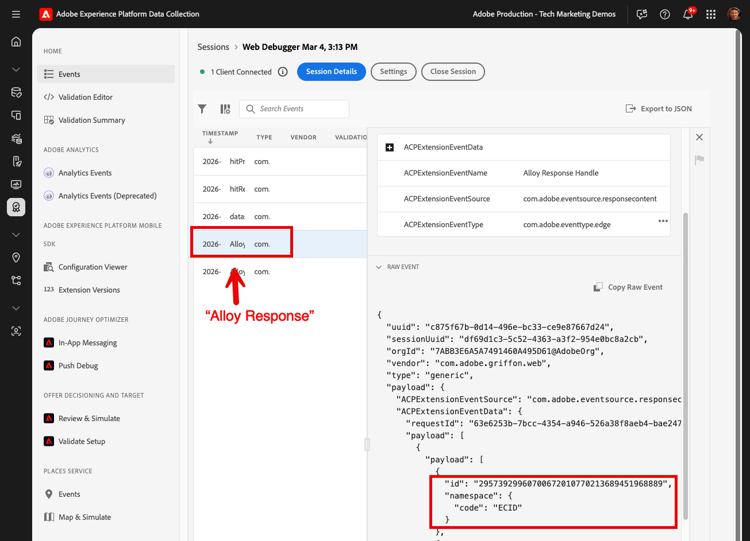
note caution CAUTION You may see a truncated ECID value due to the width of your window. Simply select the handle bar in the interface and drag to the left to view the entire ECID.
In future lessons, you use Assurance to validate fully processed payloads reaching an Adobe application enabled in your datastream.
With an XDM object now firing on a page, and with the knowledge of how to validate your data collection, you are ready to set up Experience Platform and the individual Adobe applications using Platform Web SDK.