On this page: Learn how to use general events to trigger journeys unitarily in real time and configure event timeouts and timeout paths to listen for an event only during a defined period.
Events allow you to trigger your journeys unitarily to send messages, in real-time, to the individual flowing into the journey.
For this type of event, you can only add a label and a description. The rest of the configuration cannot be edited. It was performed by the technical user. See this page.
Learn more about event throughput and journey processing rates in this section.
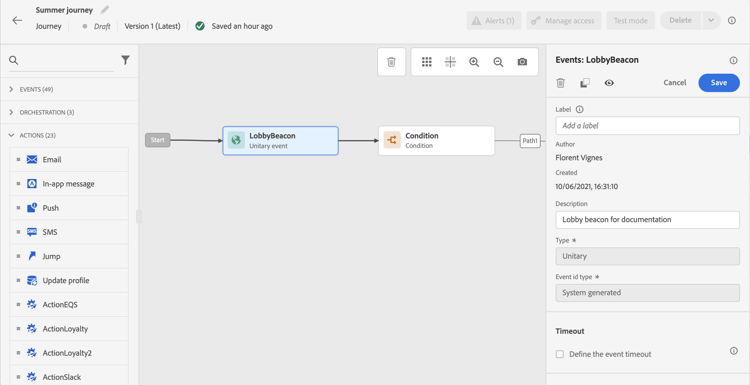
When you drop a business event, it automatically adds a Read Audience activity. For more information on business events, refer to this section
Listening to events during a specific time events-specific-time
An event activity positioned in the journey listens to events indefinitely. To listen to an event only during a certain time, you must configure a timeout for the event.
The journey will then listen to the event during the time specified in the timeout. If an event is received during that period, the person will flow in the event path. If not, the customer will either flow into the timeout path if it is defined, or will continue that journey.
If no timeout path is defined, the timeout setting will act as a wait activity, making the profile wait for a period of time, which could be stopped if an event happens before the end of that wait. If you want profiles to be excluded from that journey after timeout, you will have to set a timeout path.
To configure a timeout for an event, follow these steps:
-
Activate the Define the event timeout option from the event properties.
-
Specify the amount of time the journey will wait for the event. The maximum duration is 90 days.
-
When no event is received within the specified timeout, best practice is to send the individuals into a timeout path. For this, enable the Set a timeout path option. In that case, the journey continues for the individual once the timeout is reached. We recommend that you always enable the Set a timeout path option.
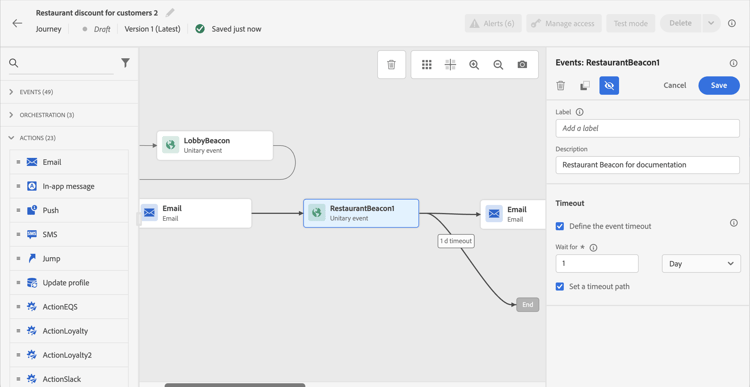
In this example, the journey sends a first welcome email to a customer after he/she enters the lobby. It then sends a meal discount email only if the customer enters the restaurant within the next day. We therefore configured the restaurant event with a 1-day timeout:
- If the restaurant event is received less than 1 day after the welcome email, the meal discount email is sent.
- If no restaurant event is received within the next day, the person flows through the timeout path.
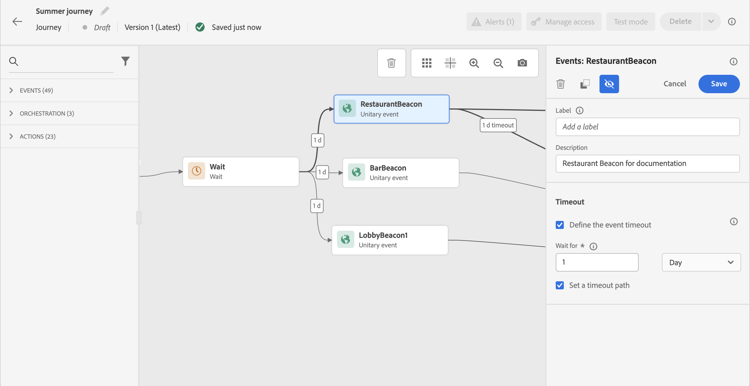
Note that if you want to configure a timeout on multiple events positioned after a Wait activity, you need to configure the timeout on one of these events only.
The defined timeout applies to all the events positioned after the Wait activity:
- If one event is received within the timeout duration, the individual flows into the received event’s path.
- If no event is received within the timeout duration, the individual flows into the timeout branch of the event where the timeout has been defined.
This section contains structured knowledge intended to support interpretation, retrieval, and question answering related to this topic.
For complete understanding, this information should be combined with the documentation on this page. Neither source is intended to stand alone; the page describes the feature, while this section provides additional context that helps disambiguate terminology, intent, applicability, and constraints.
- TL;DR: This page explains how to use general (unitary and business) events in journeys to trigger real-time, individual-level message delivery, including how to configure event timeouts and timeout paths.
Intents:
- Add a general event activity to a journey canvas to trigger real-time profile entry
- Configure an event timeout to limit how long a journey listens for an event
- Set up a timeout path to handle profiles that do not trigger the expected event in time
- Distinguish between unitary events and business events and understand when each is added automatically
- Combine event timeouts with Wait activities to control multi-event timeout behaviour
Glossary:
- Unitary event: An event that triggers the journey for one individual at a time, in real-time (product-specific)
- Business event: A non-profile-related event that triggers a journey for an audience of profiles, automatically adding a Read Audience activity (product-specific)
- Event timeout: A configurable duration (up to 90 days) after which the journey stops waiting for a specific event and routes the profile to a timeout path (product-specific)
- Timeout path: An optional journey branch that profiles follow when the expected event is not received within the timeout window (product-specific)
Guardrails:
- Event label and description are the only editable fields for a general event on the canvas; all other configuration is performed by a technical user and cannot be changed from the journey
- Maximum event timeout duration is 90 days
- When multiple events follow a Wait activity, the timeout must be configured on only one of those events; the defined timeout then applies to all events after the Wait
- If no timeout path is defined, the timeout acts as a Wait activity; profiles that do not receive the event remain in the journey until the timeout elapses
Terminology:
- Canonical name: General event — Acronym: none — variants: unitary event, custom event
- Synonyms: “general event” = “unitary event” (in the context of the canvas activity)
- Do not confuse: “business event” ≠ “unitary event” — a business event targets an audience of profiles, while a unitary event targets a single individual
FAQ:
- Q: Can I change the event configuration from the journey canvas? — No; only the label and description can be edited on the canvas. The full event configuration is set by a technical user and cannot be modified from the journey.
- Q: What happens if no event is received before the timeout expires? — If a timeout path is defined, the profile flows into that path. If no timeout path is set, the timeout behaves like a Wait activity and the profile continues the journey after the timeout period.
- Q: What is the maximum event timeout duration? — 90 days.
- Q: When should I enable the timeout path option? — Always enable it if you want profiles to exit that branch after the timeout; without a timeout path, profiles remain in the journey waiting for the event.
- Q: How does a business event differ from a unitary event in the journey canvas? — Dropping a business event automatically adds a Read Audience activity, because business events target multiple profiles simultaneously rather than a single individual.