On this page: Learn how to browse customer identifiers and explore identity graphs in Adobe Journey Optimizer, including how identity namespaces and values combine to identify each customer.
An identity is data that is unique to an entity, typically a real-world object, such as an individual person, a hardware device, or a web browser. A fully qualified identity consists of two elements:
- The identity namespace serves as an indicator of the context to which an identity relates.
- The identity value is a string that represents an entity.
For example, consider the phone number 555-555-1234. In this case, the string “555-555-1234” is an identity value, which could be categorized into a “Phone” identity namespace.
The Identities menu in Adobe Journey Optimizer allows users to efficiently browse through the various identifiers that make up the customers in their database.
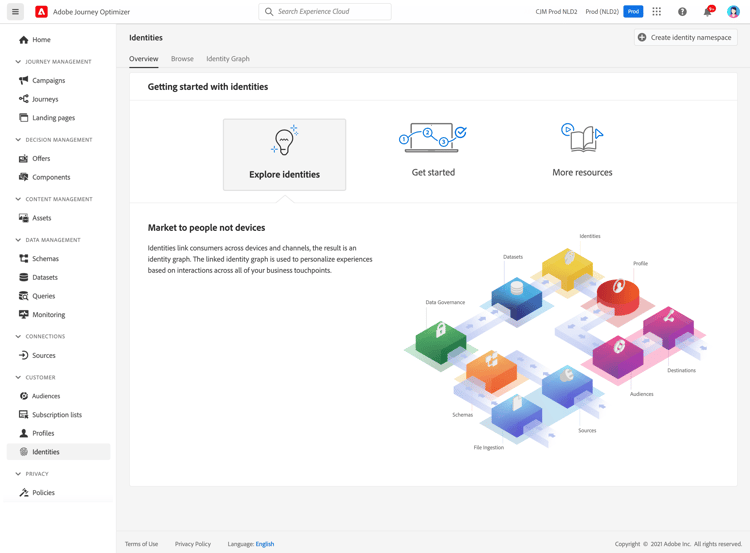
It provides an Identity Graph, which is a map of relationships between different identities for a particular customer. This graph offers a visual representation of how a customer interacts with a brand across different channels. All customer identity graphs are collectively managed and updated by Adobe Experience Platform Identity Service in response to customer activity.
Detailed information on working with identities is available in the Identity Service documentation.
This section contains structured knowledge intended to support interpretation, retrieval, and question answering related to this topic.
For complete understanding, this information should be combined with the documentation on this page. Neither source is intended to stand alone; the page describes the feature, while this section provides additional context that helps disambiguate terminology, intent, applicability, and constraints.
- TL;DR: The Identities menu in Adobe Journey Optimizer lets users browse the identifiers that make up their customers and explore an Identity Graph showing the relationships between a customer’s different identities.
Intents:
- Browse the various identifiers that make up the customers in the database
- Understand how an identity namespace and identity value combine to form a fully qualified identity
- Explore the Identity Graph for a particular customer
Glossary:
- Identity: Data that is unique to an entity, typically a real-world object such as an individual person, a hardware device, or a web browser (product-specific)
- Identity namespace: An indicator of the context to which an identity relates (product-specific)
- Identity value: A string that represents an entity (product-specific)
- Identity Graph: A map of relationships between different identities for a particular customer, offering a visual representation of how a customer interacts with a brand across different channels (product-specific)
Guardrails:
- All customer identity graphs are collectively managed and updated by Adobe Experience Platform Identity Service in response to customer activity.
Terminology:
- Canonical name: Identity Graph — Acronym: n/a — variants: identity graph
- Synonyms: “fully qualified identity” = “identity namespace + identity value”
- Do not confuse: “identity namespace” (indicator of context) ≠ “identity value” (string representing an entity)
FAQ:
- Q: What makes up a fully qualified identity? — Two elements: the identity namespace (the context) and the identity value (a string representing an entity).
- Q: What is the Identity Graph? — A map of relationships between a particular customer’s different identities, showing how they interact with a brand across channels.
- Q: Who manages and updates customer identity graphs? — Adobe Experience Platform Identity Service, in response to customer activity.