Audience Agent B2B
Powered by Adobe Experience Platform Agent Orchestrator, Audience Agent B2B is available in Journey Optimizer B2B Edition. Using this agent enhances efficiency and effectiveness in exploring and scaling audiences, accelerating buying group creation, and seamless workflows for journey activation:
-
Prioritize target audiences by intent: Infer personas based on product intent for various audiences and streamline campaign planning, reducing time spent on audience validation.
-
Leverage AI to detect and create buying groups: Use AI, structured, unstructured data, and unified first-party data to streamline buying group discovery and creation.
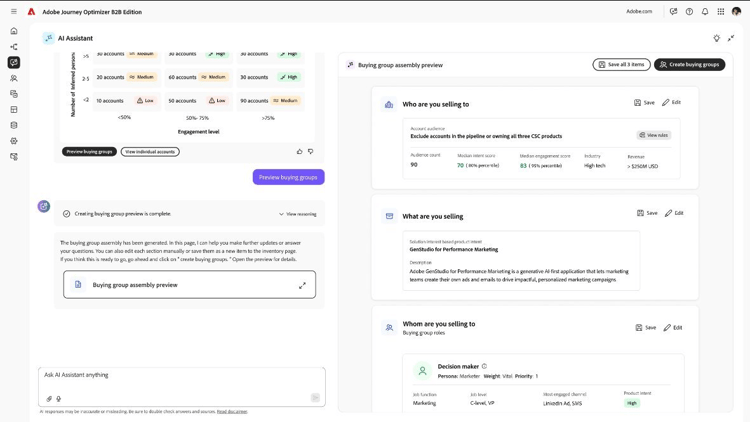
Audience Agent B2B capabilities
-
Measure account intent strength (such as low, medium, and high) for specific products.
-
Compare product interest trends over time (such as top products in the last n days).
-
Identify accounts actively showing interest in specific products.
-
Surface engagement patterns that combine account activity with persona coverage.
-
Helps teams focus on the right accounts at the right time.
-
Improves pipeline quality by prioritizing accounts with genuine purchase signals.
-
Enables proactive engagement before competitors act.
-
Detect and rank the top personas by product intent.
-
Identify personas involved in buying one or multiple products.
-
Map personas to functional roles (such as Champion, Decision Maker, and Influencer) with justification.
-
Validate why a given person is considered a champion.
-
Ensures that the sales team engages the true decision-makers and influencers.
-
Reduces wasted effort on low-impact contacts.
-
Increases win rates by aligning outreach with buyer power dynamics.
-
Assess buying group size (for example, groups with more than n members).
-
Measure persona coverage across accounts (for example, below x%).
-
Track role distribution and coverage gaps within buying groups.
-
Highlight accounts with champions identified in recent deals.
-
Reveals coverage gaps that could stall deals.
-
Strengthens multi-threading strategies by ensuring full role representation.
-
Improves deal health tracking through group-level engagement insights.
-
Recommend role-to-persona mappings based on observed persona and role patterns.
-
Generate a buying group role template for a specified product.
-
Support template customization by including or excluding specific personas and roles.
-
Validate that required roles are defined before buying groups are created.
-
Reduces manual effort and risk of incomplete buying group templates.
-
Ensures role coverage is validated before creation, mitigating the risk of coverage gaps.
-
Turns analysis insights into immediate, operational next steps.
Limitations
Audience Agent B2B depends on configured intent taxonomy, XDM field mappings, and experience event data. Insights are less reliable when opportunity data is incomplete, the intent taxonomy is missing or out of date, or required profile and account identifiers are not mapped. For intent calculation, the agent processes only these experience events: directMarketing.emailClicked, directMarketing.emailOpened, directMarketing.emailUnsubscribed, and web.webpagedetails.pageViews.
Prompt examples
These prompt samples demonstrate some of the ways that you can use the agent:
- Show the trend window: earliest and latest updates for account product intent per product.
- For
<product>, list buying groups with product intent and scores. - For
<product>, list personas and roles with their opportunity metrics (win rate, membership rate, counts). - For accounts in
<industry>, what is the average account persona coverage for<product>? - Which accounts have low intent for any product but still have open opportunities (worth nurturing)?
- Which accounts added new intent signals for
<account_name>this week? - Show me the personas associated with
<product>. - Show me the role to persona mapping recommendation for
<product>. - Create a buying group template for
<product>. - Create a buying group template for
<product>without the<persona>persona and remove the<role>role.
Concepts
Sometimes accounts don’t have all their opportunity data in perfect shape, which is fine and the agent can still detect product intent purely from engagement patterns.
The agent maps each identified persona to the role they are most likely to play for a specific product, based on job title, function, seniority, and other attributes you configure. It also shows coverage for each role so you can see which roles are well-represented and where gaps remain in your engagement strategy.
To give you the most accurate view of who is engaging and where their interests lie, the agent approaches persona ranking and product intent according to the following:
- Best case scenario: If you can provide data like Opportunity Stage, Opportunity Close Date, and a clear Opportunity-to-Product Mapping, the agent can confidently rank personas per product.
- This ranking provides a precise understanding of engagement and interest across the account.
But the agent knows that the data is not always complete, which is OK. It includes smart fallbacks to keep things moving:
- The agent analyzes the volume of activities, giving more weight to recent ones using time decay.
- This weighting allows the agent to differentiate and rank personas, even without full opportunity data.
When it comes to linking opportunities to products, here’s how the agent handles it:
- Ideal: You provide or help the agent create the mapping table.
- If not available: the agent uses fuzzy matching to connect the dots.
- No linkage at all: The agent infers product intent based on recent activities prior to the close date.
This layered approach ensures that the agent can still deliver meaningful insights, even when the data isn’t perfect.
The agent looks at historical opportunity data to understand which factors most strongly predict a win, and it uses three core dimensions to do that:
- Win rate: Shows how often deals are successfully closed when certain personas are involved. If accounts with a specific persona pattern (like a technical evaluator or a VP-level decision maker) tend to convert more often, the model gives higher weight to that pattern. This information is a percentage of total opportunities, such as opportunities that are closed or won.
- Membership rate: Measures how frequently a persona type shows up across opportunities for a given product. If certain personas consistently appear in successful deals, it indicates that they play a critical role in the buying process.
- Persona influence: Quantifies how much a given persona contributes to the outcome, not just whether they are present, but how their engagement or activity level correlates with wins.
Together, these signals help infer which personas have the strongest impact on purchase outcomes, even when opportunity data is incomplete. Over time, it allows the system to surface high-impact personas and patterns that are most predictive of deal success, which then inform account intent, persona mapping, and buying group recommendations.
The agent starts with a taxonomy, which is basically a list of the customer’s products and the keywords that describe them. This information helps the agent to understand what each piece of content or interaction is about.
Next, the agent uses that taxonomy to label visitor activity, such as which keywords or products their actions relate to.
Then, the agent looks at how deeply someone engages, such as how many pages they visit or how often they interact. It uses this information to calculate their individual intent score for specific keywords, products, or product categories. It buckets each intent score into High, Medium, or Low intent to indicate the interest strength. (Low intent:
<=0.2, Medium intent: 0.2 < score <= 0.6, High intent: 0.6 < score <= 1)Finally, the agent combines the intent scores of all people from the same company (account) to see the overall account-level intent, showing which products or topics that company seems most interested in.
Decision Makers hold the most influence and typically control budget approvals. Influencers shape evaluation and recommendations. Champions help build internal consensus, while End Users validate the product’s fit.
By showing you these roles, the agent helps you understand who is driving the buying decision, where your engagement is strongest, and where coverage gaps might exist. This information enables you to focus on the roles that matter most for this product.
For each account, the agent calculates coverage by checking how many of those N roles are represented by at least one person within that account.
If all N roles are present, the account has full coverage. If only some roles are represented, the coverage is partial.
In simple terms, role and persona coverage measure how complete your buying group is for a product, based on whether all the important decision-makers, influencers, and champions are included.
XDM data prerequisites
Audience Agent provides insights on accounts showing first-party intent for products and computes personas and roles based on the defined data. Ensure that the following prerequisite data is configured to use Audience Agent capabilities:
XDM field mapping
Taxonomy data
Audience Agent leverages first-party intent detected within Journey Optimizer B2B Edition:
- Intent computation requires taxonomy data (customer products and corresponding keywords) from Customers > Taxonomy
- Taxonomy data is used to label event data (asset labeling). This data provides insights for what keywords and products visitors are interested in based on their event data > Asset Labeling
- Labeled assets (event data) are combined with visitor behaviors (number of pages visited) to determine a visitor intent at keyword, product and product category level → Intent calculation
- Intent scores at a visitor profile level are aggregated at account level to determine account intent in a given keyword, product and product category > Intent Account Aggregation
The following fields are required in addition to configuring the intent taxonomy: