Email experiences
With Adobe GenStudio for Performance Marketing, you can use generative AI to streamline the creation of high-impact email experiences.
Create enables modern marketers to use guidelines, image assets, and a well-crafted prompt to quickly create brand-aligned email experiences.
When generating email experiences four variations are created and shown in the Canvas.
Editable sections of an email experience include:
- Pre-header
- Headline
- Sub-headline
- Body
- Call to action (CTA)
- Image
See Template elements.
Multi-section emails
Email experiences can feature multiple sections, allowing full customization to align with your brand and goals. Select Products and visual assets for each section and use structured prompts to craft unique content. Each section supports one visual asset.
See customizing templates with sections to learn how to create a multi-section template.
Progressive loading
When the content generation process starts, each section of generated content in email variants progressively loads in the Canvas. Experiences, assets, and fields and sections within experiences, appear individually in the Canvas as they are generated.
When you click Generate, a loading indicator appears at the bottom of the Canvas updating you on the progress of generation.
Each field and section of email experiences are progressively loaded in this sequence:
-
Variant names
-
Subject lines for all variations
-
Pre-headers
-
Headlines, email body (for single section emails), and calls-to-action
-
Email body for subsequent sections (for multi-section emails)
-
Brand validation
Brand validation and content check process occurs and the Content check summary populates for each variant.
Character counts
After you generate a set of email variants, you can see the character count displayed for each section. Hover over or click into a generated section, such as the subject line or the body, and see the section name and character count for that section.

Content fragment swap content-fragment-swap
Enterprise email content often needs both newly generated copy and approved modular blocks (such as disclaimers, safety language, offers, and regulated claims) alongside content you shape for templates. Teams that store modular content in Adobe Experience Manager can find and swap that content to use in email experiences without leaving GenStudio for Performance Marketing. This can be useful for:
- Compliance-aware content: AI can fill creative slots while compliance-approved fragments replace injectable slots; locked legal areas stay unchanged through export.
- Reusable approved content components: Approved headlines, regional disclaimers, or product descriptions can remain the system of record in Adobe Experience Manager while authors pull them into variants without copy-paste workarounds.
Creators assemble experiences on the Canvas; brand and compliance teams keep approval workflows in Adobe Experience Manager; IT and integrations teams connect repositories and permissions your organization requires.
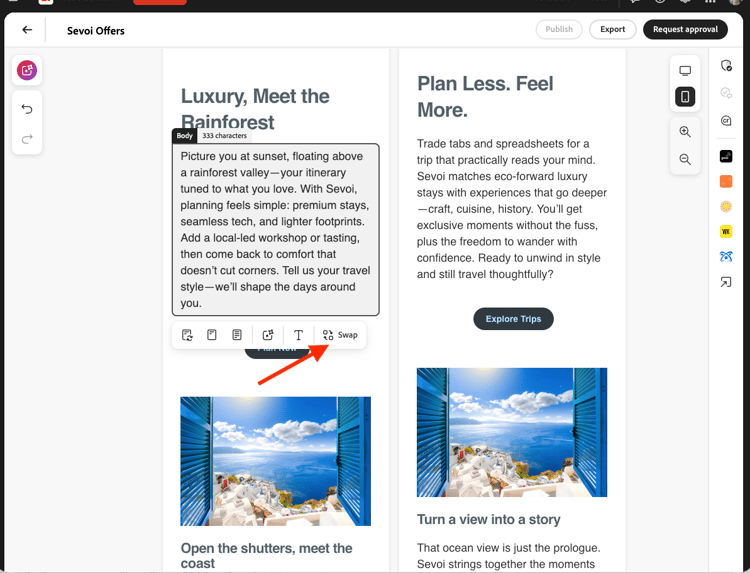
When your organization enables content fragment swap, you can expect:
- Content fragment fields can be populated from a connected content library instead of only manual typing or AI generation alone.
- Browse, search, and filter fragments using metadata such as campaign, persona, channel, language, and brand.
- A repository picker is available when multiple repositories are configured.
- Preview of a fragment before it replaces field text.
- Propagation of a fragment selection across all variants in one action.
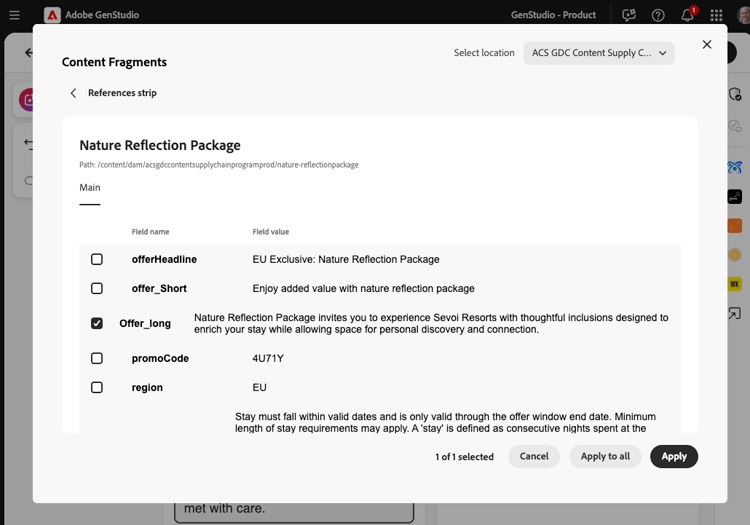
Your organization chooses which content fragment sources and repositories are available. See Find content fragment extension for how administrators configure sources and how authors swap copy from the Canvas with Swap.
You can also translate an approved email experience into multiple languages on the HTML canvas. See Translate and localize experiences.