The Trade Desk - CRM connection
- If you source data in the EU, use the The Trade Desk - CRM (EU) destination.
- If you source data in the APAC or NAMER regions, use the The Trade Desk - CRM (NAMER & APAC) destination.
Overview overview
Understand how you can activate profiles to your Trade Desk account for audience targeting and suppression based on CRM data.
This connector sends data to The Trade Desk for First-Party Data activation. The Trade Desk store your raw (unhashed) emails and phone numbers.
Prerequisites prerequisites
ID Matching Requirements id-matching-requirements
Depending on the type of IDs that you ingest into Adobe Experience Platform, you must adhere to their corresponding requirements. Read the Identity Namespace overview for more information.
Supported identities supported-identities
The Trade Desk supports the activation of identities described in the table below. Learn more about identities.
Both unhashed and hashed emails addresses and phone numbers are supported by Adobe Experience Platform. Follow the instructions in the ID matching requirements section and use the appropriate namespaces for plain text and hashed email addresses, respectively.
Supported audiences supported-audiences
This section describes which types of audiences you can export to this destination.
This category includes all audience origins outside of audiences generated through the Segmentation Service. Read about the various audience origins. Some examples include:
- custom upload audiences imported into Experience Platform from CSV files,
- look-alike audiences,
- federated audiences,
- audiences generated in other Experience Platform apps such as Adobe Journey Optimizer,
- and more.
Supported audiences by audience data type:
Email hashing requirements email-hashing
You can hash email addresses before ingesting them into Adobe Experience Platform or use raw email addresses.
To learn about ingesting email addresses in Experience Platform, read the batch ingestion overview.
If you select to hash the email addresses yourself, make sure to comply with the following requirements:
-
Remove leading and trailing spaces.
-
Convert all ASCII characters to lowercase.
-
In
gmail.comemail addresses, remove the following characters from the username part of the email address:- The period (
.) character (ASCII code 46). For example, normalizejane.doe@gmail.comtojanedoe@gmail.com. - The plus sign (
+) character (ASCII code 43) and all subsequent characters. For example, normalizejanedoe+home@gmail.comtojanedoe@gmail.com.
- The period (
Phone number normalization and hashing requirements phone-hashing
Here’s what you need to know about uploading phone numbers:
- You must normalize phone numbers before sending them in a request, regardless of whether you send them hashed or unhashed in a request.
- To upload normalized, hashed, and encoded data, you must send phone numbers as Base64-encoded SHA-256 hashes of the normalized phone numbers.
Whether you want to upload raw or hashed phone numbers, you must normalize them.
Here’s what you need to know about phone number normalization requirements:
-
The UID2 Operator accepts phone numbers in the E.164 format, which is the international telephone number format that ensures global uniqueness.
-
E.164 phone numbers can have a maximum of 15 digits.
-
Normalized E.164 phone numbers use the following syntax:
[+][country code][subscriber number including area code]with no spaces, hyphens, parentheses, or other special characters. Here are a few examples:- US: 1 (234) 567-8901 is normalized to +12345678901.
- Singapore: 65 1243 5678 is normalized to +6512345678.
- Australia: mobile phone number 0491 570 006 is normalized to add the country code and drop the leading zero: +61491570006.
- UK: mobile phone number 07812 345678 is normalized to add the country code and drop the leading zero: +447812345678.
Make sure that the normalized phone number is UTF-8, not another encoding system such as UTF-16.
A phone number hash is a Base64-encoded SHA-256 hash of a normalized phone number. The phone number is first normalized, then hashed using the SHA-256 hashing algorithm, and then the resulting bytes of the hash value are encoded using Base64 encoding. Note that the Base64 encoding is applied to the bytes of the hash value, not the hex-encoded string representation.
The following table shows an example of a simple input phone number, and the result as each step is applied to arrive at a secure, opaque value.
Export type and frequency export-type-frequency
Refer to the table below for information about the destination export type and frequency.
Connect to the destination connect
Authenticate to Destination authenticate
The Trade Desk CRM Destination is a daily batch file upload and does not require authentication by the user.
Fill in Destination Details fill-in-details
Before you can send, or activate, audience data to a destination, you must set up a connection to your own destination platform. While setting up this destination, you must provide the following information:
- Account Type: Please choose the Existing Account option.
- Name: A name by which you will recognize this destination in the future.
- Description: A description that will help you identify this destination in the future.
- Advertiser ID: your Trade Desk Advertiser ID, which can either be shared by your Trade Desk Account Manager or be found under Advertiser Preferences in the Trade Desk UI.
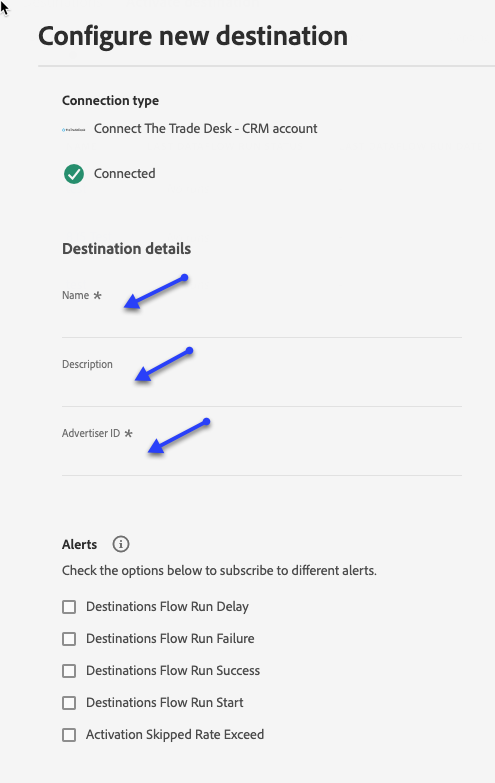
When connecting to the destination, setting a data governance policy is completely optional. Please review the Experience Platform data governance overview for more details.
Activate audiences to this destination activate
- To activate data, you need the View Destinations, Activate Destinations, View Profiles, and View Segments access control permissions. Read the access control overview or contact your product administrator to obtain the required permissions.
- To export identities, you need the View Identity Graph access control permission.
Read activate audience data to batch profile export destinations for instructions on activating audiences to a destination.
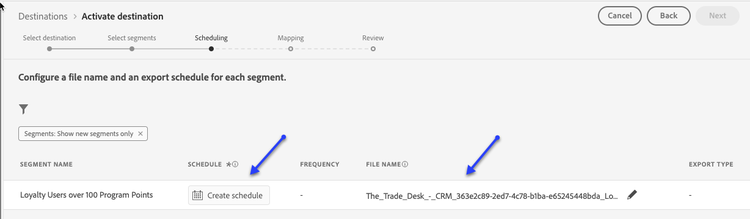
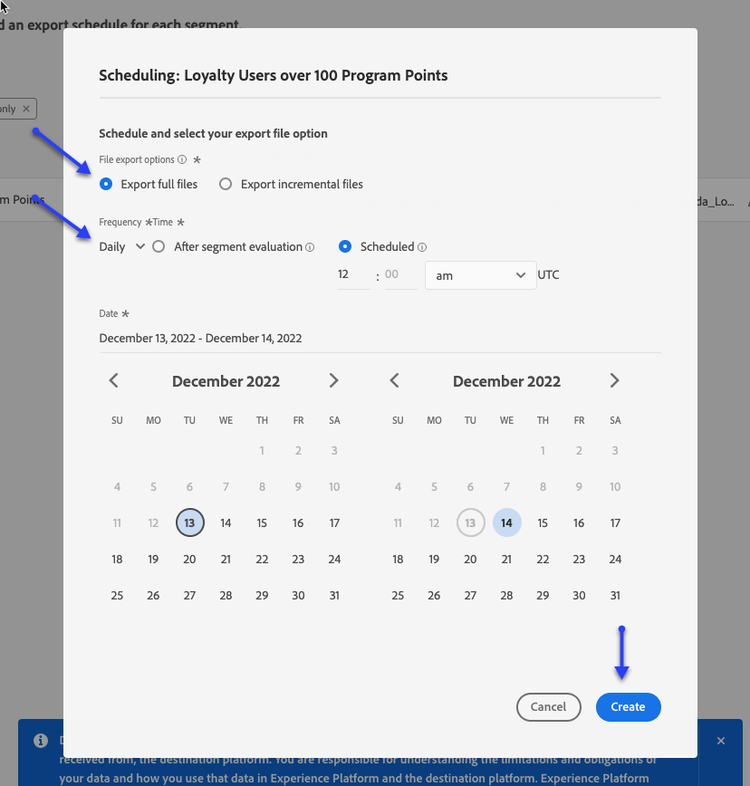
In the Scheduling page, you can configure the schedule and the file names for each audience you are exporting. Configuring the schedule is mandatory, but configuring the file name is optional.
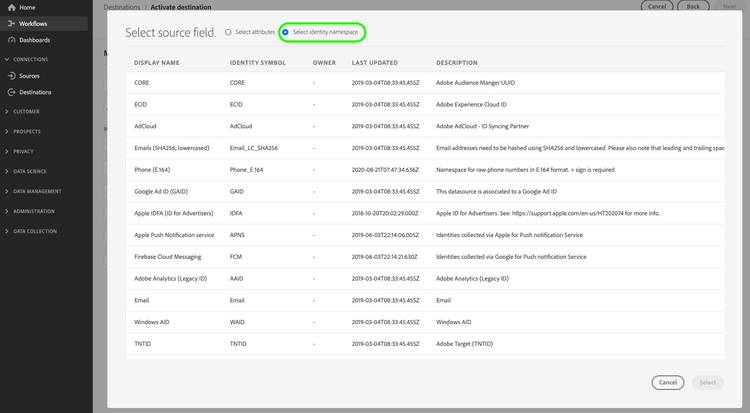
In the Mapping page, you must select attributes or identity namespaces from the source column and map to the target column.
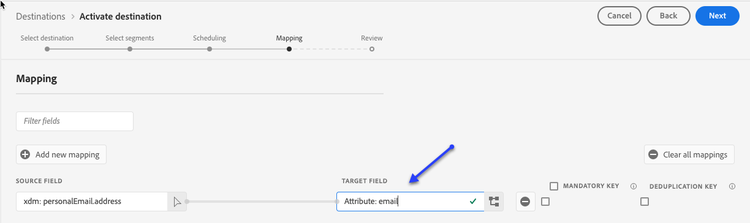
Below is an example of correct identity mapping when activating audiences to The Trade Desk CRM destination.
Selecting source and target fields:
Validate Data Export validate
To validate that data is correctly exported out of Experience Platform and into The Trade Desk, please find the audiences under the Adobe 1PD tab within The Trade Desk “Advertiser Data and identity” library. Here are the steps to finding the corresponding ID within the Trade Desk UI:
- First, select the Libraries tab, and review the Advertiser data and identity section.
- Select the Adobe 1PD, and it will list out all audiences activated to The Trade Desk.
- The Segment Name or Segment ID from Experience Platform will appear as the Segment Name in the Trade Desk UI.
Data usage and governance data-usage-governance
All Adobe Experience Platform destinations are compliant with data usage policies when handling your data. For detailed information on how Adobe Experience Platform enforces data governance, see the Data Governance overview.