Search and analyze AEM content with natural language
Use the Content AI MCP Server (a companion to the AEM MCP Server) from Adobe CX Coworker to search and analyze Content AI sources in natural language, without writing low-level API code or navigating the UI.
In this tutorial you discover available sources, run keyword, semantic, and hybrid searches, and use natural language search to express complex intent, all from Adobe CX Coworker against a Content AI source.
Tools and access
The Content AI MCP Server provides six tools:
list_indexesget_index_configfulltext_searchsemantic_searchhybrid_searchnatural_language_searchThe Content AI MCP Server is public-source-only: the X-Api-Key header grants source access. An API key is required; a request without it is rejected.
Add the Content AI MCP Server
Connect Adobe CX Coworker to the Content AI MCP Server and run the scenario below.
Let’s set up the Content AI MCP Server in Adobe CX Coworker with these steps.
-
Sign in to Adobe CX Coworker.

-
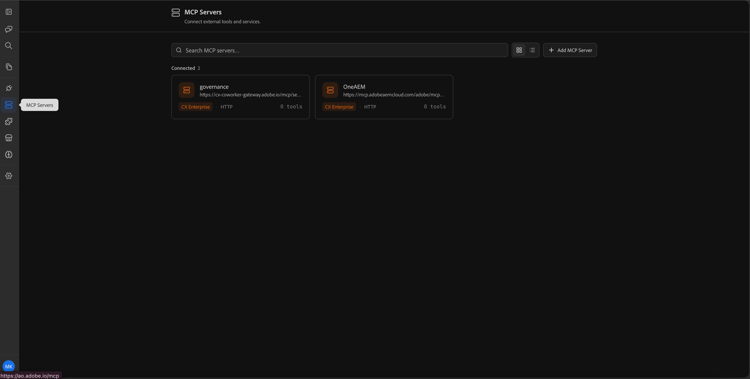
From the side rail, click MCP Servers.
-
Click Add MCP Server.

-
In the Add MCP Server dialog, enter the following details:
table 0-row-2 1-row-2 2-row-2 3-row-2 4-row-2 Field Value Server name content-ai-mcpMCP URL https://mcp.adobeaemcloud.com/adobe/experimental/aemagents-expires-20260331/mcp/content-aiConnection type HTTPAuthentication type Passthrough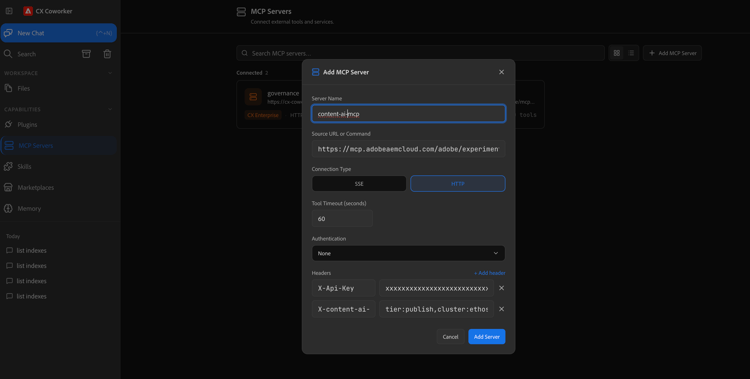
note NOTE Authentication type is set to Passthroughso CX Coworker forwards your signed-in Adobe identity to the MCP Server. This identity is not used for Content AI source access (see Tools and access), so you do not need a separate sign-in or OAuth step for search itself. -
Click Add headers and add:
table 0-row-2 1-row-2 2-row-2 Header Value X-Api-KeyYour Content AI API key. Required — searches are rejected without it. x-content-ai-mcp-routing(Optional) Environment/routing info, for example tier=publish,bucket=p12345-e67890,cluster=ethos21-prod-va7,namespace=ns-team-example.note NOTE If you do not set the x-content-ai-mcp-routingheader, the server asks for your environment (tierandbucket) in chat the first time you run a tool, then retries automatically.natural_language_searchneeds more than the other five tools: it requiresclusterandnamespacein routing, in addition totierandbucket. If either is missing, the tool returns amissing_nls_routingerror — reply with the missing value(s) and the server retries automatically. -
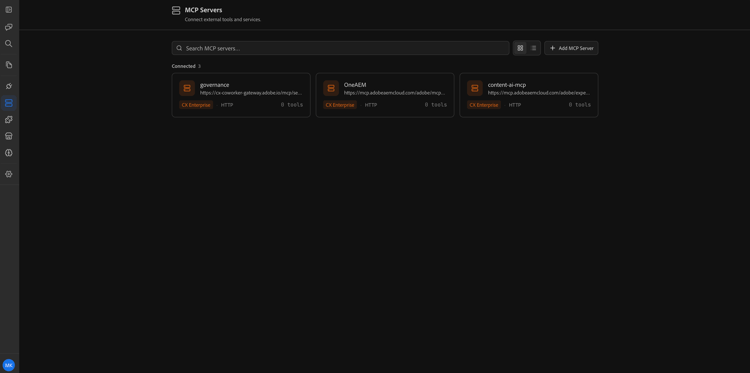
Click Add. The content-ai-mcp server now appears in your list of MCP Servers.
-
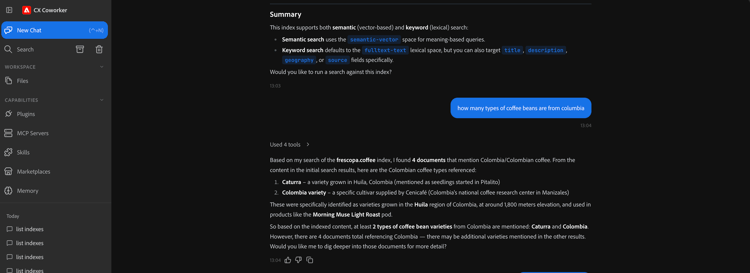
Click New chat to start using the Content AI MCP Server.
Searching public sources
Content AI sources exposed through this server are public: read-only, and intended for openly available, non-sensitive content. Anyone with a valid API key can search them.
Use this server when:
- You want to search openly available content (for example, public documentation or a demo catalog).
- You do not need per-user, permission-scoped results.
- You want a simple setup that only requires an API key.
With the server connected as described in Add the Content AI MCP Server, discover and search sources directly from chat.
-
In CX Coworker, open a new chat and list the sources available to your API key:
code language-text List all Content AI sources available in my environment.The server returns the public sources matching your routing/environment.
Congratulations!
You set up the Content AI MCP Server in Adobe CX Coworker and used it to search Content AI sources. You discovered available sources and searched them in natural language, with keyword, semantic, hybrid, and natural language search. You also learned that this server searches public sources only via an API key, and how to reduce response size with field selection. You can use the same simple approach from CX Coworker to search and analyze Content AI sources without switching to a UI or writing low-level search API code.