[AEM Assets]{class="badge positive" title="Applies to AEM Assets)."}
Use Content Advisor to access AEM Assets in Adobe Express native-integration-adobe-express-using-content-advisor
Adobe Experience Manager (AEM) Assets integrates natively with Adobe Express, allowing you to discover, access, and use assets from AEM Assets directly within the Express interface using Content Advisor.
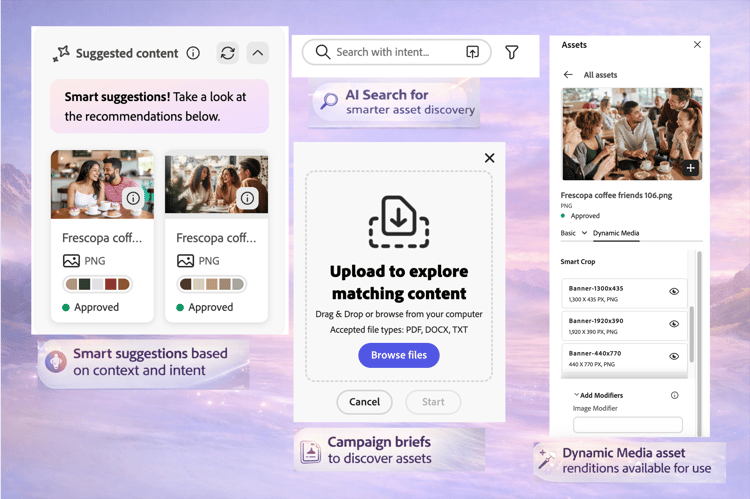
Content Advisor transforms how you discover and use assets in Adobe Express by bringing intelligent, context-aware asset discovery directly to your creative workflow. Instead of searching for assets by typing keywords, Content Advisor surfaces relevant, approved assets based on your canvas content, campaign brief, and intent, helping you find the right asset faster.
With smart suggestions, access to Dynamic Media renditions, and full visibility into asset metadata, Content Advisor enables you to efficiently locate, evaluate, and use assets from AEM Assets without leaving Adobe Express. This ensures faster content creation, improved asset reuse, and consistent use of approved, brand-compliant assets.
You can also place assets in the Express canvas and save new or edited content back to AEM Assets, ensuring centralized asset management and governance. Native integration with Adobe Express provides the following key benefits:
-
Accelerated content creation with context-aware asset discovery and recommendations.
-
Increased content reuse by editing existing assets and saving new assets to AEM Assets.
-
Faster access to approved, channel-optimized Dynamic Media renditions.
-
Reduced time and effort to create new assets or new versions while maintaining brand consistency.
Prerequisites prerequisites
Entitlements to access Adobe Express and at least one environment within AEM Assets. The environment can be any of the Assets as a Cloud Service repositories.
Use AEM Assets in Adobe Express editor use-aem-assets-in-express
Perform the following steps to start using AEM Assets in Adobe Express editor:
-
Open the Adobe Express web application.
-
Open a new blank canvas by loading a new template or a project, or by creating an asset.
-
Click Assets available in the left navigation pane. Adobe Express displays Content Advisor, which lists the repositories that you are entitled to access along with the list of assets and folders available at the root-level.
-
Browse or search for assets in your repository using Content Advisor, then drag and drop them onto the canvas. Alternatively, click on the assets to place them onto the canvas. You can also filter

note NOTE Filter by dimension does not apply to videos. 
Intelligent asset discovery with Content Advisor intelligent-asset-discovery-content-advisor
Content Advisor helps you discover relevant assets using intelligent, context-aware recommendations based on your canvas content or campaign brief. It also allows you to select channel-ready Dynamic Media renditions optimized for your use case.
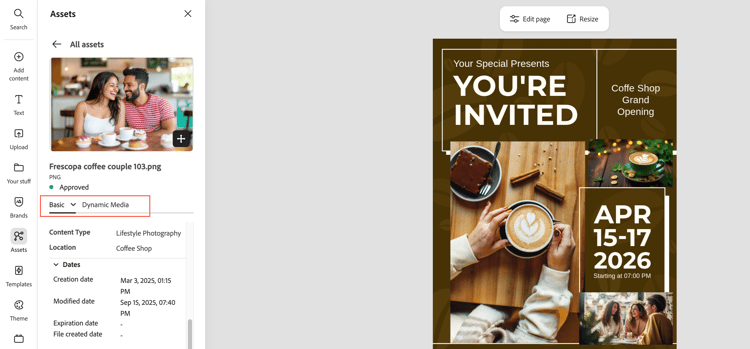
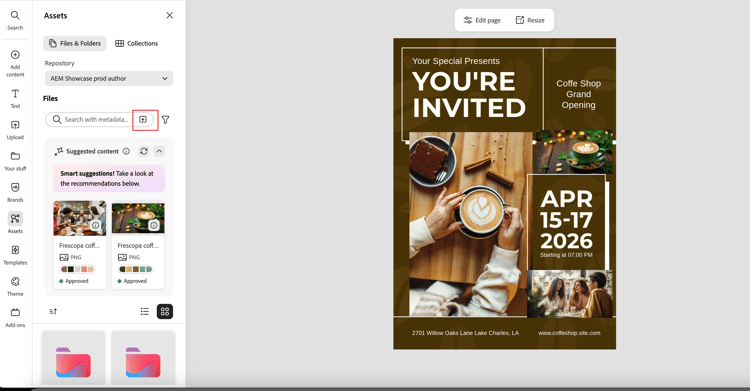
Content Advisor displays the list of files, folders, and collections in List and Grid views. It allows you to add assets in PNG, JPEG, PSD, MP4, SVG and PDF formats to the Express canvas. You can also preview the scrollable PDF files or any other format types by clicking the

Click the
Content Advisor provides the following key features:
AI Search for smarter asset discovery content-advisor-ai-search
Content Advisor uses an advanced search capability that understands the meaning and intent behind a user’s query rather than relying on exact keyword matches. It uses Artificial Intelligence (AI) and machine learning to deliver more accurate and context-aware results.
Unlike traditional keyword-based search, which looks for exact terms, AI Search interprets relationships between words, concepts, and user intent. This ensures that users find what they are looking for—even if their query is phrased differently, contains typos, or is in another language.

Some if its key benefits include:
-
Multilingual support: Search across multiple languages without requiring exact translations. Users can find relevant content regardless of their query language.
-
Handles misspellings: Interprets typos and spelling errors, ensuring accurate results even with imperfect input.
-
Understands synonyms: Delivers results for related terms and phrases, so users do not need to guess the right keyword.
-
Context-Aware search: Recognizes the intent behind a query, not just the exact words.
- Minimum required AEM release version to access AI Search within Content Advisor is
21994.
Smart suggestions based on context and intent smart-suggestions-content-advisor
Content Advisor displays smart suggestions based on the context and intent of the content in the Express canvas. This helps you quickly discover and use assets that align with your content needs without the time-consuming manual search.
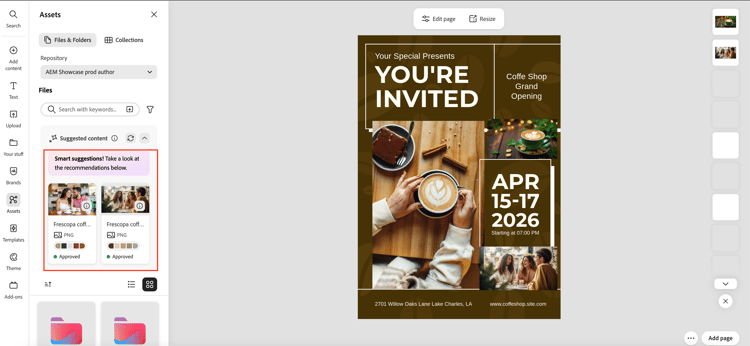
- Content Advisor displays smart suggestions based on the context and intent of the content available in the text layers or the title in the Express canvas. It does not display results based on the images available in the canvas.
- You must sign a GenAI Rider to access this feature within Content Advisor. To sign GenAI rider, contact your Adobe representative.
- Minimum required AEM release version to access this feature is
21994. - Smart suggestions do not update automatically as you update the canvas. Click the refresh icon on Suggested Content panel to view the updated list of suggestions,
Campaign briefs to discover relevant assets campaign-briefs-content-advisor
Content Advisor allows you to upload a campaign brief document to discover relevant assets without manually entering search keywords. Content Advisor analyzes the information in the campaign brief to understand the campaign’s intent and recommends relevant assets available in AEM Assets.
- Content Advisor analyzes the information available as text in the campaign brief to recommend relevant assets. It does not analyze the information available as images in the campaign brief.
- The supported file types that you can upload as a campaign brief include PDF, DOCX, and TXT documents.
- You must sign a GenAI Rider to access this feature within Content Advisor. To sign GenAI rider, contact your Adobe representative.
- Minimum required AEM release version to access this feature is
21994.
Dynamic Media asset renditions available for use dynamic-media-renditions-content-advisor
Dynamic Media renditions provide ready-to-use, channel-optimized versions of assets, including image presets, Smart Crops, format types, and color profiles. These renditions help ensure that the selected asset meets channel and design requirements without requiring manual editing or asset duplication.
You can also apply Dynamic Media modifiers to preview adjustments in real-time before placing the rendition on the Express canvas, enabling faster selection of the most appropriate rendition while maintaining asset consistency and quality.
Click the
You must have a valid AEM Dynamic Media license to view the Dynamic Media tab.
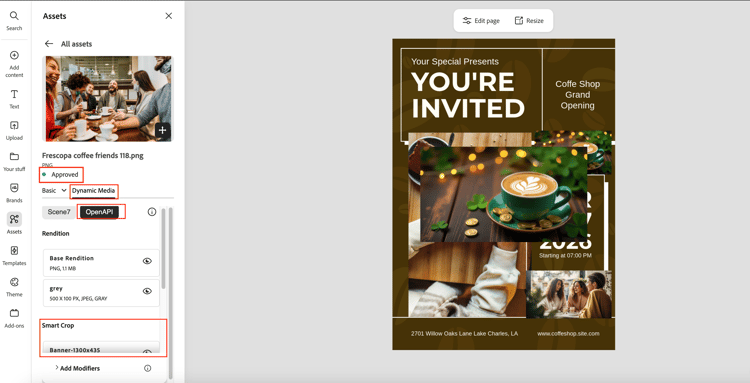
Click the

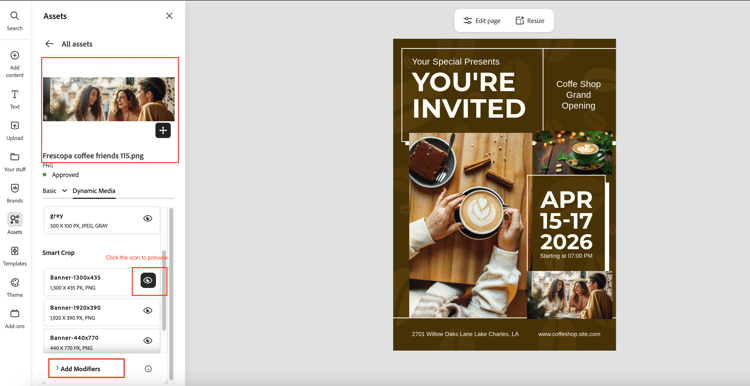
Click Add Modifiers, specify a modifier in the text box, and press Enter to apply the transformation to the renditions in real-time. Similarly, you can add multiple modifiers to a rendition and preview those transformations. Drag and drop the asset from the preview onto the canvas. The rendition after applying those modifiers is not saved. See the list of supported modifiers for Dynamic Media Scene7 and Dynamic Media with OpenAPI.
Access asset metadata consistent with Assets view asset-metadata-content-advisor
Content Advisor provides access to asset properties defined in AEM Assets, including metadata available in the Assets view. Content Advisor uses the same metadata configuration as in Assets View, replicating the list of metadata tabs and content in Assets view asset details page. This allows you to review key asset details such as title, description, format, size, and other metadata before selecting an asset. Access to asset properties helps ensure you choose the correct and approved asset for your content.
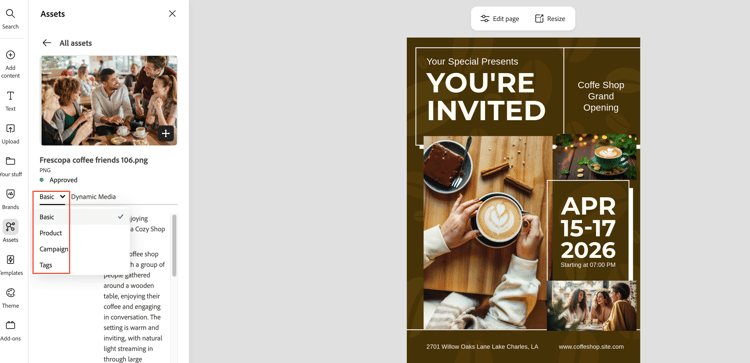
Click the
Content Advisor displays properties (metadata) for files in a read-only view. The properties are not displayed for collections and folders.
Access filters consistent with Assets view filters-content-advisor
Content Advisor provides the same filtering capabilities in Express that are available in the Assets view, enabling you to refine assets using predefined filters. Same filtering capabilities as available in Assets view also apply to the filters specific to content types, such as files, folders, and collections. This ensures a consistent asset discovery experience and helps you efficiently locate relevant assets within Adobe Express.
If you do not have filters set up in Assets view via filter schema, Content Advisor displays out-of-the-box filters including File Type, File Format, Asset Status, File Size, Image Width, Image Height, Modified Date, and Created Date.
Access and reuse recent and saved searches saved-searches-content-advisor
Saved searches created in the Assets view are also available, enabling you to reuse predefined search criteria. Saved searches works consistently between Assets view and Content Advisor across browsers. This helps you efficiently locate assets using consistent search patterns across AEM Assets and Adobe Express.
To save your frequently used search using Content Advisor:
-
Specify a search term (optional), click the filters icon, and select the options based on your requirements to create a search query.
-
Click Apply to view the results.
-
Click the filters icon > Manage saved searches > Create new Saved Search.
-
Specify the name of the search and click

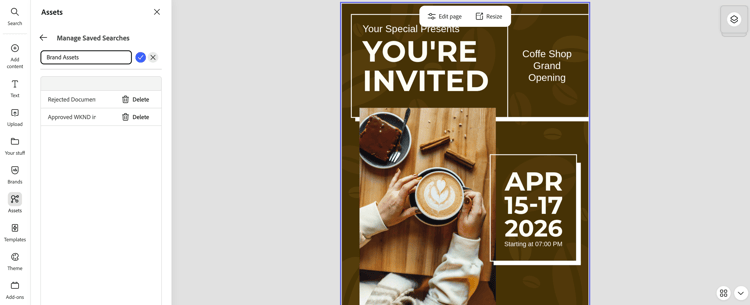
To apply any of the saved search items, click the filters icon, select the search item from the Saved Searches drop-down list and click Apply.
Content Advisor saves your recent searches and also allows you to save frequently used searches for quick access later. The list of recent searches is not consistent between Assets view and Content Advisor. The same user can have different set of recent searches in Assets view and Content Advisor. If you are using Incognito mode to access Content Advisor, the list of recent searches is not available. In addition, recent searches are not shared across different browsers for the same user and are AEM environment-specific.
The Default Saved Search feature, available in Assets view, is not available yet in Content Advisor.
Search for assets across and within collections search-collections-content-advisor
Content Advisor allows you to search for assets or collections across all collections or limit your search to a specific collection. This helps you quickly locate and use assets from curated collections while preserving their intended organizational context.
Replace image using AEM upload replace-image-using-aem-upload
Additionally, you can replace the added images using AEM Upload. To do this, execute the following steps:
-
Browse or search assets and drag & drop onto the canvas.
-
Select the image which you want to replace. Click Replace and select AEM Assets among various other options.

-
Content Advisor opens in the left navigation pane. Adobe Express displays the list of repositories that you are entitled to access along with the list of assets and folders available at the root-level. Select an asset from there to preview the replacement on the canvas, then click Replace to confirm.
note NOTE SVG file types are not supported.
Save Adobe Express projects in AEM Assets save-express-projects-in-assets
After incorporating appropriate modifications in the Express canvas, you can save it in AEM Assets.
-
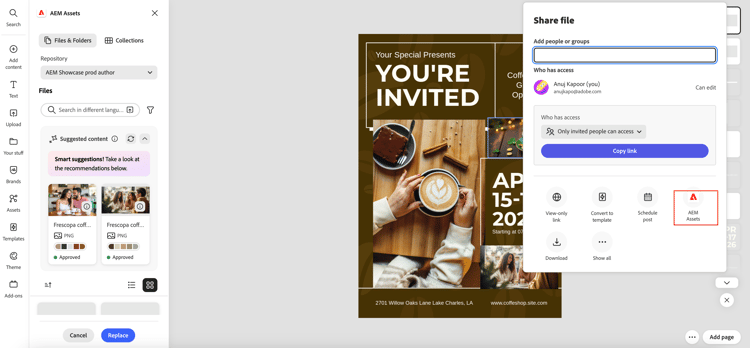
Click Share to open the Share dialog.
-
Select AEM Assets. Adobe Express displays the upload dialog.
-
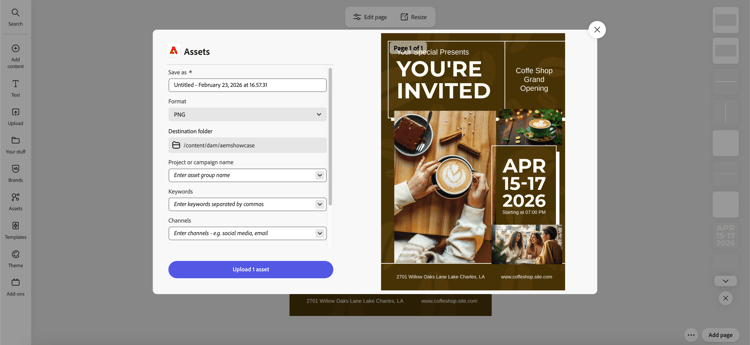
Select either Current Page or All Pages. Specify a name and format for the asset(s) to export. You can export the canvas contents in PNG, JPEG, PDF, MP4, MP4+PNG, or MP4+JPEG formats. The format adjusts automatically based on the asset(s) on the canvas page(s).
Selecting Current Page saves the asset on your current page to your destination folder. If you select All Pages and the export format is not PDF, all canvas pages are saved as separate files in a new folder within your destination folder. If the export format is PDF, all canvas pages are saved as a single PDF file in the destination folder. -
Click the folder icon under Destination Folder to select a location and save the asset(s).
-
Optional: You can add campaign metadata for your upload using the Project or campaign name field. You can use an existing name or create a new one. You can define multiple Project or Campaign names for your upload. To register the name, simply type the name and hit enter.
As a best practice, Adobe recommends specifying values in the rest of the fields as well as creating an enhanced search experience for your uploaded assets. -
Similarly, define values for the Keywords and Channels fields.
-
Click Upload to upload the asset(s) to AEM Assets.
note NOTE If you are saving asset(s) to Content Hub delivery repository, Project or campaign name is a mandatory field. You also do not need to select a destination folder in this case, as it is automatically derived from metadata.
Supported file formats supported-file-formats-import-assets
Adobe Express natively supports the formats available at Review the minimum image requirements. However, AEM Assets supports the following format types:
Limitations limitations
-
For importing and exporting, the supported video file type is MP4.
-
For MP4 video import, videos with transparent backgrounds (alpha channel) are not supported.
-
For MP4 video export, the maximum file size supported is 200 MB. If this limit exceeds, an alert suggests trimming the video to 200 MB or less, or manually uploading it to the AEM Assets destination folder after downloading it.
Frequently Asked Questions frequently-asked-questions-content-advisor
What is Content Advisor in the AEM Assets and Adobe Express integration? content-advisor-overview
Content Advisor is an intelligent, context-aware asset discovery capability built into the native AEM Assets integration within Adobe Express. It surfaces relevant, approved assets based on the content of the Express canvas, campaign brief, and creative intent — without requiring manual keyword searches. Content Advisor also provides access to Dynamic Media renditions, asset metadata, filters, saved searches, and collections, enabling designers to locate, evaluate, and use AEM Assets directly within the Adobe Express interface without switching tools.
What are the prerequisites for using AEM Assets in Adobe Express? aem-assets-express-prerequisites
Using AEM Assets in Adobe Express requires entitlements to access Adobe Express and at least one AEM Assets environment. The environment can be any Adobe Experience Manager Assets as a Cloud Service repository. No additional connector or plugin installation is required — the integration is native to Adobe Express.
How do I start using AEM Assets in the Adobe Express editor? access-aem-assets-in-express
To start using AEM Assets in Adobe Express, open the Adobe Express web application and open a new blank canvas, template, or project. Click Assets in the left navigation pane to open Content Advisor, which displays the repositories available along with assets and folders at the root level. Browse or search for assets, then drag and drop them onto the canvas or click an asset to place it automatically. Assets can also be filtered by approval status, file type, MIME type, and dimensions. Note that filter by dimension does not apply to video assets.
Which repository type must I select in Content Advisor to access all features? content-advisor-repository-selection
An author repository must be selected from the Repository drop-down in Content Advisor to access all Content Advisor features including AI Search, Smart Suggestions, campaign briefs, and Dynamic Media renditions. A delivery repository does not display any Content Advisor features. Assets in a delivery repository are displayed at the root level only in a flat structure — they are not organized in folders or collections.
What file formats can be added to the Adobe Express canvas using Content Advisor? content-advisor-supported-formats
Content Advisor supports adding assets in PNG, JPEG, PSD, MP4, SVG, and PDF formats to the Adobe Express canvas. PDF files can be previewed as scrollable documents by clicking the Info icon on the asset card before placing them on the canvas. Asset metadata and Dynamic Media renditions are also accessible via the Info icon for each asset in both List and Grid views.
How does AI Search work in Content Advisor? content-advisor-ai-search-faq
AI Search in Content Advisor uses artificial intelligence and machine learning to interpret the meaning and intent behind a search query rather than matching exact keywords. It supports multilingual queries, handles misspellings and typos, understands synonyms and related terms, and delivers context-aware results based on user intent — enabling users to find relevant assets even when queries are phrased differently or entered in a different language. The minimum required AEM release version to access AI Search within Content Advisor is 21994.
What are Smart Suggestions in Content Advisor and what content do they analyze? content-advisor-smart-suggestions-overview
Smart Suggestions in Content Advisor automatically surface relevant assets based on the context and intent of text layers or the title present in the Adobe Express canvas. Smart Suggestions analyze text content on the canvas only — they do not analyze images available in the canvas. Smart Suggestions do not update automatically as the canvas changes; click the refresh icon on the Suggested Content panel to view an updated list of suggestions. The minimum required AEM release version to access Smart Suggestions is 21994.
Do Smart Suggestions in Content Advisor require any additional agreement to access? content-advisor-smart-suggestions-genai-rider
Accessing Smart Suggestions in Content Advisor requires signing a GenAI Rider. Contact your Adobe representative to sign the GenAI Rider and enable Smart Suggestions for your organization. Once the GenAI Rider is signed, Smart Suggestions become available within Content Advisor in Adobe Express for all users in the organization who meet the minimum AEM release version requirement of 21994.
How do I use a campaign brief to discover assets in Content Advisor? content-advisor-campaign-briefs
Content Advisor supports uploading a campaign brief document to discover relevant assets without manually entering search keywords. Upload a campaign brief in PDF, DOCX, or TXT format and Content Advisor analyzes the text content to understand the campaign’s intent and recommends relevant assets from AEM Assets. Campaign briefs are analyzed based on text content only — images within the brief document are not analyzed. Accessing campaign briefs requires signing a GenAI Rider — contact your Adobe representative to enable this. The minimum required AEM release version is 21994.
How do I access Dynamic Media renditions for an asset in Content Advisor? content-advisor-dynamic-media-renditions
To access Dynamic Media renditions in Content Advisor, click the Info icon on an asset card and select the Dynamic Media tab. Available renditions include image presets, Smart Crops, format types, and color profiles optimized for specific channels. Select either Dynamic Media Scene7 or Dynamic Media with OpenAPI renditions. For OpenAPI renditions, available renditions display only when the asset is approved and available in Dynamic Media with OpenAPI. A valid AEM Dynamic Media license is required to view the Dynamic Media tab.
Can I preview and apply modifiers to Dynamic Media renditions before placing them on the canvas? content-advisor-dynamic-media-modifiers
Dynamic Media renditions in Content Advisor can be previewed and modified before being placed on the Adobe Express canvas. Click the preview icon on a rendition to preview it, or click the rendition name to place it directly on the canvas. Click Add Modifiers, specify a modifier in the text box, and press Enter to apply real-time transformations. Multiple modifiers can be applied and previewed simultaneously. Drag and drop the previewed rendition onto the canvas to place it — modifiers applied during preview are not saved to the asset in AEM Assets.
How does Dynamic Media help with the file size limit in Adobe Express? content-advisor-dynamic-media-file-size
Dynamic Media in Content Advisor overcomes the 80 MB upload file size limit in Adobe Express by delivering optimized renditions of large assets directly from AEM Assets. A 300 MB TIFF asset, for example, can be delivered as a 2.5 MB rendition without compromising visual quality. This enables efficient use of high-resolution assets in Adobe Express without requiring manual file size reduction or duplication before importing.
How do saved searches work in Content Advisor and are they shared with Assets view? content-advisor-saved-searches
Saved searches created in the Assets view are available in Content Advisor and work consistently across browsers, enabling reuse of predefined search criteria in both interfaces. To save a search in Content Advisor, apply the desired filters, click the filters icon, select Manage Saved Searches, click Create New Saved Search, and specify a name. Recent searches, however, are not consistent between Assets view and Content Advisor — the same user may have different recent searches in each interface. Recent searches are not shared across different browsers, are not available in Incognito mode, and are AEM environment-specific. The Default Saved Search feature available in Assets view is not available in Content Advisor.
Can I search for assets within a specific collection using Content Advisor? content-advisor-collection-search
Content Advisor supports searching for assets across all collections or limiting search to a specific collection. This enables quick access to assets from curated collections while preserving their intended organizational context. The same filtering capabilities available in Assets view apply to searches within collections in Content Advisor, ensuring a consistent asset discovery experience across AEM Assets and Adobe Express.
How do I replace an image on the Express canvas with an asset from AEM Assets? replace-image-aem-assets-express
To replace an image on the Adobe Express canvas with an asset from AEM Assets, select the image on the canvas, click Replace, and select AEM Assets from the available options. Content Advisor opens in the left navigation pane displaying the available repositories and assets. Select the replacement asset to preview it on the canvas, then click Replace to confirm. SVG file types are not supported for image replacement using this workflow.
How do I save an Adobe Express project back to the AEM Assets repository? save-express-project-aem-assets
To save an Adobe Express project to AEM Assets, click Share on the Express canvas to open the Share dialog, then select AEM Assets. In the upload dialog, select either Current Page or All Pages, specify a name and export format, and click the folder icon under Destination Folder to select a save location. Supported export formats include PNG, JPEG, PDF, MP4, MP4+PNG, and MP4+JPEG. Optionally add campaign metadata using the Project or Campaign Name, Keywords, and Channels fields before clicking Upload. If saving to a Content Hub delivery repository, the Project or Campaign Name field is mandatory and the destination folder is automatically derived from metadata.
What are the file size and dimension limits for assets imported into Adobe Express from AEM Assets? aem-assets-express-file-size-limits
Adobe Express via AEM Assets supports the following file size and dimension limits: JPEG and PNG assets support up to 65 megapixels — for example 8K × 8K or 16K × 4K — with a maximum file size of 80 MB on desktop and 40 MB on mobile. SVG files support a maximum file size of 250 KB. MP4 videos support up to 3840 × 3840 pixels with a maximum file size of 200 MB. PSD files support up to 65 megapixels with a maximum file size of 80 MB on desktop and 40 MB on mobile. PDF files have no defined maximum dimension or file size limit.
What are the video limitations in the AEM Assets and Adobe Express integration? aem-assets-express-video-limitations
The AEM Assets and Adobe Express integration supports MP4 as the only video file type for both import and export. For MP4 video import, videos with transparent backgrounds (alpha channel) are not supported. For MP4 video export, the maximum supported file size is 200 MB. If the export file size exceeds 200 MB, an alert recommends trimming the video to 200 MB or less, or manually uploading the video to the AEM Assets destination folder after downloading it locally.
See also
- Translate Assets
- Assets HTTP API
- Assets supported file formats
- Search assets
- Connected assets
- Asset reports
- Metadata schemas
- Download assets
- Manage metadata
- Manage Dynamic Media templates
- Manage reports in Assets view
- Search facets
- Manage collections
- Bulk metadata import
- Publish Assets to AEM and Dynamic Media