Get started with Coworker Chat ui-guide
Coworker Chat lets you work with your Adobe CX Enterprise data and tools by asking for what you need in plain language. Use this page to open Coworker Chat, send your first message, and set it up the way you work.
Availability
Coworker Chat is available as an immersive experience, a full-page workspace, and as an in-product experience in some CX Enterprise applications.
The following table shows where each experience is available.
* Early September 2026 in Preview instance for select eligible Workfront system administrators
* Mid September 2026 in Production instance for eligible fast release Workfront customers
* Mid October 2026 in Production instance for eligible quarterly release Workfront customers
Open Coworker Chat immersive
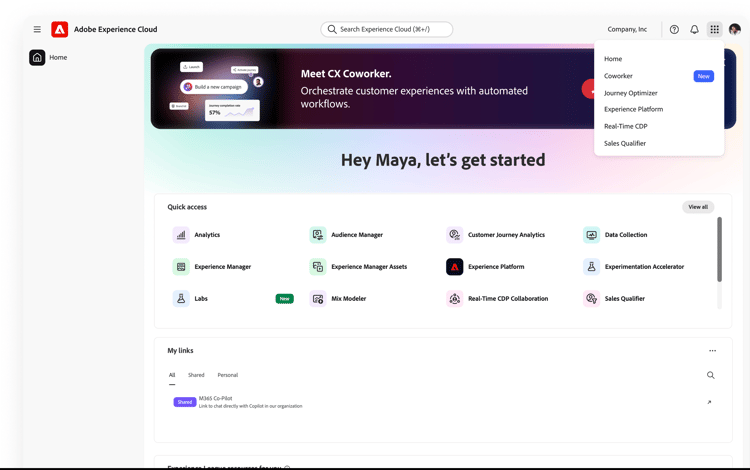
To use the immersive experience, sign in with your Adobe credentials. You can open it from a direct link or from within CX Enterprise.
- Go to https://experience.adobe.com/#/coworker.
- Sign in with your Adobe ID.
- In CX Enterprise, click the application selector menu

- To open Chat (the in-product experience), click Chats

Video - Basics of the Coworker Chat interface
Choose your organization
Your organization and sandbox determine which data, skills, and connected tools a conversation can reach. Check them before you start. Your current context appears at the bottom of the left navigation rail, under your name.
To change your context:
-
Click your name at the bottom of the navigation rail to open the account menu.
-
Click Organization and choose the IMS organization you want to work in.

-
Clidk Sandbox and choose the AEP sandbox you want to work in.

The account menu also includes the following options:
Find your way around
The workspace has two areas: the navigation rail on the left and the conversation canvas that fills the rest of the window.

Use the navigation rail to move between the parts of the product and return to recent work.
Send your first message
The Home screen shows a greeting, the input (Chat) box, and suggested prompts based on what Coworker Chat can do in your sandbox. You can start with a suggestion or write your own message.
To send a message:
-
Click Home in the navigation rail.
-
Do one of the following:
- Select a prompt under Suggested for you. Coworker Chat adds it to the input box, where you can edit it.
- Enter your own request in the Ask Coworker anything box.
-
(Optional) Add context, choose how Coworker Chat responds, or dictate your message. See Add context and choose a response style.
-
Click Send.
To point Coworker Chat at a specific object in your sandbox, type + in the input box and Click a schema, journey, dataset, or other object. This is called an entity mention. It tells Coworker Chat exactly which object you mean.
Add context and choose a response style input-options
The toolbar below the input box controls what you attach, how Coworker Chat approaches the task, and how much of its work you see.
Attach a file or object
Attach a file or object when Coworker Chat needs more information to do the work.
-
Click + in the input box.
-
Click one of the following:
- Attach file: Upload a file for Coworker Chat to read and reference.
- Add data or object: Reference an object in your sandbox, such as a dataset or schema, so Coworker Chat works against your live data.

Review a plan before Coworker Chat acts plan-mode
Use Plan mode for complex tasks or tasks that change data. When Plan mode is on, Coworker Chat proposes a plan and waits for your approval before it carries it out. When Plan mode is off, Coworker Chat starts the work right away.
- Click Plan mode in the input toolbar to turn it on.
- Send your message.
- Review the plan and approve it to continue.

Choose a transcript view
The transcript view controls how much of Coworker Chat’s reasoning and tool activity appears in the conversation.
-
Click Transcript view in the input toolbar.
-
Click a view:
table 0-row-2 1-row-2 2-row-2 3-row-2 View What you see Normal A summary of key thinking steps and tool activity. Focus Mostly the answer. Coworker Chat hides most intermediate steps. Verbose Every thinking step, skill load, file read, and query.

Review a response
Coworker Chat shows its work as it goes, then returns an answer. A response can include its reasoning, a record of the tools it used, artifacts, and a summary.

Follow the activity
While Coworker Chat works, you can follow and verify what it does. Expand any entry to see more detail.
- Thought for: A collapsible block with Coworker Chat’s reasoning and how long it took.
- Loaded skill: The specialized capability Coworker Chat used for the task.
- Read file and Ran 1 query: The files Coworker Chat read and the queries it ran, with the time each took.
Work with artifacts
Coworker Chat shows results, such as a table of audiences, as artifact cards in the response. You can download a table artifact as a CSV file from its card. When a response includes more than one artifact, use Previous and Next to move between them.
Use the summary
Below the artifacts, Coworker Chat explains what the results mean, highlights notable findings, and suggests follow-up actions. Use these suggestions to continue the conversation.

Rate and copy a response
Each response includes controls that you can use to give feedback or reuse the content.
- Click Thumbs up or Thumbs down to rate the response. Your rating helps improve future answers.
- Click Copy, then choose Copy as Markdown to keep formatting or Copy as Plain Text to remove it.

Manage your chats
Your chat history keeps past conversations so you can return to them. Click Chats in the navigation rail to open it. Conversations are grouped by date, and each row shows the title and the number of turns.

On the Chats page, you can:
- Enter a name in Search by title to find a conversation.
- Click Show pinned to see only the conversations you starred.
- Click Show archived to see archived conversations.
- Click New chat to start a conversation.
To pin, rename, archive, or delete a conversation, click the row menu (…) on its row and choose an option.
Customize Coworker Chat
Configurations is where you control what Coworker Chat can do. Click Configurations in the navigation rail, then choose a tab: Skills, MCP servers, Marketplaces, Plugins, or Memory.
Add and view skills
Skills are specialized capabilities that Coworker Chat uses automatically when they apply. You can also start a skill yourself by typing / in the chat. The Skills tab lists every installed skill.

-
On the Skills tab, click Add Source to install skills from a new source.
-
Enter a name in Search to find a skill. Use the view toggle to switch between grid and list layouts.
-
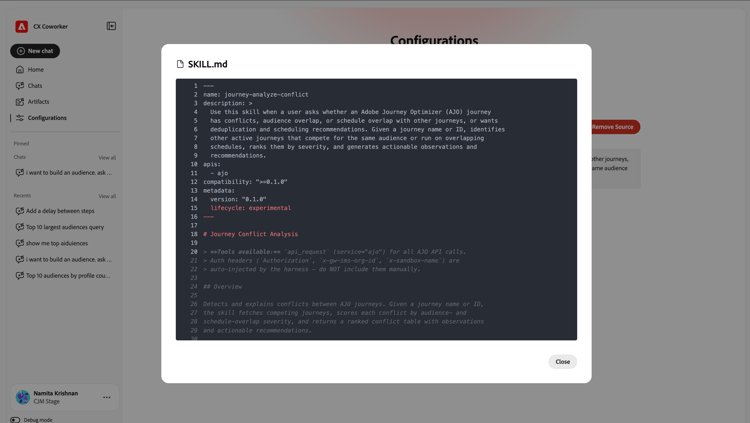
Select a skill to see the plugin it belongs to, when Coworker Chat uses it, and the files it includes.

-
(Optional) Click View SKILL.md to read the full skill definition, or click Remove Source to uninstall the skill.
Connect MCP servers
Model Context Protocol (MCP) servers connect Coworker Chat to external tools and services, such as Adobe Journey Optimizer, Real-Time CDP, Target, and Workfront. The MCP servers tab lists your connected servers and the number of active connections. Each card shows the server name, its endpoint, and tags that describe what it provides.
To connect a server, click Add server and follow the prompts.

Add a marketplace
A marketplace is a registry of plugins that you can browse and install from. On the Marketplaces tab, click Add Marketplace to register a new one. Use Search or filter by group to narrow the list. A marketplace with a Ready status is available to install from.

Manage plugins
A plugin bundles skills and MCP servers so that you can install and manage them together. The Plugins tab shows your installed plugins.
- Click Browse Marketplaces to find new plugins.
- Filter by marketplace to see where each plugin came from.
- Click Uninstall to remove a plugin and everything it bundles.

Manage memory
Memory lets Coworker Chat remember your preferences across conversations, so responses stay relevant over time. Use the Memory tab to control what it keeps.
- Click Memory on the Configurations page.
- Turn on Enable memory. Turn it off to stop Coworker Chat from remembering across sessions.
- Under Stored preferences, review what Coworker Chat saved. You can edit, delete, or inspect each entry, and filter entries by category.
- Use Saved memories history to see a timeline of changes to your memories.
