Auf dieser Seite: Erfahren Sie, wie Sie mit der Zielgruppenbestimmungsaktivität „Zielgruppe speichern“ eine wiederverwendbare Zielgruppe aus der zuvor in einer orchestrierten Kampagne erstellten Population erstellen oder überschreiben.
Die Aktivität Zielgruppe speichern ist eine Targeting-Aktivität, mit der basierend auf der zuvor in der orchestrierten Kampagne generierten Population eine neue Zielgruppe erstellt oder eine vorhandene aktualisiert wird. Nach dem Speichern wird die Zielgruppe zur Liste der Anwendungszielgruppen hinzugefügt und kann über das Menü Zielgruppen aufgerufen werden.
Sie dient häufig dazu, Zielgruppensegmente zu erfassen, die innerhalb desselben Kampagnen-Workflows erstellt wurden, sodass sie zur Wiederverwendung in zukünftigen Kampagnen verfügbar sind. Normalerweise ist dies mit anderen Targeting-Aktivitäten verbunden, z. B. Zielgruppe erstellen oder Kombinieren, um die endgültige Zielpopulation zu speichern.
Beachten Sie, dass Sie eine vorhandene Zielgruppe nicht mit der Aktivität Zielgruppe speichern aktualisieren können. Sie können lediglich eine neue Zielgruppe erstellen oder eine vorhandene mit einer neuen Definition überschreiben.
Konfigurieren der Aktivität „Zielgruppe speichern“ save-audience-configuration
Führen Sie die folgenden Schritte aus, um die Aktivität Zielgruppe speichern zu konfigurieren:
-
Fügen Sie Ihrer orchestrierten Kampagne eine Aktivität des Typs Zielgruppe speichern hinzu.
-
Geben Sie ein Zielgruppen-Label ein, das die gespeicherte Zielgruppe identifiziert.
note NOTE Das Zielgruppen-Label muss in allen Kampagnen eindeutig sein. Sie können keinen Zielgruppennamen wiederverwenden, der bereits in der Aktivität Zielgruppe speichern einer anderen Kampagne genutzt wird. -
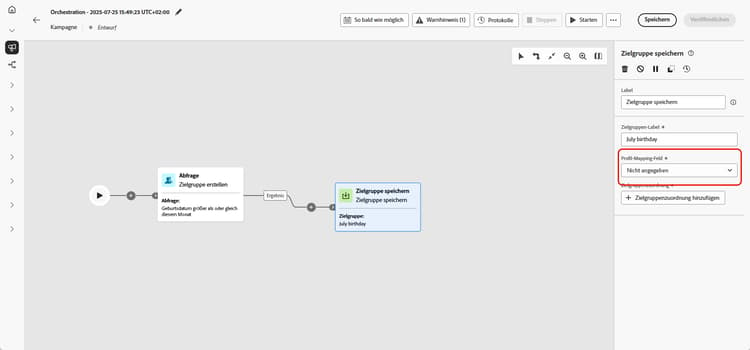
Wählen Sie ein Profil-Mapping-Feld aus der Zielgruppendimension Ihrer Kampagne aus. Diese Zuordnung definiert, wie Profile in der gespeicherten Zielgruppe bei der Ausführung mit der Zieldimension der Kampagne verknüpft werden.
Um eine ordnungsgemäße Abstimmung zwischen der Zielgruppe und dem Kampagnenkontext sicherzustellen, sind in der Dropdown-Liste nur Zuordnungen verfügbar, die mit der aktuellen Zieldimension kompatibel sind, d. h. mit der der eingehenden Transition.
-
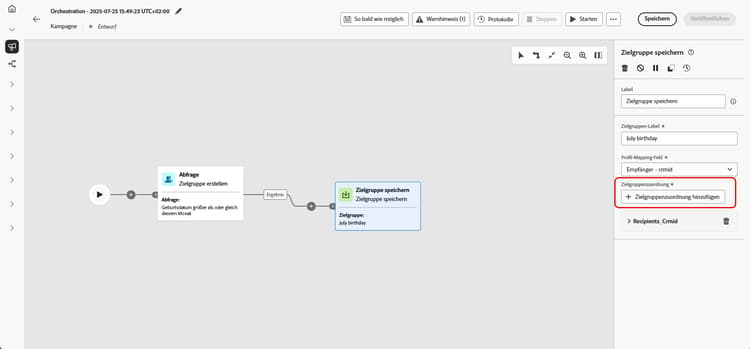
Klicken Sie auf Zielgruppenzuordnungen hinzufügen, um zusätzliche Daten aus Attributen der Zieldimension oder aus angereicherten Profilattributen einzuschließen.
So können Sie der Aktivität Gespeicherte Zielgruppe über die primäre Profilzuordnung hinaus weitere Informationen zuordnen, wodurch die Targeting- und Personalisierungsoptionen verbessert werden.
-
Schließen Sie die Einrichtung ab, indem Sie die orchestrierte Kampagne speichern und veröffentlichen. Dadurch wird Ihre Zielgruppe generiert und gespeichert.
-
Veröffentlichen Sie die Kampagne für die Zielgruppe, die erstellt oder ersetzt werden soll, da die Aktivität Zielgruppe speichern nicht ausgeführt wird, während sich die Kampagne im Entwurfsmodus befindet.
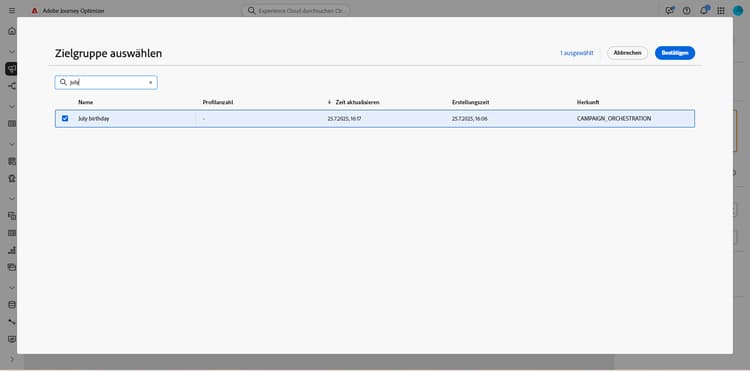
Der Inhalt der gespeicherten Zielgruppe ist dann in der Detailansicht der Zielgruppe verfügbar. Diese kann über das Menü Zielgruppen aufgerufen oder bei der Zielgruppenbestimmung ausgewählt werden, z. B. mit der Aktivität Zielgruppe lesen.
Beispiel save-audience-example
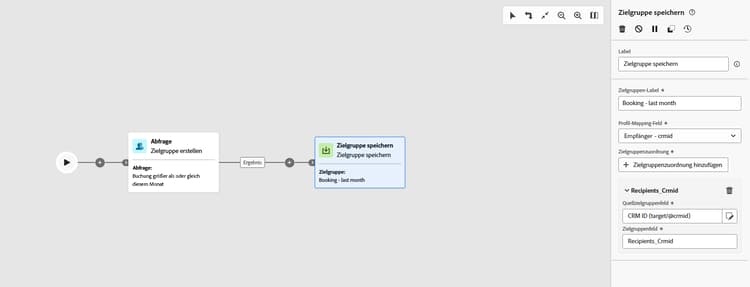
Im folgenden Beispiel wird veranschaulicht, wie eine einfache Zielgruppe mithilfe von Targeting erstellt wird. Eine Abfrage identifiziert alle Empfängerinnen und Empfänger, die in den letzten 30 Tagen eine Reise gebucht haben, indem sie diese Population in Ihrer orchestrierten Kampagne filtert. Wenn Sie Empfänger – CRMID als Zielgruppendimension auswählen, richtet sich die Zielgruppe an jedes einzelne Buchungsereignis und nicht nur an die Empfängerin bzw. den Empfänger als Ganzes. Die Aktivität Zielgruppe speichern erfasst dann diese Profile, um eine wiederverwendbare Zielgruppe aus kürzlichen Käuferinnen und Käufern zu erstellen.
This section contains structured knowledge intended to support interpretation, retrieval, and question answering related to this topic.
For complete understanding, this information should be combined with the documentation on this page. Neither source is intended to stand alone; the page describes the feature, while this section provides additional context that helps disambiguate terminology, intent, applicability, and constraints.
- TL;DR: This page explains how to configure the Save audience activity in an Orchestrated campaign to create a new audience or overwrite an existing one from the population built earlier in the workflow.
Intents:
- Configure the Save audience activity to create or overwrite an audience.
- Enter an audience label that identifies the saved audience.
- Choose a profile mapping field from the Campaign Targeting dimension to link profiles to the saved audience.
- Add audience mappings to associate additional target dimension attributes or enriched profile attributes.
- Access the resulting saved audience from the Audiences menu or select it in a Read audience activity.
Glossary:
- Save audience activity: a Targeting activity that creates a new audience or overwrites an existing one with a new definition, based on the population generated earlier in the Orchestrated campaign (product-specific)
- Audience label: the identifier entered to name the saved audience (product-specific)
- Profile mapping field: the field, chosen from the Campaign Targeting dimension, that defines how profiles in the saved audience are linked to the campaign’s target dimension during execution (product-specific)
- Audience mappings: additional data added from attributes of the Target dimension or enriched Profile attributes, beyond the primary profile mapping (product-specific)
Guardrails:
- The Save audience activity cannot update an existing audience; it can only create a new audience or overwrite an existing one with a new definition.
- The audience label must be unique across all campaigns; an audience name already used in another campaign’s Save audience activity cannot be reused.
- Only profile mappings compatible with the current target dimension (the one from the incoming transition) are available in the profile mapping field dropdown, to ensure proper reconciliation between the audience and the campaign context.
- The Save audience activity does not execute while the campaign is in Draft mode; the campaign must be published for the audience to be created or replaced.
- At publication time, Save audience activities always execute before any message activities in the workflow: the audience shell is created and profiles begin ingesting into the Audience Portal before any channel activity starts processing.
- If the audience definition uses Experience Platform schema attributes labeled with data usage (DULE), those labels are automatically inherited by the saved audience; reapplying them is not necessary.
Terminology:
- Acronym: DULE — variants: Data usage labels
- Do not confuse: “Save audience” (the Targeting activity that creates or overwrites an audience) ≠ “Saved audience” (the resulting audience object, accessible from the Audiences menu or selectable in a Read audience activity).
FAQ:
- Q: Can the Save audience activity update an existing audience’s content? — No, it can only create a new audience or overwrite an existing one with a new definition.
- Q: Does the audience label need to be unique? — Yes, it must be unique across all campaigns; it cannot reuse an audience name already used in another campaign’s Save audience activity.
- Q: When does the Save audience activity execute? — At publication time, before any message activities in the workflow; it does not execute while the campaign is in Draft mode.
- Q: Where can the saved audience be accessed afterward? — From the Audiences menu, or it can be selected when targeting an audience, for example with a Read audience activity.
- Q: Do data usage labels need to be reapplied on the saved audience? — No, if the audience definition uses Experience Platform schema attributes labeled with data usage (DULE), those labels are automatically inherited by the saved audience.
Examples:
- Save audience: a query filters recipients who booked a trip in the last 30 days within an Orchestrated campaign; by choosing Recipients - CRMID as the targeting dimension, the audience targets each individual booking event rather than just the recipient as a whole, and the Save audience activity captures these profiles to create a reusable audience of recent purchasers.
Related pages:
- To create a Campaign Targeting dimension for the profile mapping field: Create your Targeting dimension (orchestrated/target-dimension.md)
- To understand the publication-time execution sequence of activities: Learn more about the publication-time execution sequence (orchestrated/start-monitor-campaigns.md)
- For data usage (DULE) label inheritance: Learn more on Data Governance (action/action-privacy.md)
Personas:
- marketer: Can select Save audience to create a new audience or overwrite an existing one, using the population built earlier in the campaign. Can enter an Audience label, select a Profile mapping field from the Campaign Targeting dimension, and select Add audience mappings for additional attributes. The page states that Save audience cannot update an existing audience; it can only create or overwrite one. Where: “Configure the Save audience activity”.
Onboarding:
- Level: Intermediate
- First minimal step: Add a Save audience activity to your Orchestrated campaign.
- Success check: The content of the saved audience is available in the detail view of the audience, accessible from the Audiences menu.
- Previous: Creating a Campaign Targeting dimension before choosing a Profile mapping field: Create your Targeting dimension (orchestrated/target-dimension.md)
- Next: Understanding the publication-time execution sequence after publishing the campaign: Start and monitor Orchestrated campaigns with Adobe Journey Optimizer (orchestrated/start-monitor-campaigns.md); Confirming how data usage labels are inherited by the saved audience: Data Governance (action/action-privacy.md)