Auf dieser Seite: Rufen Sie die generierte cURL-Anfrage ab und verwenden Sie sie, um Ihre durch APIs ausgelösten Live-Kampagne über die APIs auszulösen. Außerdem finden Sie Anleitungen zur Fehlerbehebung, damit Sie Versandverzögerungen und Authentifizierungsfehler beheben können.
Nachdem Ihre Kampagne aktiviert wurde, müssen Sie die generierte Beispiel-cURL-Anfrage abrufen und im API verwenden, um Ihre Payload zu erstellen und die Kampagne auszulösen.
Wichtige Informationen must-read
-
Start- und Enddatum einer Kampagne – Wenn Sie bei der Erstellung der Kampagne ein bestimmtes Start- und/oder Enddatum konfiguriert haben, wird die Kampagne außerhalb dieses Zeitraums nicht ausgeführt und API-Aufrufe schlagen fehl.
-
Aufrufzeitüberschreitung – Der Aufruf der REST-API zur Ausführung interaktiver Nachrichten hat einen Zeitüberschreitungswert von 60 Sekunden. Im Falle unerwarteter Zeitüberschreitungen gibt es jedoch interne erneute Zustellversuche, um den Versand zu gewährleisten.
Auslösen der Kampagne trigger
-
Öffnen Sie die Kampagne, kopieren Sie dann die Payload-Anfrage aus dem Abschnitt cURL-Anfrage und fügen Sie diese ein. Diese Payload enthält nun alle Personalisierungsvariablen (Profil und Kontext), die in der Nachricht verwendet werden. Sie ist verfügbar, sobald die Kampagne aktiv ist.
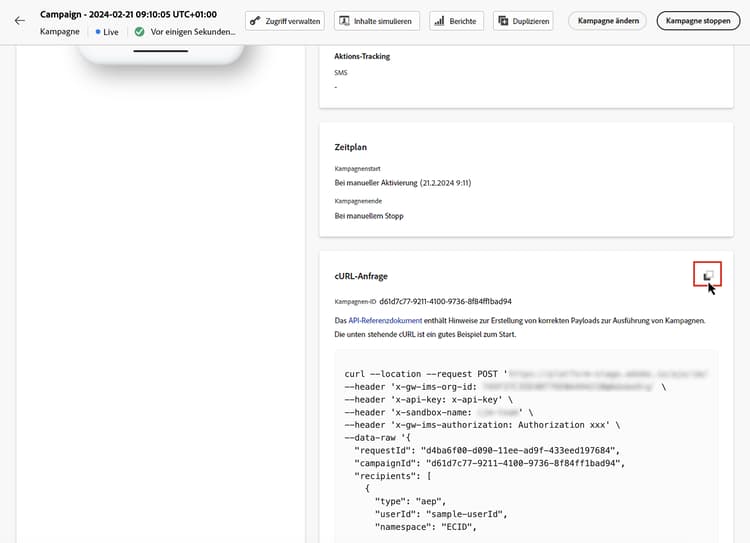
note important IMPORTANT Die Endpunkte im cURL-Abschnitt unterscheiden sich zwischen standardmäßigen Kampagnen und Kampagnen mit hohem Durchsatz. -
Verwenden Sie diese cURL-Anfrage in den APIs, um Ihre Payload zu erstellen und die Kampagne auszulösen. Weitere Informationen finden Sie in der Dokumentation zur Interactive Message Execution-API, wo alle Endpunkte für standardmäßige Kampagnen und Kampagnen mit hohem Durchsatz aufgelistet sind.
Beispiele für API-Aufrufe finden Sie auch auf dieser Seite.
Fehlerbehebung troubleshooting
Verzögerungen beim E-Mail-Versand delivery-delays
Wenn die E-Mail-Versandzeiten länger als erwartet sind, untersuchen Sie potenzielle Ausfälle oder Leistungsprobleme mit externen Services, wie Cloud-Infrastrukturanbietern oder E-Mail-Dienstanbietern. Journey Optimizer protokolliert Ausgangszeitstempel von Nachrichten, mit denen festgestellt werden kann, ob in nachgelagerten Bereichen der Versand-Pipeline Verzögerungen aufgetreten sind.
Azure Cosmos DB-Authentifizierungsfehler (500 interner Server-Fehler) cosmosdb-auth-errors
Wenn beim Auslösen von durch API ausgelösten Kampagnen Fehler des Typs 500 Internal Server Error auftreten und die Systemprotokolle einen 403 Forbidden-Fehler von Azure Cosmos DB mit einer Meldung wie der folgenden zeigen:
„Access to your account is currently revoked because the Azure Cosmos DB service is unable to obtain the AAD authentication token for the account’s default identity“
Dieser Fehler tritt normalerweise auf, wenn der für die Cosmos DB-Authentifizierung erforderliche Azure-Service-Prinzipal deaktiviert, gelöscht oder falsch konfiguriert wurde.
-
Prüfen Sie den Azure-Service-Prinzipal: Stellen Sie sicher, dass Ihr Azure-Service-Prinzipal oder Ihre verwaltete Identität aktiviert ist und in Ihrem Azure Active Directory nicht deaktiviert oder gelöscht wurde.
-
Prüfen Sie Berechtigungen: Vergewissern Sie sich, dass der Service-Prinzipal über die erforderlichen Berechtigungen zum Zugriff auf die Ressourcen für den Azure Key Vault und Cosmos DB verfügt. Der Service-Prinzipal muss über geeignete Rollenzuweisungen verfügen, damit die Authentifizierung bei Azure Cosmos DB möglich ist.
-
Prüfen Sie die Konfiguration von Azure Cosmos DB CMK: Wenn Sie kundenseitig verwaltete Schlüssel (CMK) verwenden, finden Sie im Leitfaden zur Fehlerbehebung bei Azure Cosmos DB CMK detaillierte Schritte zur Wiederherstellung der AAD-Token-Akquise.
-
Aktivieren Sie erneut und testen Sie: Nach der Korrektur der Konfiguration müssen Sie den Service-Prinzipal erneut aktivieren, falls er deaktiviert war, und Ihre transaktionalen Kampagnen-API-Aufrufe erneut testen, um zu prüfen, ob die Authentifizierung erfolgreich ist und Nachrichten gesendet werden.
| note |
|---|
| NOTE |
| Dieses Problem tritt normalerweise aufgrund einer Fehlkonfiguration oder einer versehentlichen Deaktivierung des Azure-Service-Prinzipals auf, der für die Cosmos DB-Authentifizierung erforderlich ist. Wenn Sie dafür sorgen, dass der Service-Prinzipal aktiviert und ordnungsgemäß konfiguriert bleibt, tritt dieser Fehler künftig nicht mehr auf. |
This section contains structured knowledge intended to support interpretation, retrieval, and question answering related to this topic.
For complete understanding, this information should be combined with the documentation on this page. Neither source is intended to stand alone; the page describes the feature, while this section provides additional context that helps disambiguate terminology, intent, applicability, and constraints.
- TL;DR: This page explains how to retrieve the generated cURL request of an activated API triggered campaign and use it in the APIs to trigger the campaign, with troubleshooting for email delivery delays and Azure Cosmos DB authentication errors.
Intents:
- Retrieve the generated sample cURL request of a live API triggered campaign
- Use the cURL request in the APIs to build the payload and trigger the campaign
- Know that campaign start and end dates and a call timeout apply to the API call
- Find the endpoints for standard and High throughput campaigns
- Troubleshoot email delivery delays and 500 Internal Server Errors caused by Azure Cosmos DB authentication
Glossary:
- cURL request: Section of the campaign that holds the generated sample request; its payload includes all personalization (profile and context) variables used in the message
- Interactive Message Execution REST API: The API into which you use the cURL request to build your payload and trigger the campaign (product-specific)
- Azure service principal: The identity required for Azure Cosmos DB authentication (product-specific)
Guardrails:
- If a specific start and/or end date was configured when creating the campaign, the campaign is not executed outside these dates, and API calls fail.
- The call to the Interactive Message Execution REST API has a timeout of 60 sec. Internal retries are in place in case of unexpected timeouts to guarantee the delivery.
- The endpoints in the cURL section differ between standard and High throughput campaigns.
Prerequisites and permissions:
- The campaign must be activated: the cURL request is available once the campaign is live.
Applicability:
- Applies to API triggered campaigns, both standard and High throughput.
Terminology:
- Canonical name: Execute an API triggered campaign
- Acronym: CMK — Customer-Managed Keys (used on the page body)
FAQ:
- Q: Where do I find the request to trigger my campaign? — Open the campaign, then copy-paste the payload request from the cURL request section. It is available once the campaign is live.
- Q: What does the cURL payload contain? — All personalization (profile and context) variables used in the message.
- Q: Why do my API calls fail? — If a specific start and/or end date was configured when creating the campaign, it is not executed outside these dates, and API calls fail.
- Q: Where are the endpoints for standard and High throughput campaigns listed? — In the Interactive Message Execution API documentation.
- Q: Where can I find API call examples? — On the messaging samples page of the Journey Optimizer APIs documentation.
Troubleshooting:
- Email delivery delays — If email delivery times exceed expectations, investigate potential outages or performance issues with external services, such as cloud infrastructure providers or email service providers. Journey Optimizer logs record message departure timestamps, which can help determine whether delays occurred downstream in the delivery pipeline.
- Azure cosmos DB authentication errors (500 internal server error) — Symptom: 500 Internal Server Errors when triggering API-triggered campaigns, and the system logs show a 403 Forbidden error from Azure Cosmos DB with a message such as “Access to your account is currently revoked because the Azure Cosmos DB service is unable to obtain the AAD authentication token for the account’s default identity”. Cause: the Azure service principal required for Cosmos DB authentication has been disabled, deleted, or misconfigured. Documented resolution: verify that the Azure service principal or managed identity is enabled and has not been disabled or deleted in your Azure Active Directory; check that the service principal has the necessary permissions and role assignments to access the Azure Key Vault and Cosmos DB resources; if you are using Customer-Managed Keys (CMK), consult the Azure Cosmos DB CMK troubleshooting guide; after correcting the configuration, re-enable the service principal if it was disabled, and re-test your transactional campaign API calls to confirm that authentication succeeds and messages are delivered.
Related pages:
- Differences between standard and High throughput endpoints: High throughput campaigns (campaigns/api-triggered-high-throughput.md)
- All endpoints for standard and High throughput campaigns: Interactive Message Execution API documentation (https://developer.adobe.com/journey-optimizer-apis/references/messaging#tag/execution)
- API call examples: page linked as “this page”, messaging samples of the Journey Optimizer APIs documentation (https://developer.adobe.com/journey-optimizer-apis/references/messaging-samples)
- Azure Cosmos DB CMK errors: Azure Cosmos DB CMK troubleshooting guide (https://learn.microsoft.com/en-us/azure/cosmos-db/cmk-troubleshooting-guide#azure-active-directory-token-acquisition-error)
Personas:
- marketer: Can open an activated campaign and copy the generated cURL request, since it is available once the campaign is live. Can use this request to build the payload and trigger the campaign through the Interactive Message Execution REST API. The page states that the call has a timeout of 60 sec, with internal retries in place to guarantee delivery. Where: “Trigger the campaign”.
Onboarding:
- Level: Intermediate
- First minimal step: Open the campaign, then copy-paste the payload request from the cURL request section.
- Success check: The cURL request section becomes available once the campaign is live.
- Next: The endpoints in the cURL section differ for a High throughput campaign: Activate High throughput mode for API triggered campaigns (campaigns/api-triggered-high-throughput.md)