Auf dieser Seite: Erfahren Sie, wie Sie berechnete Attribute erstellen, die Verhaltensereignisse in Profilattributen aggregieren und für die Segmentierung, Personalisierung und Journey-Logik in Adobe Journey Optimizer verwenden.
Berechnete Attribute ermöglichen das Zusammenfassen einzelner Verhaltensereignisse in berechnete Profilattribute, die in Adobe Experience Platform verfügbar sind. Diese Attribute basieren auf profilaktivierten Erlebnisereignis-Datensätzen, die in Adobe Experience Platform aufgenommen werden und als aggregierte Datenpunkte dienen, die in Kundenprofilen gespeichert werden.
Jedes berechnete Attribut ist ein Profilattribut, das Sie für die Segmentierung, Personalisierung und Aktivierung in Journeys und Kampagnen nutzen können. Diese Vereinfachung verbessert die Fähigkeit, Ihren Kundinnen und Kunden zeitnahe und aussagekräftige, personalisierte Erlebnisse bereitzustellen.
Erstellen von berechneten Attributen manage
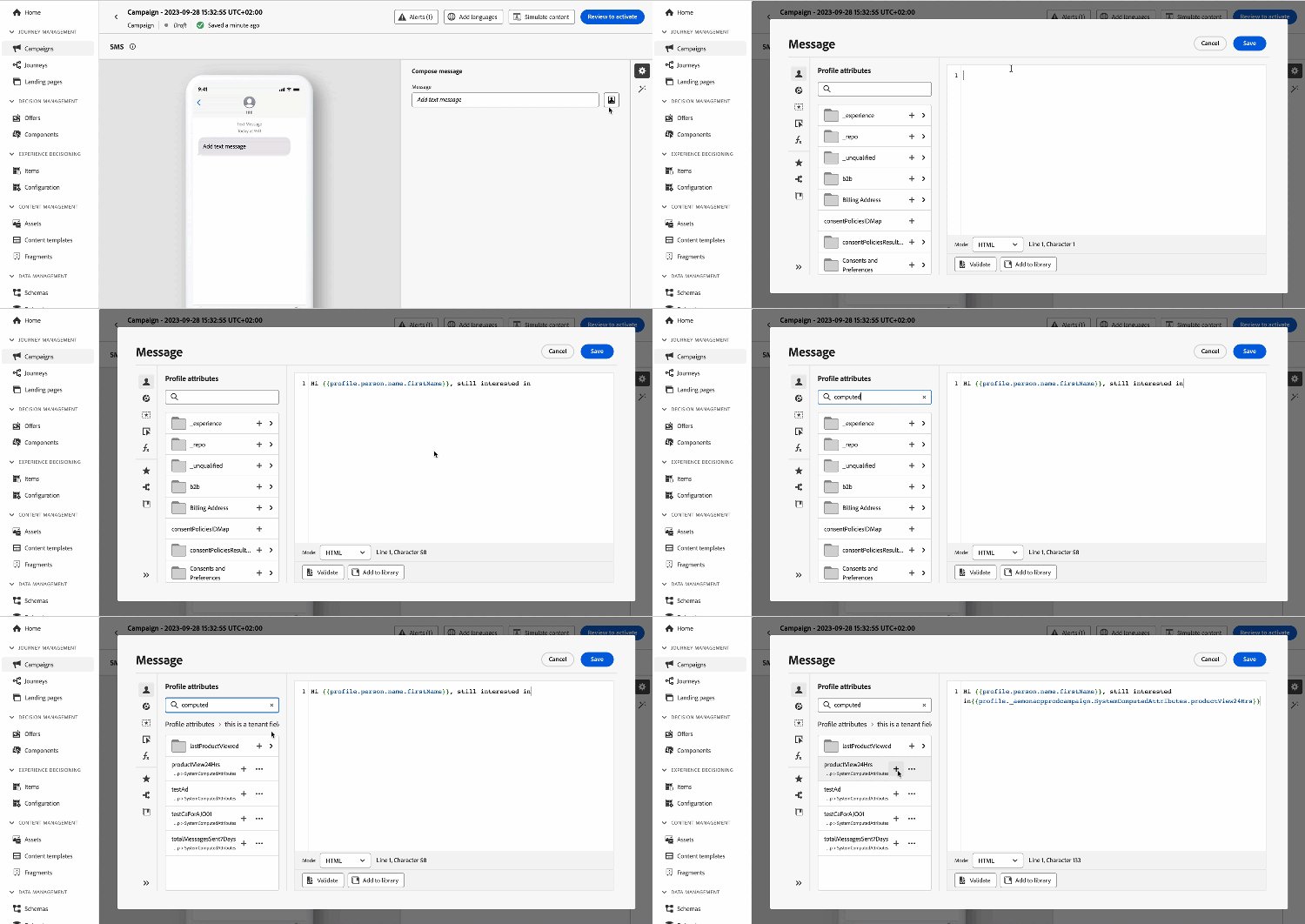
Navigieren Sie zum Erstellen berechneter Attribute zur Registerkarte Berechnete Attribute im Menü Profile auf der linken Seite.
Auf diesem Bildschirm können Sie berechnete Attribute erstellen, indem Sie Regeln erstellen, die Ereignisattribute und Aggregatfunktionen zusammen mit einem bestimmten Lookback-Zeitraum kombinieren. Sie können beispielsweise die Summe der Käufe der letzten drei Monate berechnen, den zuletzt angezeigten Artikel eines Profils ermitteln, das in der letzten Woche keinen Kauf getätigt hat, oder die von jedem Profil gesammelten Belohnungspunkte addieren.
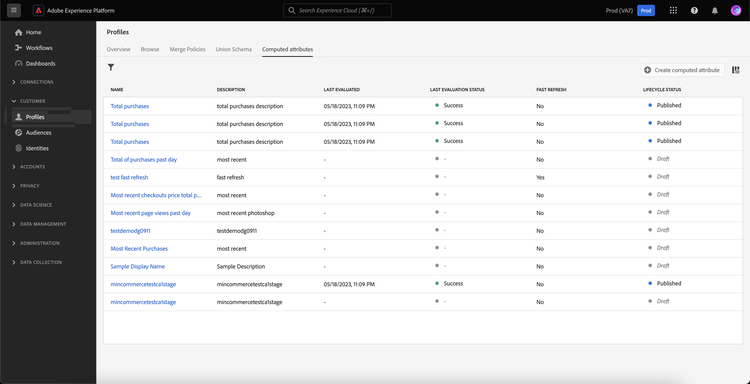
Sobald Ihre Regel fertig ist, veröffentlichen Sie das berechnete Attribut, um es in anderen nachgelagerten Diensten, einschließlich Journey Optimizer, verfügbar zu machen.
Die Dokumentation zu berechneten Attributen enthält detaillierte Informationen zum Erstellen und Verwalten berechneter Attribute.
Hinzufügen von berechneten Attributen zur Adobe Experience Platform-Datenquelle source
Um berechnete Attribute in Journey Optimizer zu nutzen, fügen Sie sie zur Experience Platform-Datenquelle von Journey Optimizer hinzu.
Die Adobe Experience Platform-Datenquelle definiert die Verbindung zum Echtzeit-Kundenprofil von Adobe. Diese Datenquelle ruft Profil- und Erlebnisereignisdaten vom Echtzeit-Kundenprofil-Dienst ab.
Gehen Sie wie folgt vor, um berechnete Attribute zur Datenquelle hinzuzufügen:
-
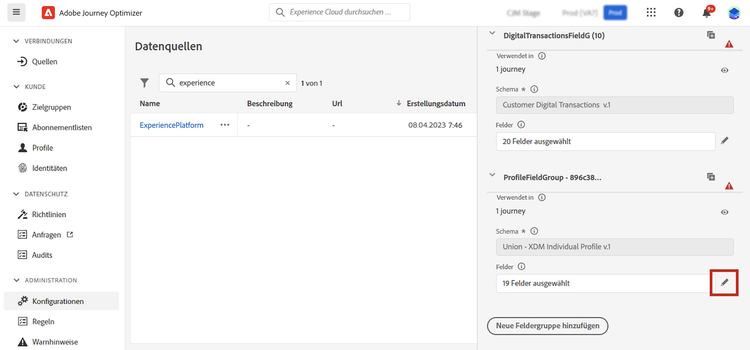
Navigieren Sie zum Menü Konfigurationen auf der linken Seite und klicken Sie dann auf die Karte Datenquellen.
-
Wählen Sie die Experience Platform-Datenquelle aus.
-
Fügen Sie die Feldergruppe Vom System berechnete Attribute hinzu, die alle erstellten berechneten Attribute enthält.
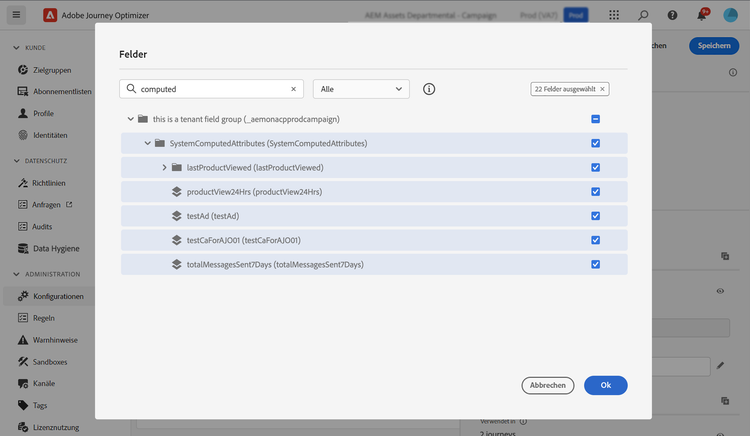
Berechnete Attribute stehen jetzt zur Verwendung in Journey Optimizer zur Verfügung. Erfahren Sie, wie Sie berechnete Attribute in Journey Optimizer verwenden
Dieser Abschnitt enthält detaillierte Informationen zum Hinzufügen von Feldergruppen zur Adobe Experience Platform-Datenquelle.
Verwenden von berechneten Attributen in Journey Optimizer use
Berechnete Attribute bieten in Journey Optimizer eine Vielzahl von Funktionen. Sie können für verschiedene Zwecke verwendet werden, z. B. zum Personalisieren von Nachrichteninhalten, Erstellen neuer Zielgruppen oder Aufteilen von Journeys basierend auf einem spezifischen berechneten Attribut. Beispielsweise kann ein Journey-Pfad anhand der Gesamteinkäufe eines Profils in den letzten drei Wochen aufgeteilt werden, indem in einer Bedingungsaktivität ein einziges berechnetes Attribut hinzufügt wird. Sie können eine E-Mail auch personalisieren, indem Sie für jedes Profil das zuletzt angezeigte Element anzeigen.
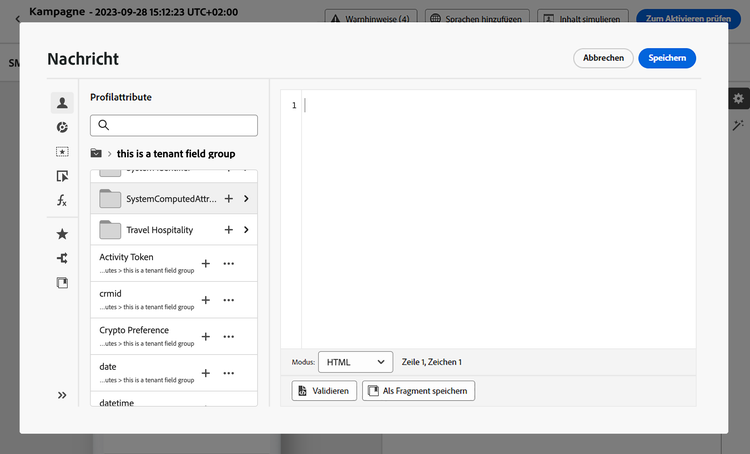
Da berechnete Attribute Profilattributfelder sind, die im Profilvereinigungsschema erstellt wurden, kann über den Personalisierungseditor in der Feldergruppe Vom System berechnete Attribute auf sie zugegriffen werden. Von dort aus können berechnete Attribute zu Ausdrücken hinzugefügt und wie jedes andere Profilattribut behandelt werden, um die gewünschten Vorgänge auszuführen.
This section contains structured knowledge intended to support interpretation, retrieval, and question answering related to this topic.
For complete understanding, this information should be combined with the documentation on this page. Neither source is intended to stand alone; the page describes the feature, while this section provides additional context that helps disambiguate terminology, intent, applicability, and constraints.
- TL;DR: Learn how to create computed attributes on Adobe Experience Platform and use them in Journey Optimizer for segmentation, personalization, and journey logic.
Intents:
- Understand what computed attributes are
- Create computed attributes by combining event attributes, aggregate functions, and a lookback period
- Add the SystemComputedAttributes field group to the Experience Platform data source in Journey Optimizer
- Use computed attributes in journey conditions, audience building, and message personalization
Glossary:
- Computed attribute: A profile attribute derived from aggregated behavioral event data, stored in customer profiles (product-specific)
- Lookback period: The time window applied when calculating a computed attribute’s aggregation rule (e.g. “last 3 months”) (product-specific)
- SystemComputedAttributes field group: The field group added to the Journey Optimizer Experience Platform data source that contains all the created computed attributes (product-specific)
- Profile union schema: The schema on which computed attributes are created as profile attribute fields
Guardrails:
- Requires View Computed attributes and Manage Computed attributes permissions to access the feature
- Computed attributes must be published before they become available in other downstream services, including Journey Optimizer
- Computed attributes must be explicitly added to the Experience Platform data source in Journey Optimizer before they can be used in journeys or personalization
- Computed attributes are based on Profile-enabled Experience Event datasets ingested into Adobe Experience Platform
Terminology:
- Canonical name: Adobe Journey Optimizer — Acronym: AJO — variants: Journey Optimizer
- Canonical name: Adobe Experience Platform — Acronym: AEP
- Synonyms: “computed attributes” = “computed profile attributes”
FAQ:
- Q: What are computed attributes? — Aggregated behavioral event data (e.g. total purchases, last viewed item) stored as profile attributes on Adobe Experience Platform and usable in Journey Optimizer.
- Q: Do I need special permissions? — Yes: “View Computed attributes” and “Manage Computed attributes” are both required.
- Q: How do I make computed attributes available in Journey Optimizer? — Add the
SystemComputedAttributesfield group to the Experience Platform data source under Configurations > Data sources. - Q: Where can I use computed attributes in Journey Optimizer? — In Condition activities (journey splitting), audience creation, and the personalization editor.
- Q: What is a lookback period? — The time window used to scope the aggregation rule, e.g. “sum of purchases in the last 3 weeks.”