在此頁面上:瞭解如何使用自動同步的電子郵件預設純文字版本或建立自訂版本,以及何時使用最有效的方式。
建議建立電子郵件內文的文字版本,當 HTML 內容無法顯示時可使用。
從安全性角度來看,提供純文字版本相當重要,因為HTML電子郵件可能會帶來風險,例如惡意指令碼、追蹤畫素或依賴豐富格式和連結的網路釣魚嘗試。 純文字可減少攻擊面,通常為安全意識高的收件者或限制或移除HTML的公司電子郵件系統所偏好。 提供兩個版本可讓收件者選擇符合其安全性和隱私權要求的格式。
存取預設文字版本 plain-text-default
依預設,電子郵件設計工具會建立電子郵件的 純文字 版本,包括個人化欄位。 此版本是自動產生,並與內容的 HTML 版本同步。
若要存取預設文字版本,請從您的電子郵件內容中選取 純文字 圖示。

使用自訂文字版本 plain-text-custom
如果您偏好為純文字版本使用不同的內容,請依照以下步驟操作:
-
從您的電子郵件中選取 純文字 圖示。
-
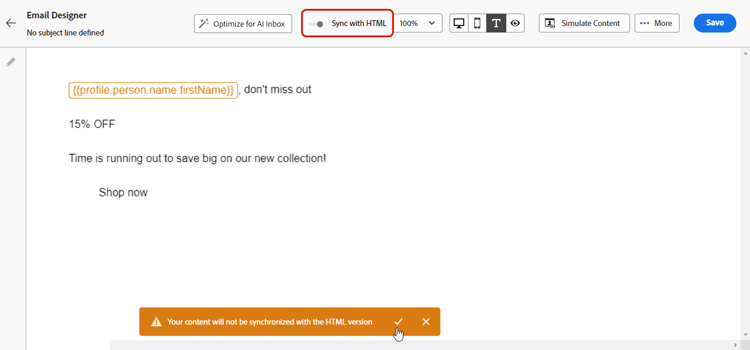
使用 與 HTML 同步 切換以停用同步。 按一下勾選記號以確認您的選擇。
-
之後,您可以視需要編輯自訂純文字版本。
-
停用同步時,在 純文字 檢視中所做的變更不會反映在HTML檢視中。
-
如果您在更新純文字內容後重新啟用「與HTML同步」選項,您的變更將會遺失,並以HTML版本產生的文字內容取代。
何時使用自訂純文字版本 when-to-use
瞭解何時應建立自訂純文字版本與使用自動同步處理,有助於確保最佳電子郵件傳遞和可讀性。
在下列情況下使用自訂純文字(停用同步):
- 複雜的HTML版面配置 — 您的HTML電子郵件包含多欄版面配置、表格,或無法妥善轉譯為純文字的複雜CSS。
- 大量視覺內容 — 您的電子郵件嚴重依賴影像,而且您想要為停用影像的使用者端提供描述性文字替代方案。
- 不同的訊息結構 — 您想要提供針對純文字閱讀程式最佳化的簡化或重新組織訊息結構。
- 協助工具需求 — 您需要特定的純文字格式,以符合協助工具標準。
- 舊版電子郵件使用者端 — 您的對象包括需要特殊格式內容的舊版電子郵件使用者端(例如Outlook 2003、純文字行動使用者端)的使用者。
- ASCII格式 — 您想要包含特定的純文字格式,例如ASCII圖案、表格或特定的分行符號。
在下列情況下使用自動同步(預設):
- 簡單的HTML設計 — 您的HTML電子郵件具有簡單線性結構,可妥善轉譯為純文字。
- 一致的內容 — 您想要維持HTML和純文字版本之間的完全一致。
- 經常更新 — 您會定期更新電子郵件內容,希望避免手動重複。
- Personalization運作良好 — 您的個人化欄位在這兩種格式中都正常運作。
- 時間限制 — 您需要快速啟動電子郵件,而不需要額外的純文字自訂。
實用範例 practical-examples
下列範例示範真實世界的情境,協助您決定使用自訂純文字還是自動同步。 每個範例都會說明內容、建議方法以及決定背後的理由。
案例:包含影像、樣式按鈕和顏色編碼區段的多欄電子報。

建議:使用自訂純文字(停用同步)。
為何選擇自訂純文字: HTML版本使用三欄格線版面配置,包含橫幅影像、樣式按鈕及色碼區段。 這些視覺元素無法透過自動同步很好地轉換為純文字,導致內容雜亂、難以閱讀。 自訂純文字版本可讓您將內容重新建構為線性、易於掃描的格式,具有清晰的區段標題和正確格式化的連結。
自訂純文字範例:
| code language-none |
|---|
|
案例:包含結構化資料(訂單編號、料號、價格、送貨詳細資料)的訂單確認。

建議:使用自動同步。
為什麼自動同步可以運作:訂單確認具有簡單線性結構,可自然從HTML轉譯為純文字。 資訊會邏輯地流動(訂單明細→料號→送貨總→),而個人化欄位(如訂單編號與客戶名稱)在兩個格式中的運作方式相同。 結構化、表格式資料可完全轉換,無需手動調整,既節省時間,又保持清晰度。
案例:包含背景影像、內嵌影片和互動式元素的活動邀請。

建議:使用自訂純文字(停用同步)。
為何選擇自訂純文字: HTML版本仰賴視覺效果,例如背景影像、視訊內嵌及互動式RSVP按鈕。 自動同步會移除這些元素,留下含有中斷參照的混淆文字版本。 自訂純文字版本可讓您以組織良好的格式提供清楚的事件詳細資料、演講者資訊和直接註冊連結,不需要視覺元素即可運作。
自訂純文字範例:
| code language-none |
|---|
|
常見使用實例 common-use-cases
下列使用案例示範建立自訂純文字版本(停用sync)有益的情況。 每個範例都會顯示HTML版本帶來的挑戰,以及自訂純文字解決方案如何解決它。
挑戰: HTML顯示含有影像、價格和購買按鈕的產品格線
純文字解決方案:建立包含明確產品名稱、價格和直接連結的結構化清單
| code language-none |
|---|
|
挑戰:品牌歡迎電子郵件,含公司標誌及樣式格式
純文字解決方案:使用ASCII圖案或文字格式來建立視覺階層
| code language-none |
|---|
|
挑戰: HTML包含樣式按鈕和表單元素
純文字解決方案:提供包含指示的純文字連結
| code language-none |
|---|
|
常見問題 faq
我的個人化欄位是否會以純文字運作?
是,類似{{profile.firstName}}的個人化欄位在HTML和純文字版本中的運作方式相同。
如何測試我的純文字版本?
- 在電子郵件Designer中切換為 純文字 檢視。 了解作法
- 傳送測試電子郵件給純文字電子郵件使用者端,例如舊版Pine或基本行動電子郵件應用程式。
如果我忘記建立純文字版本,會發生什麼事?
系統會自動從您的HTML產生純文字版本,這可能不是最佳格式化,但將確保傳遞到純文字使用者端。
我可以在HTML中使用與純文字不同的個人化嗎?
可以,一旦您停用同步,您就可以獨立自訂每個版本,包括使用不同的個人化欄位或內容。
哪些電子郵件使用者端僅支援純文字?
現代的使用者端很少是純文字,但有些公司電子郵件原則、協助工具及舊版行動裝置可能會顯示純文字。 這也是HTML轉譯失敗時的遞補內容。
我應該多久更新一次純文字版本?
每當您對HTML內容進行重大變更時,請更新它。 如果核心訊息維持不變,微幅調整HTML可能不需要更新純文字。
我可以在純文字電子郵件中包含連結嗎?
是! 包含完整URL (例如https://example.com/page),且大多數電子郵件使用者端會自動使其可點選。
我是否應該包含純文字的影像?
否,純文字不支援影像。 請改為說明影像所顯示的內容,或提供線上檢視影像的連結。
This section contains structured knowledge intended to support interpretation, retrieval, and question answering related to this topic.
For complete understanding, this information should be combined with the documentation on this page. Neither source is intended to stand alone; the page describes the feature, while this section provides additional context that helps disambiguate terminology, intent, applicability, and constraints.
- TL;DR: This page explains how to use the auto-synced default plain text version of an email or create a custom one by disabling sync, and when each approach works best.
Intents:
- Access the default, auto-generated plain text version of an email
- Create and edit a custom plain text version by disabling synchronization
- Decide when to use custom plain text versus auto-sync
- Understand how personalization fields behave in the plain text version
- Test the plain text version
Glossary:
- Plain text version: A text version of the email body, used when HTML content cannot be displayed (product-specific)
- Default (auto-synced) plain text: The Plain text version the Email Designer generates automatically, including personalization fields, and keeps synchronized with the HTML content (product-specific)
- Sync with HTML: The toggle that enables or disables synchronization between the Plain text and HTML versions (product-specific)
- Custom plain text version: A plain text version you edit independently after disabling Sync with HTML (product-specific)
Guardrails:
- When synchronization is disabled, changes made in Plain text view are not reflected in HTML view.
- If you re-enable Sync with HTML after updating your plain text content, your changes are lost and replaced with text content generated from the HTML version.
- If you do not create a plain text version, the system automatically generates one from your HTML, which may not be optimally formatted but ensures delivery to text-only clients.
- Plain text does not support images; describe what the image shows or link to view it online.
- Personalization fields work identically in both HTML and plain text versions; once sync is disabled you can use different personalization in each.
Terminology:
- Canonical name: text version of an email — Acronym: n/a — variants: plain text version, Plain text, custom plain text
- Synonyms: “auto-sync” = “Sync with HTML enabled”
- Do not confuse: “default (auto-synced) plain text” (generated from and synchronized with HTML) ≠ “custom plain text version” (edited independently after disabling sync)
FAQ:
- Q: How do I create a custom plain text version? — Select the Plain text icon, use the Sync with HTML toggle to disable synchronization and confirm, then edit the custom plain text as desired.
- Q: What happens to my custom text if I re-enable sync? — Your changes are lost and replaced with text content generated from the HTML version.
- Q: Do personalization fields work in plain text? — Yes; personalization fields work identically in both HTML and plain text versions.
- Q: What if I forget to create a plain text version? — The system automatically generates one from your HTML, ensuring delivery to text-only clients.
- Q: When should I use custom plain text instead of auto-sync? — For complex HTML layouts, visual-heavy content, a different messaging structure, accessibility requirements, legacy email clients, or specific ASCII formatting.
- Q: How do I test my plain text version? — Toggle to Plain text view in the Email Designer, and send test emails to text-only clients.