在此页面上:了解如何在编排的活动中使用分叉流控制活动,以创建并行运行多个活动的多个叫客过渡。
分叉活动是一个 流程控制 组件,可用于创建多个出站过渡,实现多个活动的并行运行。
配置“分叉”活动 fork-configuration
请按照以下步骤操作,配置 分叉 活动:
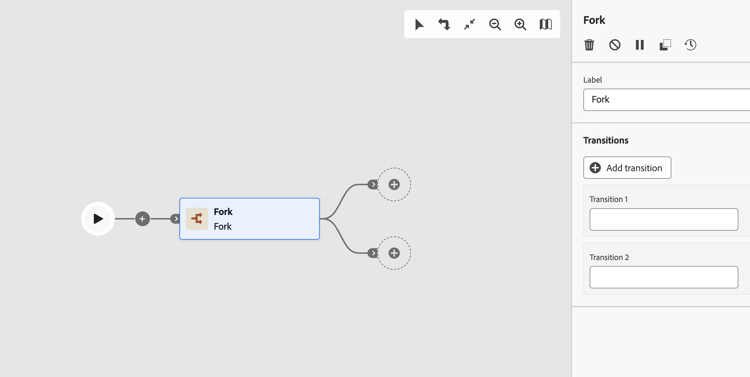
-
将 分支 活动添加到您的编排营销活动中。
-
定义一个标签。
-
为每个出站过渡分配标签。 默认提供两个过渡。
-
要移除过渡,请单击

-
如果需要,请单击 添加过渡 以添加其他出站过渡。
示例 fork-examples
以下是 分支 活动的典型用法:使用两个不同的电子邮件渠道(一个营销和一个事务性)定位相同的受众,以比较投放行为。
在 构建受众 活动选择目标群体后,分支将创建两个并行分支:
- 分支1连接到营销电子邮件渠道活动。 报文遵循标准业务规则,并且仅发送给选择加入的用户档案。
- 分支2连接到事务型电子邮件渠道活动。 消息绕过业务规则,将传递到所有用户档案,而不管选择加入状态如何。
此模式有助于了解渠道类别设置如何影响投放行为,以及在单次营销活动运行时向同一受众发送不同消息类型。
This section contains structured knowledge intended to support interpretation, retrieval, and question answering related to this topic.
For complete understanding, this information should be combined with the documentation on this page. Neither source is intended to stand alone; the page describes the feature, while this section provides additional context that helps disambiguate terminology, intent, applicability, and constraints.
- TL;DR: This page explains how to configure the Fork flow control activity in an Orchestrated campaign to create multiple outbound transitions so that several activities run in parallel.
Intents:
- Add a Fork activity to an Orchestrated campaign.
- Use a Fork to run two or more activities in parallel.
- Define a label for the Fork activity and for each of its outbound transitions.
- Add or remove outbound transitions on a Fork activity.
- Use a Fork to send different message types to the same audience in a single campaign run.
Glossary:
- Fork: a Flow control component that lets you create multiple outbound transitions, enabling several activities to run in parallel (product-specific)
- Flow control: the category of component that the Fork activity belongs to (product-specific)
- Label: the name assigned to the Fork activity itself, and separately to each outbound transition (product-specific)
- Add transition: the button used to add an additional outbound transition to a Fork activity (product-specific)
Guardrails:
- By default, two outbound transitions are created with a Fork activity.
- Each outbound transition can be assigned its own label.
- A transition can be removed using the delete icon next to it.
- Additional outbound transitions can be added using the Add transition button.
Terminology:
- Canonical name: Fork — category: Flow control
FAQ:
- Q: What does the Fork activity do? — It creates multiple outbound transitions, enabling several activities to run in parallel.
- Q: How many outbound transitions does a Fork activity have by default? — Two, by default.
- Q: Can I add more than the default outbound transitions? — Yes, click Add transition to define an additional outbound transition and enter its label.
- Q: How do I remove an outbound transition? — Click the delete icon next to the transition.
- Q: What is a typical use of the Fork activity? — Targeting the same audience with two different email channels, one Marketing and one Transactional, to compare delivery behavior.
Examples:
- Example: targeting the same audience with two different email channels — one Marketing and one Transactional — to compare delivery behavior. After a Build audience activity selects the target population, a Fork activity creates two parallel branches: Branch 1 connects to a Marketing email channel activity, where messages follow standard business rules and are sent only to opted-in profiles; Branch 2 connects to a Transactional email channel activity, where messages bypass business rules and are delivered to all profiles regardless of opt-in status.
Personas:
- marketer: Can add a Fork activity to an Orchestrated campaign and define a Label for it and for each outbound transition. Can select Add transition to create an additional outbound transition, or remove one using the delete icon. The page states that two outbound transitions are created by default. Where: “Configure the Fork activity”.
Onboarding:
- Level: Intermediate
- First minimal step: Add a Fork activity to your Orchestrated campaign.
- Success check: Two outbound transitions are provided by default, and each can be assigned its own label.