在此页面上:了解如何在编排的活动中使用重复数据删除定位活动,以在使用目标数据之前从入站活动的结果中删除重复记录。
重复数据删除活动是一种 目标选择 活动。 利用此活动,您可以删除入站活动结果中的重复项,例如收件人列表中重复的轮廓。 通常,在目标选择活动之后且在允许使用目标数据的活动之前进行 重复数据删除 活动。
配置“重复数据删除”活动 deduplication-configuration
请按照以下步骤操作,配置 重复数据删除 活动:
-
将 重复数据删除 活动添加到您的编排营销活动。
-
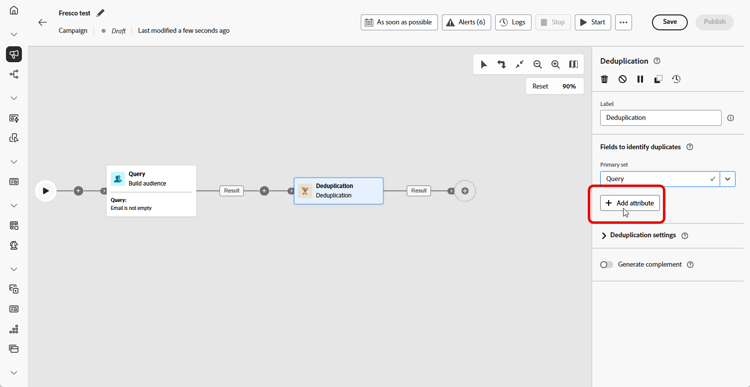
在 用于识别重复项的字段 部分,单击 添加属性 按钮,指定可用于识别重复项的字段(例如:电子邮件地址、名字、姓氏等)。字段顺序可用于指定优先处理的字段。
-
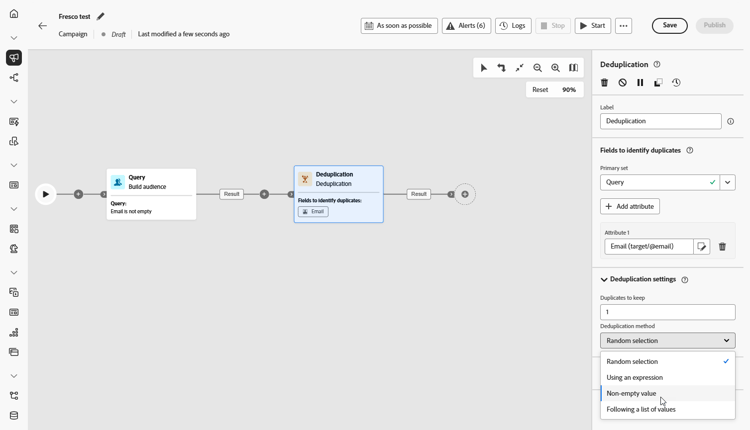
在 重复数据删除设置 部分中,使用“要保留的重复项”字段选择要保留的唯一记录数量。 默认值为 1,这会为每个重复组保留一个记录。 将其设置为 0 可保留所有重复项。
例如,如果记录 A 和 B 是记录 Y 的重复项,而记录 C 是记录 Z 的重复项:
- 如果字段的值为 1:只保留 Y 和 Z 记录。
- 如果字段的值为 0:保留所有记录(A、B、C、Y、Z)。
- 如果字段的值为 2:保留 C 和 Z,并随机保留或根据重复数据删除方法保留 A、B 和 Y 中的两个值。
-
选择重复数据删除方法,这将定义系统如何确定保留每组重复项中的哪些记录:
- 随机选择:随机选择要保留的重复项记录。
- 使用表达式:根据您定义的表达式,保留具有最高值或最低值的记录。
- 非空值:保留所选字段不为空的记录,例如,仅保留电话号码不为空的轮廓。
- 遵循值列表:优先保留一个或多个字段的特定值,例如,您可以优先保留“国家/地区”设置为“法国”的记录。 单击属性,选择字段或创建自定义表达式。 使用添加按钮,按优先级顺序输入首选值。
-
如果您想利用剩余群体的数据,可以选中 生成补集 选项。 补集包含所有重复项。 然后,一个额外的过渡将添加到活动中。
示例 deduplication-example
在以下示例中,使用 重复数据删除 活动在发送投放之前从目标受众中删除重复记录。 首先,对受众进行筛选,仅包含具有非空电子邮件字段的轮廓。 然后,重复数据删除活动使用电子邮件地址来识别和排除重复项。

This section contains structured knowledge intended to support interpretation, retrieval, and question answering related to this topic.
For complete understanding, this information should be combined with the documentation on this page. Neither source is intended to stand alone; the page describes the feature, while this section provides additional context that helps disambiguate terminology, intent, applicability, and constraints.
- TL;DR: This page explains how to configure the Deduplication targeting activity in an Orchestrated campaign to remove duplicate records from the results of inbound activities before using the targeted data.
Intents:
- Add a Deduplication activity to an Orchestrated campaign.
- Specify the fields that identify duplicates, in processing order.
- Choose how many unique records to keep per duplicate group using the Duplicates to keep field.
- Choose a Deduplication Method to decide which records are kept from each duplicate group.
- Generate a complement to exploit the remaining (excluded) population.
Glossary:
- Deduplication activity: a Targeting activity that deletes duplicates in the result(s) of the inbound activities, for example duplicated profiles in the recipient list (product-specific)
- Fields to identify duplicates: the section where you specify, in order, the fields whose identical values identify duplicates (for example email address, first name, last name) (product-specific)
- Duplicates to keep: the field that sets how many unique records to keep per duplicate group (product-specific)
- Deduplication Method: the setting that defines how the system decides which records to keep from each group of duplicates (product-specific)
- Random selection: a Deduplication Method that randomly selects the record to keep out of the duplicates (product-specific)
- Using an expression: a Deduplication Method that keeps records with the highest or lowest value based on a defined expression (product-specific)
- Non-empty values: a Deduplication Method that keeps records where the selected field is not empty (product-specific)
- Following a list of values: a Deduplication Method that prioritizes specific values for one or more fields, in a priority order entered using the Add button (product-specific)
- Generate complement: an option that adds an additional outbound transition carrying the remaining population excluded as duplicates (product-specific)
Guardrails:
- The Deduplication activity is a Targeting activity, generally used following targeting activities, and before activities that allow the use of targeted data.
- The default value of Duplicates to keep is 1, which keeps one record per duplicate group.
- Setting Duplicates to keep to 0 keeps all duplicates.
- By default, the record to keep out of the duplicates is randomly selected.
- Enabling Generate complement adds an additional transition to the activity, carrying the complement (all the duplicates).
Terminology:
- Canonical name: Deduplication activity — variants: Deduplication
- Do not confuse: “Random selection” (randomly selects which record to keep) ≠ “Following a list of values” (prioritizes specific field values in a defined order) ≠ “Non-empty values” (keeps records where the selected field is not empty) ≠ “Using an expression” (keeps the highest or lowest value per a defined expression) — these are the four Deduplication Method options.
- Do not confuse: “Duplicates to keep” (how many records survive per duplicate group) ≠ “Deduplication Method” (which records are chosen to survive).
FAQ:
- Q: What does the Deduplication activity do? — It deletes duplicates in the results of the inbound activities, for example duplicated profiles in the recipient list.
- Q: When is the Deduplication activity typically used? — Generally following targeting activities, and before activities that allow the use of targeted data.
- Q: What happens if Duplicates to keep is set to 0? — All duplicates are kept (for example, records A, B, C, Y, Z in the page’s example).
- Q: What is the default Deduplication Method? — By default, the record to keep out of the duplicates is randomly selected (Random selection).
- Q: How do I identify which fields define a duplicate? — In the Fields to identify duplicates section, click Add attribute to specify the fields, such as email address, first name, or last name; the order of the fields specifies which to process first.
- Q: How can I use the records excluded as duplicates? — Toggle on Generate complement to add an additional outbound transition carrying the remaining (duplicate) population.
Personas:
- marketer: Can add a Deduplication activity to an Orchestrated campaign to delete duplicates in the results of inbound activities, and toggle on Generate complement. Can select fields to identify duplicates, such as email address and first name, and choose a Deduplication Method. The page states that the default value of Duplicates to keep is 1, which keeps one record per duplicate group. Where: “Configure the Deduplication activity”.
Onboarding:
- Level: Intermediate
- First minimal step: Add a Deduplication activity to your Orchestrated campaign.
- Success check: An additional transition is added to the activity when the Generate complement option is checked.