이 페이지에서: 개인화된 최적화 모델이 머신 러닝을 사용하여 고객, 오퍼 및 컨텍스트 데이터(사용 사례, 앙상블 모델 구성 요소, 데이터 세트 요구 사항, 가정 및 콜드 스타트 동작 등)에서 학습하는 방법을 이해하면 개인화된 오퍼를 제공하고 KPI를 최대화하기 위해 이 모델을 사용할 시기를 결정할 수 있습니다.
개인화된 최적화를 통해 감독 머신 러닝 및 딥 러닝에서 최신 기술을 활용함으로써 비즈니스 사용자(마케터)는 비즈니스 목표를 정의하고 고객 데이터를 활용하여 비즈니스 지향 모델을 교육하여 개인화된 오퍼를 제공하고 KPI를 극대화할 수 있습니다.
각 오퍼의 글로벌 성과를 기반으로 최적화하는 비개인화 등급과 달리, 개인화된 최적화는 개별 고객의 속성과 해당 고객을 위해 선택한 KPI를 유도할 가능성이 가장 높은 오퍼 간의 관계를 학습합니다. 그 결과 모든 사용자에게 제공되는 하나의 최상의 오퍼가 아니라 각 프로필에 맞게 조정된 오퍼 선택이 이루어집니다.
사용 사례 및 이점 use-cases
개인화된 최적화는 다양한 고객이 사용 가능한 오퍼에 다르게 반응하고 오퍼 카탈로그가 의미있게 차별화되고 자주 변경되지 않는 의사 결정 시나리오에 적합합니다. 일반적인 사용 사례는 다음과 같습니다.
- 다음 오퍼 선택: 각 고객에게 실시간으로 제공할 여러 경쟁 오퍼 또는 프로모션 중 하나를 선택합니다.
- 콘텐츠 개인화: 웹, 모바일, 이메일 및 기타 채널에서 각 고객에 대한 콘텐츠(예: 배너, 크리에이티브) 또는 메시지 선택
- 대상 인식 개인화: 권장 사항이 고객의 신원과 상호 작용의 컨텍스트를 반영하도록 대상 멤버십, 프로필 특성 및 컨텍스트 신호를 통합합니다.
- 수익 및 가치 최적화: 클릭 수 및 전환 수와 같은 이진 결과뿐만 아니라 수익 또는 고객 생애 가치와 같은 지속적인 결과를 최적화합니다.
컨트롤 패널에서 제공되는 주요 이점은 다음과 같습니다.
- 글로벌 최적 오퍼가 아닌 각 고객이 응답할 가능성이 가장 높은 오퍼를 제공하여 선택하는 비즈니스 KPI를 극대화합니다.
- 새로운 상호 작용 데이터가 도착하면 지속적으로 적응하여 테스트되지 않은 오퍼에 대한 탐색과 검증된 수행자의 활용 사이에서 균형을 맞춥니다.
- AI 모델 공식 빌더 표현식에서 직접 사용할 수 있는 등급 점수로 이진 및 연속 최적화 지표를 모두 지원합니다.
- 고객 맞춤 오퍼를 자동으로 학습하여 A/B 테스트 및 규칙 작성의 수작업 부담을 줄여줍니다.
데이터 세트 요구 사항 dataset
개인화된 최적화 모델을 교육하려면 지난 30일 이내에 데이터 세트에 250개 이상의 디스플레이 이벤트(예: 노출 횟수)와 하나의 성공 이벤트(예: 클릭 또는 전환)가 있는 오퍼가 두 개 이상 있어야 합니다.
표시 이벤트가 250개 미만이거나 지난 30일 이내에 성공 이벤트가 없는 오퍼는 탐색 트래픽 및 새 오퍼 부스터 트래픽에 포함할 수 있습니다. 또한 개인화 트래픽에 포함할 수 있지만 필요한 최소 디스플레이/성공 이벤트를 충족하고 모델을 다시 교육할 때까지 의사 결정에서 예측된 오퍼가 가장 낮은 점수와 동등한 것으로 처리됩니다.
개인화된 최적화 모델이 처음 교육될 때까지 개인화된 최적화 모델을 활용하는 선택 전략 내의 오퍼가 임의로 제공됩니다.
작동 방식 how
이 모델은 오퍼, 사용자 정보 및 컨텍스트 정보 간의 복잡한 기능 상호 작용을 학습하여 최종 사용자에게 개인화된 오퍼를 추천합니다. 피쳐는 모델에 대한 입력입니다.
기능에는 네 가지 유형이 있습니다.
이 모델에는 다음 두 가지 단계가 있습니다.
- 오프라인 모델 교육 단계에서는 이전 데이터의 기능 상호 작용을 학습하고 기억하여 모델을 교육합니다.
- 온라인 추론 단계에서는 모델에서 생성한 실시간 점수를 기반으로 후보 오퍼의 순위가 지정됩니다. 개인화된 최적화는 사용자와 오퍼를 위한 기능을 포함하기 어려운 기존의 협업 필터링 기법과 달리, 딥러닝 기반의 추천 방법으로, 복잡하고 비선형적인 기능 상호 작용 패턴을 포함하고 학습할 수 있다.
이 모델은 이진 변수(예: 클릭 및 전환) 외에도 연속 변수(예: 수입 및 고객 라이프타임 값)의 최적화를 지원합니다. 클릭수와 같은 이진 지표에 대해 예측된 값은 항상 0과 1 사이입니다. 주문 값과 같은 연속 지표에 대한 예측된 값은 항상 0보다 크거나 같은 숫자일 것입니다. 등급 점수는 공식 또는 비교에 사용할 때 두 지표 유형 간에 일관된 비헤이비어를 보장하기 위해 표준화됩니다.
결정 시 컨텍스트 전달 pass-context
모델이 컨텍스트 피쳐를 사용하는 경우 결정 요청에는 해당 피쳐에 대한 값이 있어야 합니다. 데이터스트림에 구성된 대로 웹 SDK 또는 Mobile SDK으로 전송합니다. 의사 결정 시 모델은 프로필의 속성 및 대상 멤버십과 함께 컨텍스트 값을 사용하여 적격 오퍼에 실시간으로 점수를 매깁니다. 컨텍스트 데이터를 설정하는 방법 알아보기
실례가 되는 예 illustrative-example
이진 응답(변환) binary-response
사용자와 오퍼 간의 이전 상호 작용 간소화된 데이터 세트를 고려하십시오. 각 행에는 표시된 오퍼와 충성도 계층 (높음 = 1) 및 고객이 최근 이메일을 열었는지 여부 (예 = 1) 와 고객이 전환했는지 여부 (예 = 1) 의 두 가지 고객 신호가 기록됩니다.
오퍼 A의 경우 두 신호가 모두 일치할 때(높거나 둘 다 낮음) 전환될 가능성이 더 높습니다. 오퍼 B의 경우 충성도 티어에 관계없이 이메일을 열었을 때 전환될 가능성이 더 큽니다. 모델은 학습된 패턴을 기반으로 각 고객의 신호를 기반으로 더 나은 오퍼를 예측할 수 있습니다.

그림 1: 강조 표시된 불일치 행에서 신호가 일치하지 않고 변환되지 않으면 오퍼 A가 표시됩니다. 학습된 패턴을 기반으로, 오퍼 B가 다음에 해당 고객에게 더 나은 추천이 될 수 있습니다.
이것이 접근 방식의 본질입니다. 역사적인 기능 상호 작용을 학습하고 기억하며 각 고객에 대한 개인화된 예측을 생성하기 위해 적용합니다.
지속적인 응답(매출) continuous-response
같은 생각은 지속적인 결과로 이어진다. 이 모델은 고객이 전환하는지 여부를 예측하는 대신 각 오퍼 및 고객 세그먼트에 대한 연속적인 값(예상 매출)을 예측하고 해당 예측된 값으로 오퍼의 등급을 지정합니다.

그림 2: 4개의 고객 세그먼트 중 2개의 오퍼에 대한 예상 매출액. 이메일을 연 충성도가 높은 고객의 경우 오퍼 A가 가장 많은 매출을 올릴 것으로 예상되며, 이메일을 연 충성도가 낮은 고객의 경우 오퍼 B가 더 강력한 선택입니다. 모델은 모든 고객에게 하나의 규칙을 적용하지 않고 각 세그먼트에 대해 예측값이 가장 높은 오퍼를 선택합니다.
앙상블 모델 구성 요소 ensemble
개인화된 최적화는 앙상블 모델로 제공됩니다. 여러 개의 보완 모델 팔이 함께 실행되며 감독 계층은 각 팔이 받는 라이브 트래픽의 양을 결정합니다. 이 디자인을 통해 시스템은 두 가지 목표를 동시에 추구할 수 있습니다. 즉, 성과가 가장 좋은 학습(탐색)과 성과가 좋은 것으로 이미 알려진 오퍼 제공(악용)입니다.
탐색 및 개발 균형 조정
모든 의사 결정 시스템은 테스트되지 않은 오퍼를 탐색하여 정보를 수집하고 입증된 오퍼를 활용하여 즉시 수익을 극대화할 수 있는 절충안에 직면해 있습니다. 탐색을 위해 너무 적은 트래픽을 예약하면 잠재적 오퍼가 검색되지 않습니다. 이미 수행하고 있는 오퍼에 너무 많은 희생을 예약하면 됩니다. 앙상블은 시간이 지남에 따라 남은 교통량을 더 나은 성능의 개인화된 무기 쪽으로 이동시키면서 최소 탐사 바닥을 잡아 이 균형을 자동으로 관리합니다.
앙상블은 4개의 교통 팔로 구성되어 있습니다.
균일 무작위(탐사대) uniform-random
균일 무작위 팔은 적격 오퍼 중에서 무작위로 고객에게 오퍼를 할당합니다. 어떤 제안도 선호하지 않기 때문에, 그것은 개인화된 팔이 배우는 원자재인 전체 카탈로그에서 고객이 어떻게 반응하는지에 대한 편견 없는 데이터를 생성합니다. 첫 번째 모델이 훈련되기 전에는 유일하게 활성화된 팔이며, 이후에는 최소 탐구장을 계속 유지해 시스템이 계속 학습하도록 한다.
- 초기화 시: 트래픽의 100%.
- 첫 번째 성공적인 교육 실행 후: 트래픽의 최소 10%, 오퍼당 관찰된 노출 및 전환 이벤트 수에 따라 최대 85%입니다.
신경망(개인화된 팔) neural-network
신경망은 속성 및 대상 멤버십을 기반으로 주어진 고객에게 최상의 오퍼를 예측하는 개인화된 팔입니다. 오퍼, 고객 기능 및 컨텍스트 간의 복잡하고 비선형적인 상호 작용을 학습하며, 다양한 기능에 걸쳐 미묘한 패턴을 캡처하는 데 적합합니다.
- 초기화 시: 트래픽의 0%.
- 첫 번째 성공적인 교육 실행 후: 트래픽의 최소 5%, 최대 80%.
컨텍스트 기반 bandit(개인화된 팔) contextual-bandit
컨텍스트 기반 밴딧은 학습과 성능의 균형을 지속적으로 유지하는 밴딧 접근 방식을 사용하여, 속성, 대상 멤버십 및 컨텍스트를 기반으로 각 고객에 대한 최상의 오퍼를 예측하는 두 번째 개인화된 팔입니다. 신경망과 함께 실행함으로써 앙상블은 두 가지의 개별적인 개인화된 방법의 장점을 끌어낼 수 있다.
- 초기화 시: 트래픽의 0%.
- 첫 번째 성공적인 교육 실행 후: 트래픽의 최소 5%, 최대 80%.
새로운 오퍼 부스터(개인화되지 않은 팔) new-offer-booster
새로운 오퍼 부스터는 모델 전환 확인 기간 내에 기록된 노출 이벤트가 거의 없는 오퍼의 성능에 대한 낙관적인 가정을 하는 전체 우승자인 Thompson 샘플링 bandit (개인화되지 않음)입니다. 이렇게 하면 모델이 충분히 많은 트래픽을 새로운 오퍼 또는 높은 성과를 보이지만 제한적인 혜택을 받는 오퍼로 유도하기 위해 어려움을 겪었던 것으로 알려진 콜드 스타트 단점을 해결하여, 스스로 입증하는 데 필요한 조기 노출을 약속하는 새로운 오퍼를 제공할 수 있습니다.
- 실제 노출 및 전환 데이터가 수집되면 각 오퍼의 예상 성능은 실제 기본 성능에 빠르게 근접하며 낙관적 가정의 영향은 거의 0에 가깝습니다.
- 비교적 새로운 오퍼가 없는 경우(예: 모든 오퍼에 유사한 노출 횟수가 있거나 모두 1,000회 이상 노출 횟수 있음), 낙관적 효과는 거의 0에 가깝고 이 팔은 개인화되지 않은 전체 승자 모델로 작동합니다.
- 초기화 시: 트래픽의 0%.
- 첫 번째 성공적인 교육 실행 후: 트래픽의 5%.
트래픽이 팔에서 할당되는 방식 traffic-allocation
초기화 시 아직 모델이 훈련되지 않았기 때문에 트래픽의 100%가 일정한 무작위 기준선으로 이동합니다. 이 기준선은 학습된 분포를 가진 유일한 팔입니다. 첫 번째 성공적인 교육 실행 후 각 팔은 최소 트래픽 플로어(5%)를 받고 감독 밴딧은 관찰된 성능을 기반으로 나머지 트래픽을 할당합니다. 모델이 연속적인 라운드를 통과하면서 트래픽은 최대 80%의 트래픽을 할당하여 최고 성능의 무기를 향해 수렴합니다.
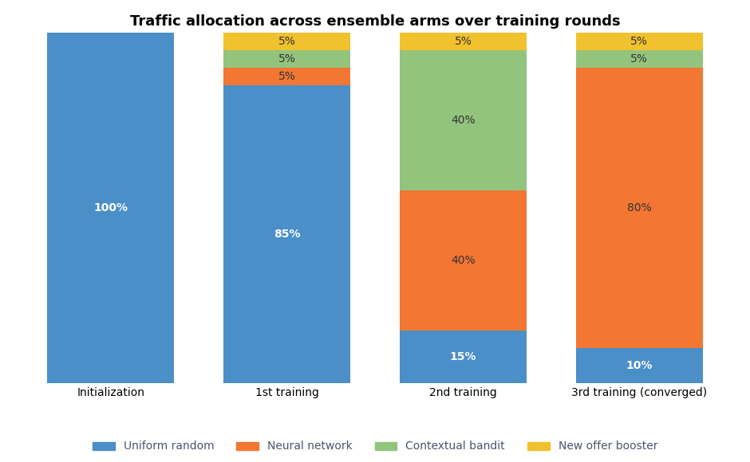
그림 3: 초기화 시 네 개의 앙상블 팔과 연속 교육 라운드에서 가능한 트래픽 할당 궤적입니다. 초기화 시 모든 트래픽은 무작위 기준선으로 흐릅니다. 각 교육 실행 후 감독 Thompson Sampling 밴딧은 팔당 최소 트래픽을 유지하면서 더 나은 성과를 보이는 팔로 할당을 전환합니다. 실제 할당은 관찰된 팔 성능에 따라 달라집니다.
주요 모델 가정 및 제한 사항 key
개인화된 최적화를 사용할 때의 이점을 극대화하기 위해 몇 가지 주요 가정과 알아 두어야 할 제한 사항이 있습니다.
- 오퍼가 충분히 다르므로 사용자가 고려할 오퍼마다 다른 환경 설정을 사용할 수 있습니다. 오퍼가 너무 유사하면 응답이 무작위로 표시되므로 결과 모델의 영향이 줄어듭니다.
예를 들어, 은행에 색상이 다른 두 개의 신용 카드 오퍼가 있는 경우 권장되는 카드가 중요하지 않을 수 있지만, 각 카드에 서로 다른 용어가 있는 경우 특정 고객이 하나를 선택하고 오퍼 간에 충분한 차이를 제공하여 보다 효과적인 모델을 구축하는 이유에 대한 근거를 제공합니다. - 사용자 트래픽 구성이 안정적입니다. 모델 교육 및 예측 중에 사용자 트래픽 구성이 크게 변경되면 모델 성능이 저하될 수 있습니다. 예를 들어 모델 교육 단계에서 대상 A의 사용자에 대한 데이터만 사용할 수 있지만 교육된 모델은 대상 B의 사용자에 대한 예측을 생성하는 데 사용된다고 가정할 경우 모델 성능에 영향을 줄 수 있습니다.
- 이 모델이 매주 업데이트되고 모델 업데이트 시 성능 변경 사항이 전달되므로 오퍼 성능이 단기간에 크게 변경되지 않습니다. 예를 들어, 이전에는 제품이 매우 인기 있었지만, 공개 보고서를 통해 해당 제품이 우리 건강에 해롭다는 사실이 확인되어 이 제품이 매우 빠르게 인기 없게 됩니다. 이 시나리오에서는 모델이 사용자 동작의 변경으로 업데이트될 때까지 모델이 이 제품을 계속 예측할 수 있습니다.
콜드-스타트 문제 cold-start
콜드 스타트 문제는 권장 사항을 작성할 데이터가 충분하지 않을 때 발생합니다. 개인화된 최적화를 위해 콜드 스타트 사례에는 5가지 유형이 있습니다.
- 내역 데이터가 없는 새 AI 모델을 만든 후 일정 기간 동안 오퍼가 임의로 제공되어 필요한 데이터를 수집한 다음 첫 번째 모델을 교육하는 데 사용됩니다.
- 첫 번째 AI 모델이 출시된 후, 전체 트래픽의 일부는 균일한 무작위 탐색에 할당되고 나머지는 모델 추천에 사용됩니다. 탐색 및 개발 밴딧 구성 요소에 대한 트래픽 분포는 오퍼 수 및 성능 임계값과 같은 요소를 기반으로 자동으로 조정됩니다.
- 새 오퍼가 오퍼 컬렉션에 추가된 후 AI 등급 모델과 관련된 전략에서 선택한 오퍼는 균일 무작위 및 새 오퍼 부스터 모델 무기(60분 이내)를 모두 사용하여 탐색할 수 있는 적격 후보가 됩니다. 예정된 다음 재교육 실행 중에 오퍼의 예상 성능은 새 오퍼 부스터 모델 팔에서 업데이트되고, 오퍼가 노출 및 클릭 임계값을 충족한 경우 개인화된 모델 팔에 포함될 수 있습니다.
- AI 등급 모델에 연결된 선택 전략과 연결된 기존 대상자 집합에 새 프로필이 추가되면 대상자 집합 자체에서 개인화 특성을 상속합니다. 따라서 콜드 스타트 문제 없이 처음부터 이러한 속성에 따라 개인화된 오퍼를 받기 시작합니다.
- 새 대상 집합, 프로필 기능 및/또는 컨텍스트 기능이 기존 모델에 추가된 후와(과) 관련된 데이터가 수집되기 시작하고 다음에 예약된 다시 교육 실행에서 사용됩니다.
재교육 re-training
모델은 최신 기능 상호 작용을 학습하고 매주 모델 성능 저하를 완화하도록 다시 교육됩니다. 교육 상태 및 모델 성능을 모니터링하려면 AI 모델 모니터링을 참조하세요.
This section contains structured knowledge intended to support interpretation, retrieval, and question answering related to this topic.
For complete understanding, this information should be combined with the documentation on this page. Neither source is intended to stand alone; the page describes the feature, while this section provides additional context that helps disambiguate terminology, intent, applicability, and constraints.
- TL;DR: Explains how the personalized optimization model uses machine learning to learn from customer, offer, and contextual data to serve personalized offers and maximize KPIs, covering its use cases, dataset requirements, features, ensemble model components, assumptions, cold-start behavior, and re-training.
Intents:
- Decide when to use Personalized optimization to serve personalized offers and maximize KPIs, based on its use cases.
- Check the dataset requirements to train a personalized optimization model.
- Identify the four feature types that can be added to the model.
- Understand how the four traffic arms of the ensemble model share live traffic.
- Review the key model assumptions and limitations.
- Understand the cold-start cases and the re-training of models.
Glossary:
-
Personalized optimization (product-specific): Uses supervised machine learning and deep learning to let a business user (marketer) define business goals and use customer data to train business-oriented models that serve personalized offers and maximize KPIs.
-
Feature: An input into the model. The model learns complex feature interactions between offers, users’ information, and contextual information to recommend personalized offers to end users. There are 4 types of features: Decisioning objects, Audiences, Profile features, and Context features.
-
Decisioning objects (product-specific): Feature type made of placementID, activityID, and decisionScopeID. Part of the decision management feedback Experience Events sent to AEP.
-
Audiences: Feature type.
-
Profile features (product-specific, Limited Availability): Feature type made of profile attributes from your profile dataset schema.
-
Context features (product-specific, Limited Availability): Feature type made of real-time context signals sent with the decision API request. Automatic context features (like channel ID) are always included. Pre-selected recommended context features (like device type, country code) can be removed. At decision time, the model uses the context values together with the profile’s attributes and audience memberships to score the eligible offers in real time.
-
Offline model training: Phase in which a model is trained by learning and memorizing feature interactions in historical data.
-
Online inference: Phase in which candidate offers are ranked based on real-time scores generated by the model. Unlike traditional collaborative filtering techniques, with which it is hard to include features for users and offers, personalized optimization is a deep learning based recommendation method, and is able to include and learn complex and nonlinear feature interaction patterns.
-
Binary metric: A metric such as clicks or conversions. Predicted values are always between 0 and 1.
-
Continuous metric: A metric such as order value. Predicted values are always a number greater than or equal to zero. The model supports optimization of continuous variables such as revenue and customer lifetime value.
-
Ranking scores: Normalized to ensure consistent behavior across both metric types when used in formulas or comparisons. They can be used directly in AI Model Formula builder expressions.
-
Ensemble model (product-specific): Personalized optimization is delivered as an ensemble model: several complementary model arms run together, and a supervisory layer decides how much live traffic each arm receives. The ensemble manages the balance between exploration and exploitation automatically by holding a minimum exploration floor while shifting the remaining traffic toward the better-performing personalized arms over time. It is composed of four traffic arms.
-
Exploration and exploitation: Exploration is exploring under-tested offers to gather information and learn which offers perform best. Exploitation is exploiting proven offers to maximize immediate return. Reserving too little traffic for exploration leaves high-potential offers undiscovered; reserving too much sacrifices lift on offers that are already performing.
-
Uniform random (exploration arm): Assigns offers to customers at random from among the eligible offers. Because it does not favor any offer, it produces unbiased data about how customers respond across the full catalog, which is the raw material the personalized arms learn from.
-
Neural network (personalized arm): Predicts the best offer for a given customer based on their attributes and audience memberships. It learns complex, nonlinear interactions among offers, customer features, and context, and is well suited to capturing subtle patterns across many features.
-
Contextual bandit (personalized arm): A second personalized arm that also predicts the best offer for each customer based on their attributes, audience memberships, and context, using a bandit approach that continually balances learning and performance as it serves. Running it alongside the neural network lets the ensemble draw on the strengths of two distinct personalized methods.
-
New offer booster (non-personalized arm) (product-specific): An overall-winner Thompson Sampling bandit (non-personalized) that makes optimistic assumptions about the performance of new offers, those with few recorded impression events within the model lookback period. It gives promising new offers early exposure and addresses a known cold-start shortcoming in which the model otherwise struggled to direct enough traffic to new or high-performing but restrictively eligible offers. As true impression and conversion data is collected, each offer’s estimated performance quickly approaches its true underlying performance, and the impact of the optimistic assumptions falls to near zero. When no offers are relatively new (for example, when all offers have a similar number of impressions, or all have more than 1,000 impressions), the optimistic effect is near zero and this arm behaves, in effect, as a non-personalized overall-winner model.
-
Cold-start problem: Occurs when there is not enough data to make recommendations. For personalized optimization, there are five types of cold-start cases:
- After creating a new AI model with no historical data, offers are randomly served for a period of time to collect the required data, which is then used to train the first model.
- After the first AI model is released, a portion of total traffic is allocated for uniform random exploration while the remainder is used for model recommendations. The traffic distribution across the exploration and exploitation bandit components is tuned automatically based on factors such as the number of offers and their performance thresholds.
- After new offers are added to the offer collection selected in the strategy associated with the AI ranking model, those offers become eligible candidates for exploration by both the uniform random and new offer booster model arms (within 60 minutes). During the next scheduled re-training run, the offer’s estimated performance is updated in the new offer booster model arm, and the offer becomes eligible for inclusion in the personalized model arms if it met the impression and click threshold.
- After new profiles are added to the existing audience set associated with the selection strategy associated with the AI ranking model, they inherit personalization attributes from the audience set itself, and start receiving personalized offers based on those attributes from the get-go, without any cold-start problem.
- After new audience sets, profile features, and/or context features are added to the existing model, the data associated with them starts to get collected and is used from the next scheduled re-training run.
-
Re-training: Models are re-trained weekly to learn latest feature interactions and mitigate model performance degradation.
Guardrails:
-
To train a personalized optimization model, the dataset must have at least two offers with at least 250 display events (for example, impressions) and one success event (for example, click or conversion) each within the last 30 days.
-
Offers with fewer than 250 display events and/or no success events within the last 30 days remain eligible for inclusion in the exploration traffic and new offer booster traffic. They are also eligible for inclusion in the personalization traffic but are treated as equivalent to the worst scoring predicted offer in decisioning, until they meet the required minimum display/success events and the model gets re-trained.
-
Audiences: 0-50 audiences can be added as features when creating or editing the Ranking AI model.
-
Profile features (Limited Availability): 0-50 can be added as features when creating or editing the Ranking AI model. If applicable, DULE policies apply to selected profile features automatically.
-
Context features (Limited Availability): 0-20 additional context features can be added when creating or editing the Ranking AI model.
-
Datatypes of profile features and context features (Limited Availability): numeric, string, Enum, and binary. Datetime, array, and key-value pair datatypes are not available.
-
Traffic per arm at initialization and after the first successful training run:
- Uniform random arm: at initialization, 100% of traffic (it is the only arm active before the first model is trained); after the first successful training run, a minimum of 10% of traffic, up to a maximum of 85% (depending on the number of observed impression and conversion events per offer).
- Neural network arm: at initialization, 0% of traffic; after the first successful training run, a minimum of 5% of traffic, up to a maximum of 80%.
- Contextual bandit arm: at initialization, 0% of traffic; after the first successful training run, a minimum of 5% of traffic, up to a maximum of 80%.
- New offer booster arm: at initialization, 0% of traffic; after the first successful training run, 5% of traffic.
- Actual traffic allocation will vary based on observed arm performance.
-
You are responsible for ensuring that data used to train Personalized optimization models, including profile, audience, and context features, is appropriate for your use case and complies with applicable laws and regulations. Sensitive or protected information, and attributes or audience memberships that proxy for it, may introduce or amplify bias in model outcomes.
-
Key assumptions and limitations of personalized optimization:
- Offers are different enough so that users have different preferences among the offers in consideration. If offers are too similar, a resulting model has less impact as the responses are seemingly random.
- User traffic composition is stable. If user traffic composition changes dramatically during model training and predicting, model performance could degrade.
- Offers performances do not change dramatically over a short period of time, as this model updates weekly and changes to performance are conveyed as the model updates.
Prerequisites and permissions:
- Profile features and context features: currently available as a Limited Availability release. Contact your Adobe representative to gain access.
- Context features (Limited Availability): if your model uses context features, the decision request must carry the values for those features. Send them with the Web SDK or Mobile SDK, as configured in your datastream.
Applicability:
- Context features (Limited Availability): only available for inbound channels.
Terminology:
- Canonical name: Personalized optimization model
- Acronym: AEP — Adobe Experience Platform
- Do not confuse: “Personalized optimization” ≠ “non-personalized ranking”. Non-personalized ranking optimizes based on the global performance of each offer, while Personalized optimization learns the relationship between an individual customer’s attributes and the offers most likely to drive the chosen KPI for that customer, so the offer selection is tailored to each profile rather than a single best offer served to everyone.
FAQ:
- What are the key benefits of Personalized optimization? It maximizes the business KPI you select, continuously adapts as new interaction data arrives, supports both binary and continuous optimization metrics, and reduces the manual effort of A/B testing and rules authoring.
- What are the dataset requirements to train a personalized optimization model? The dataset must have at least two offers with at least 250 display events and one success event each within the last 30 days.
- What happens before the first personalized optimization model is trained? Offers within a selection strategy utilizing a personalized optimization model are served at random.
- Which feature types can be added to the model? Decisioning objects, Audiences, Profile features (Limited Availability), and Context features (Limited Availability).
- How often are models re-trained? Weekly.
- What happens when new offers are added to the offer collection selected in the strategy? They become eligible candidates for exploration by both the uniform random and new offer booster model arms (within 60 minutes).
Examples:
-
Use cases of Personalized optimization, which is well suited to decisioning scenarios where different customers respond differently to the available offers and where the catalog of offers is meaningfully differentiated and does not change often:
- Next-best-offer selection: choosing which of several competing offers or promotions to present to each customer in real time.
- Content personalization: choosing which piece of content (for example, banner, creative) or message for each customer across web, mobile, email, and other channels.
- Audience-aware personalization: incorporating audience membership, profile attributes, and contextual signals so that recommendations reflect who the customer is and the context of the interaction.
- Revenue and value optimization: optimizing toward continuous outcomes such as revenue or customer lifetime value, in addition to binary outcomes such as clicks and conversions.
-
Illustrative example, binary response (conversion): a simplified dataset of historical interactions between users and offers. Each row records an offer that was shown, two customer signals (loyalty tier, high = 1; whether the customer opened a recent email, yes = 1), and whether the customer converted (yes = 1). For Offer A, conversion is more likely when both signals agree (both high or both low). For Offer B, conversion is more likely when the email was opened, regardless of loyalty tier. Based on the learned pattern, the model can predict the better offer for each customer based on their signals.
-
Illustrative example, continuous response (revenue): instead of predicting whether a customer converts, the model predicts a continuous value (expected revenue) for each offer and customer segment, and ranks offers by that predicted value. For high-loyalty customers who opened the email, Offer A is expected to drive the most revenue; for low-loyalty customers who opened the email, Offer B is the stronger choice.
-
Example for the first assumption: if a bank has two credit card offers with the only difference being color, it may not matter which card is recommended; if each card has different terms, this provides rationale for why certain customers would choose one.
-
Example for the second assumption: if only data for users in audience A is available in the model training phase, but the trained model is used to generate predictions for users in audience B, model performance could be impacted.
-
Example for the third assumption: a product was very popular before, but a public report identifies the product to be harmful to our health, and the product becomes unpopular extremely fast. In this scenario, the model could continue to predict this product until the model updates with changes in user behavior.
Related pages:
- To set up context data when your model uses context features: Learn how to set up context data (experience-decisioning/context-data.md)
- To monitor training status and model performance: AI model monitoring (experience-decisioning/ranking/ai-model-observability.md)
Personas:
- marketer: Can define business goals and use customer data to train business-oriented models that serve personalized offers and maximize KPIs. Can add 0-50 audiences as features when creating or editing the Ranking AI model. Can also add 0-50 profile features (Limited Availability) and 0-20 additional context features (Limited Availability, only available for inbound channels). Can remove pre-selected recommended context features such as device type and country code. Can refer to AI model monitoring to monitor training status and model performance. The page states that at least two offers must each have at least 250 display events and one success event within the last 30 days. Where: “How it works”.
Onboarding:
- Level: Experienced
- First minimal step: Add 0-50 audiences as features when creating or editing the Ranking AI model.