이 페이지에서: 통합, 교차 또는 제외 작업을 통해 인바운드 모집단을 세그먼트화하는 오케스트레이션된 캠페인에서 Combine 타깃팅 활동을 사용하는 방법을 알아봅니다.
결합 활동은 인바운드 모집단을 효과적으로 세그먼트화할 수 있는 타기팅 활동 유형입니다. 이 활동을 사용하여 여러 집단을 병합하거나 특정 세그먼트를 제외하거나 여러 타깃에 걸쳐 공유된 데이터만 유지할 수 있습니다.
다음 세분화 옵션을 사용할 수 있습니다.
-
합집합: 여러 활동의 결과를 하나의 통합 타깃으로 병합합니다.
-
교집합: 모든 인바운드 집단에 공통으로 포함되는 원소만 유지합니다.
-
제외: 한 집단에서 지정한 조건을 기준으로 원소를 제거합니다.
결합 활동 구성 combine-configuration
결합 활동 구성을 시작하려면 다음과 같은 일반적인 단계를 따르십시오.
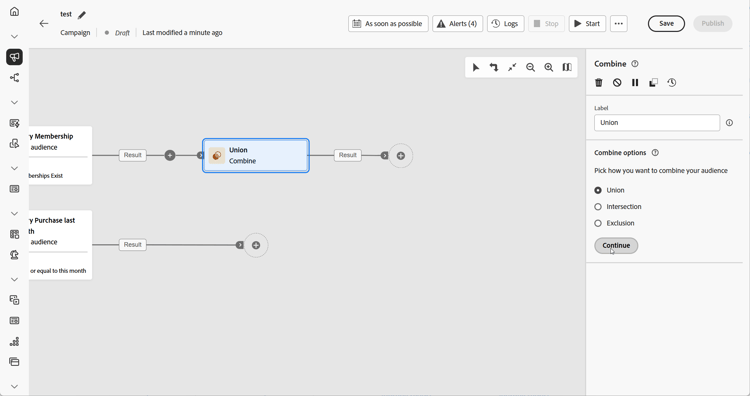
합집합 combine-union
결합 활동 내에서 조정 유형을 선택하여 중복 레코드를 관리하는 방법을 결정함으로써 합집합을 구성할 수 있습니다.
-
키만(기본값): 여러 인바운드 전환이 동일한 키를 공유할 때 단일 레코드를 유지합니다. 이 옵션은 인바운드 집단이 동질적일 경우에만 적용할 수 있습니다.
-
선택한 열: 데이터 조정에 사용할 열을 지정할 수 있습니다. 속성 추가를 선택합니다.
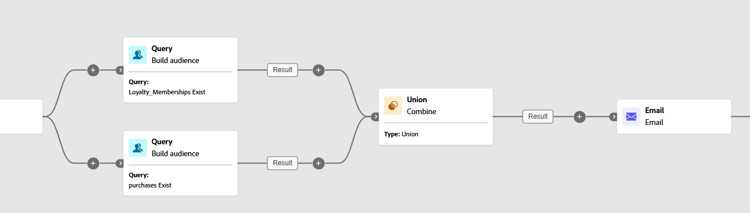
다음 예제에서는 결합 활동을 합집합과 함께 사용하여 로열티 멤버와 구매자라는 두 쿼리의 결과를 두 세그먼트의 모든 프로필을 포함하는 더 큰 단일 대상자로 병합합니다.
교집합 combine-intersection
결합 활동에서 교집합을 구성할 수 있습니다. 그러려면 아래의 추가 단계를 수행해야 합니다.
-
중복 처리 방법을 정의하기 위해 조정 유형을 선택합니다.
-
키만(기본값): 여러 인바운드 전환이 동일한 키를 공유할 때 단일 레코드를 유지합니다. 이 옵션은 인바운드 집단이 동질적일 경우에만 적용할 수 있습니다.
-
선택한 열: 데이터 조정에 사용할 열을 지정할 수 있습니다. 속성 추가를 선택합니다.
-
-
남은 집단을 처리하려면 여집합 생성을 활성화합니다. 여집합에는 교집합을 제외한 모든 인바운드 활동 결과의 합집합이 포함됩니다. 활동에 추가 아웃바운드 전환이 추가됩니다.
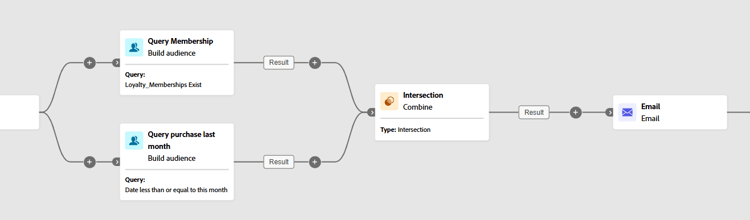
다음 예는 두 쿼리 활동 간의 교집합 사용을 보여 줍니다. 로열티 멤버이고 지난달 내에 구매한 적이 있는 프로필을 식별하는 데 사용됩니다.
제외 combine-exclusion
결합 활동에서 제외를 구성할 수 있습니다. 그러려면 아래의 추가 단계를 수행해야 합니다.
-
조인할 집합 섹션에서 주 집단을 나타내는 기본 집합을 선택합니다. 다른 집합에서 발견된 레코드는 이 기본 집합에서 제외됩니다.
-
필요한 경우 인바운드 테이블을 조정하여 다양한 차원에서 가져온 타깃을 정렬할 수 있습니다. 다른 차원의 타깃을 제외하려면 먼저 기본 집단과 동일한 타기팅 차원으로 가져와야 합니다. 이렇게 하려면 규칙 추가를 클릭하고 차원을 변경하는 조건을 정의합니다. 그런 다음 속성 또는 조인을 사용하여 조정을 수행합니다.
-
남은 집단을 처리하려면 여집합 생성을 활성화합니다. 여집합에는 교집합을 제외한 모든 인바운드 활동 결과의 합집합이 포함됩니다. 활동에 추가 아웃바운드 전환이 추가됩니다.
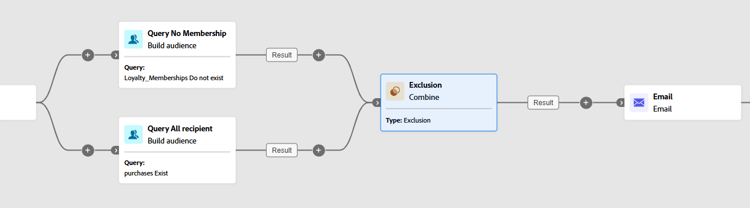
다음 제외 예제에서는 제품을 구매한 프로필을 필터링하도록 구성된 두 개의 쿼리를 보여 줍니다. 그 뒤 로열티 멤버십이 없는 프로필을 첫 번째 집합에서 제외합니다.
This section contains structured knowledge intended to support interpretation, retrieval, and question answering related to this topic.
For complete understanding, this information should be combined with the documentation on this page. Neither source is intended to stand alone; the page describes the feature, while this section provides additional context that helps disambiguate terminology, intent, applicability, and constraints.
- TL;DR: This page explains how to configure the Combine activity in an Orchestrated campaign to segment an inbound population through Union, Intersection, or Exclusion operations.
Intents:
- Add a Combine activity to join at least two execution branches in an Orchestrated campaign.
- Merge multiple populations into a single target using Union.
- Keep only the elements common to all inbound populations using Intersection.
- Remove elements from one population based on specified criteria using Exclusion.
- Choose a reconciliation type (Keys only or A selection of columns) to handle duplicates in a Union or Intersection.
- Process the remaining population after an Intersection or Exclusion by enabling Generate completement.
Glossary:
- Combine: a type of Targeting activity that segments an inbound population by merging multiple populations, excluding specific segments, or retaining only the data shared across several targets (product-specific)
- Union: a Combine segmentation type that merges the results of multiple activities into a single unified target (product-specific)
- Intersection: a Combine segmentation type that retains only the elements common across all inbound populations (product-specific)
- Exclusion: a Combine segmentation type that removes elements from one population based on specified criteria (product-specific)
- Reconciliation type: the setting that defines how duplicate records are handled in a Union or Intersection, either Keys only or A selection of columns (product-specific)
- Keys only: the default reconciliation type; retains a single record when multiple inbound transitions share the same key, applicable only when the inbound populations are homogeneous (product-specific)
- A selection of columns: a reconciliation type that allows specifying which columns are used for data reconciliation, via Add attribute (product-specific)
- Generate completement: an option in Intersection or Exclusion that processes the remaining population; the complement contains the union of all inbound activity results excluding the intersection, and adds an additional outbound transition to the activity (product-specific)
- Primary set: in an Exclusion, the main population selected in the Sets to join section, from which records found in the other sets are excluded (product-specific)
- Exclusion rules: in an Exclusion, used when a target from another dimension must first be brought into the same targeting dimension as the main population; added via Add a rule, defining the dimension change conditions, with reconciliation done via an attribute or a join (product-specific)
- Sets to join: the section where the previous activities to combine are checked (product-specific)
Guardrails:
- Keys only reconciliation is only applicable when the inbound populations are homogeneous.
Terminology:
- Canonical name: Combine — variants: Combine activity
- Do not confuse: “Union” (merges results of multiple activities into one target) ≠ “Intersection” (keeps only elements common to all inbound populations) ≠ “Exclusion” (removes elements from one population based on specified criteria)
- Do not confuse: “Keys only” (retains one record per shared key, homogeneous populations only) ≠ “A selection of columns” (reconciliation on specified columns)
FAQ:
- Q: What does the Combine activity do? — It segments an inbound population by merging multiple populations, excluding specific segments, or retaining only the data shared across several targets.
- Q: What are the three segmentation types in the Combine activity? — Union, Intersection, and Exclusion.
- Q: What is the default reconciliation type for a Union or Intersection? — Keys only, which retains a single record when multiple inbound transitions share the same key.
- Q: When is Keys only applicable? — Only when the inbound populations are homogeneous.
- Q: What does Generate completement do? — It processes the remaining population in an Intersection or Exclusion; the complement contains the union of all inbound activity results excluding the intersection, and adds an additional outbound transition.
- Q: What is the Primary set in an Exclusion? — The main population chosen in the Sets to join section, from which records found in the other sets are excluded.
- Q: How do you exclude a target from a different dimension in an Exclusion? — Click Add a rule in the Exclusion rules section and define the dimension change conditions; reconciliation is then done via an attribute or a join.
Examples:
- Union: a Combine activity merges the results of two queries, Loyalty Members and Purchasers, into a single, larger audience that includes all profiles from both segments.
- Intersection: a Combine activity identifies profiles who are Loyalty Members and have made a purchase within the last month.
- Exclusion: two queries are configured to filter profiles who purchased a product; profiles who do not have a loyalty membership are then excluded from the first set.
Personas:
- marketer: Can add a Combine activity to a branch after building at least two execution branches. Can select Union, Intersection, or Exclusion as the segmentation type, then check previous activities in the Sets to join section. The page states that Keys only reconciliation is only applicable when the inbound populations are homogeneous. Where: “Configure the Combine activity”.
Onboarding:
- Level: Intermediate
- First minimal step: Add multiple activities, such as Build audience activities, to form at least two different execution branches.
- Success check: The Union merges the results of two queries, Loyalty Members and Purchasers, into a single, larger audience that includes all profiles from both segments.